A Quick Note on Smores

If you have been around a campfire for recreational reasons (assuming you’re not lost and hypothermic) you probably cooked something over the camp fire to enjoy the experience a little more.  Hot dogs roasted on the end of a stick are great and taste better than the wieners sold at the baseball stadium.  But for the sweet tooth, my Black Diamond helmet goes off to smores!

I realized, once again, how much I appreciate their magical qualities a few weeks ago.  That was when I was promoted at work, something I have worked long and hard for.  My wife and I celebrated at a local restaurant and started I with a craft brew, which is expected.  What was unexpected was that for dessert they offered the chance to make our own smores.  They even offered some variations to the choices of chocolate.  The slightly browned roasted marshmallows was enough to bring me back to summers in the High Peaks of the Adirondacks.

The lesson from this experience was 1) that smores can evoke memories from camping; 2) that you can make smores on a fondue table stove even if you don’t have a fireplace; and 3) that a number of other chocolate bars work great instead of just the usual one you get in the check out aisle.

While the traditional chocolate bar works well, here are some alternatives to use with the marshmallow and graham crackers:

  • Kit Kats
  • Reese’s Peanut Butter Cups
  • Lindt Extra Creamy Milk Chocolate

I am sure there are plenty of others, but these are just what my wife and I can vouch for.  I hope they send you to back to your mountains!

Well, thanks again for visiting.  If you enjoyed this post, please consider following the Suburban Mountaineer on Facebook.

In the Anchorage Bowl and Up Ptarmigan Peak

Ptarmigan Peak by Szalay 2004

Looking east toward Ptarmigan Peak's pyramid, just off the Powerline Trail (All Rights Reserved 2004).

Good morning.  I went through some photos from my trip to Alaska I took several years ago and thought one hike was worth sharing; while most hikes are in Denali National Park and Preserve or on the Kenai Peninsula, visitors often overlook the convenience of peaks in the Anchorage Bowl. 

Anchorage is surrounded on three sides by water and ringed by the Chugach Mountains on the eastern side.  If you are visiting Alaska for the first time and possibly only time, I recommend you hit up the traditional sites, like Wonder Lake for Denali, Talkeetna for beer, and Resurrection Bay for dramatic scenery.  But if you have a day or so in Anchorage, as I did when I was waiting for the friend I was visiting to get out of work, a hike or climb up Ptarmigan Peak (4,880 ft./1,487 m) might be called for. 

The mountains outside of Anchorage are often overlooked, and for good reason.  The peaks are small compared to the others deeper in the Chugach Range, or in the Wrangell-St. Elias region.  When there is plentiful supply of big, beautiful mountains to be had, the hills surrounding Anchorage can easily be dismissed.  

As many visitors to Anchorage do, we visited Flattop (3,510 ft./1,070m.) in South Anchorage at the Glen Alps entrance of Chugach State Park the evening I arrived.  Flattop is known as the most climbed peak in Alaska.  Perhaps because of its popularity, it reminded me a tourist trap (of course, I think Niagara Falls would be so much nicer if the casino and railings were removed).  But the view was nice.  But it was near the trailhead I first saw Ptarmigan Peak. 

The peak is named for Alaska’s state bird and it has beautiful lines.  Later in the week, after visiting some more exciting landmarks of the 49th State, I returned to the Glen Alps trailhead and hiked down the Powerline Trail approximately three miles before turning right and heading up the spongy slope to Ptarmigan Pass. 

I was hoping to scramble up the steep north face.  After moving delicately and foolishly over the scree field I soon realized why this field was here; the slope was full of rotten rock.  Much of it came apart as I gripped the wall.  Since I was climbing alone, I opted for a more conservative approach to the top.  While I did not know if then, back in 1997 a group of students from the University of Alaska were practicing here and two died and 11 were seriously injured from a fall, according the 1998 edition of Accidents in North American Mountaineering

The western ridge from Ptarmigan Pass provides a mostly narrow path to the summit.  Portions are only three feet wide and the views to the tarn below can be thrillingly dizzying.  The last one-hundred feet or so require some scrambling and is not for the faint of heart.  A rope and a partner may be recommended for most travelers. 

Return the same way, hop back on the highway and head for Snow Goose and order a beer from the Sleeping Lady Brewery.  If the weather is right, you might catch a glimpse of Denali from their back deck. 

Well, if you enjoyed this post, you may follow the Suburban Mountaineer on Facebook.
Vittorio Sella’s Photography Reviewed

I hope everyone had a good Oktoberfest weekend by enjoying some brew and perhaps a brat, like I did.  If not, hopefully you were out on the trail. 

This weekend I came across a review by Mark Feeney of the Boston Globe of the work of the great mountain photographer Vittorio Sella, who’s work is on display at the Panopticon Gallery in Boston.  Sella followed the Duke of Abruzzi, Luigi Amedeo, around for several expeditions.  These trips included the legendary journey by the Duke that named the most direct route up K2, the Abruzzi Ridge. 

Here is a sample of Sella’s work at this link.  The sample does not do him full justice.  Sella’s finished work in Europe brought the strange lands of the Himalayas and elsewhere to life the way National Geographic had in a time when the work beyond our borders was alien, not just exotic. 

Sella, as well as Amedeo, are responsible for advancing mountain exploration and inspiring climbers and mountain photographers like Bradford Washburn and their successors.  While some of us may wish the mountains were as mysterious today as they were then, it is thanks to their work that we can plunge into the great ranges with knowledge of the risks and dangers of the terrain and weather. 

So here is an Oktoberfest toast: To Vittorio — Proost! 

If you enjoy these posts, you can follow them on Facebook.

Analogue Altimeters Promote Better Mountain Skills

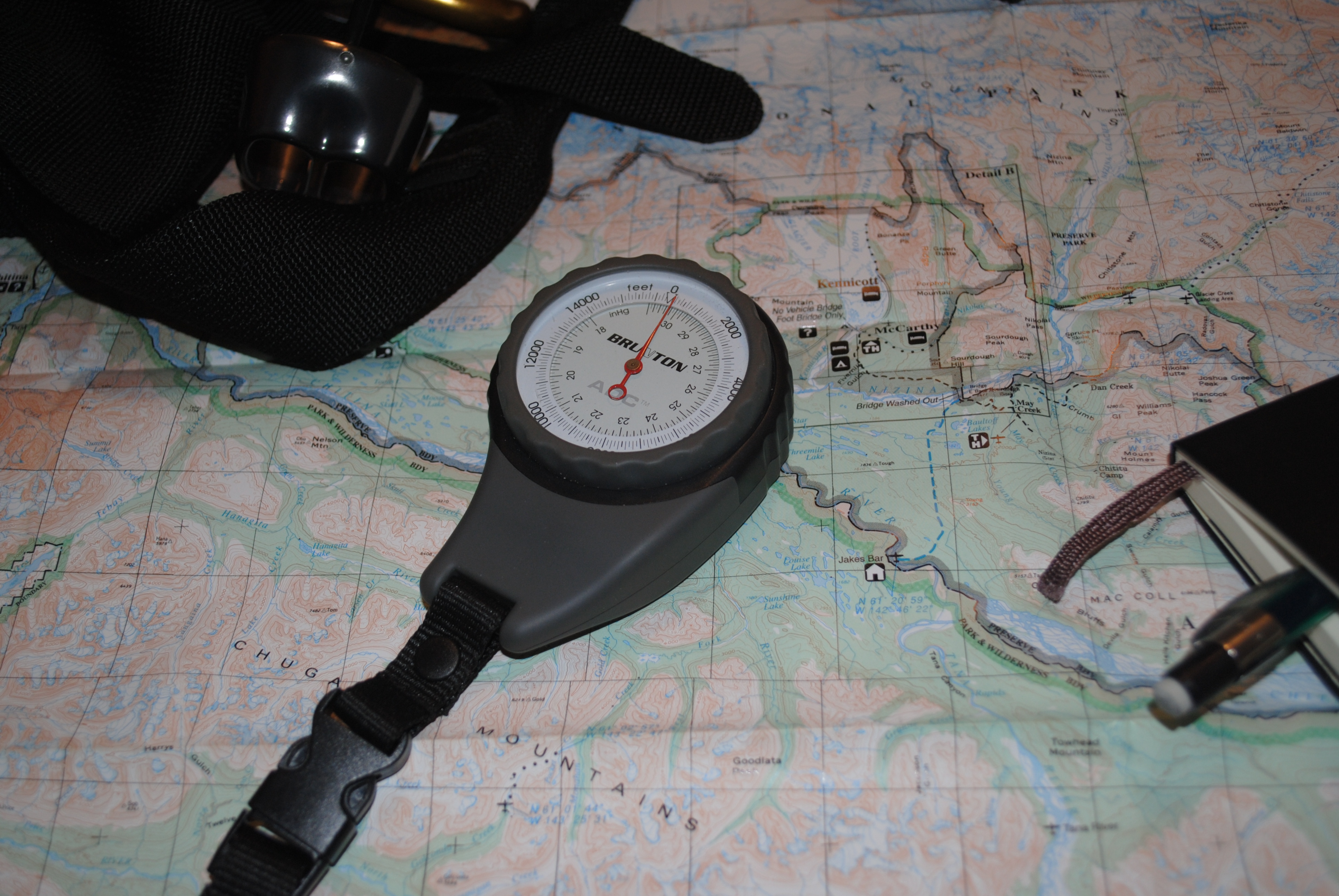
ADC Ridge analogue/aneroid altimeter (Szalay 2010).

There are a number of devices on the market that can determine your elevation, or to use a cooler mountaineering term: altitude.  While pilots may use any type of altimeter, such as radar altimeters, alpinists only use aneroid altimeters.  Aneroid altimeters measure the barometric pressure, or the air’s weight, to correspond to the altitude.

Digital altimeters, like the watches from Suunto or Casio or a GPS device with elevation output, and analogue altimeters, like my ADC Ridge shown in the picture above all have pros and cons.  Digital altimeters are also aneroid devices, which use a barometric scale that corresponds to altitude, but the output of data is presented digitally instead of on a pressure gauge.  The biggest advantage of a digital device is that it distinguishes barometric pressure changes from weather system from real elevation changes; analogue altimeters require the user to make the adjustments manually.  The downside is that digital devices are electronic and dependent on batteries though both are equally susceptible to moisture.

The analogue altimeter requires a bit of work to operate.  To properly determine your elevation with an analogue instrument you must adjust the dial to place the known elevation at the appropriate altitude.  However, the device requires the user to confirm higher elevations on its gauge at known points, to counter for non-climbing changes to the detected barometric pressure.   This requires the user to be using their navigation skills.  In this way, the altimeter compliments a hiker’s or climber’s information about his or her location, but it doesn’t replace map and compass skills.

In fact, if used properly, the analogue altimeter can help the hiker or climber be more aware of his or her terrain.  The compass determines bearings, the map can identify topography, and an altimeter can help confirm both.  By comparison, a digital altimeter provides the same output, but an analogue instrument encourages the user to actively think about the clues of the landscape.

Thanks again for stopping by. If you enjoyed this post, please consider following The Suburban Mountaineer on Twitter and Facebook.

Vermont’s Long Trail

The word Vermont was made from a loose version of French to mean green mountain.  The settlers adopted it in 1777 as a unique name for their land.  Arguably, the Green Mountain state would not have maintained its blend of rural life and passion for the environment without the establishment of the Long Trail.

The Long Trail was the brainchild of John P. Taylor, who back in 1908 came to Vermont to be an assistant principal at a local school.  He quickly noticed that while the area was rich in hills and woodland, there were no established trails for the community to enjoy and benefit from them.  In 1910, the Green Mountain Club was formed and his idea for a trail spanning the state through the Green Mountain range was adopted as the club’s own.

The trail is the oldest long distance trail in the United States and claims to have inspired the creation of the larger Appalachian Trail.  It was built between 1910 and 1930 and covers 272 mi./438 km. from East Mountain in Massachusetts to Quebec.  Approximately 100 mi./ 160 km. of which are shared with the AT until Sherburne Pass near Killington, VT, where a popular ski resort is located, as well as the Inn at Long Trail.

The Inn at Long Trail has been a traditional stop for through hikers of the AT and the Long Trail.  I’ve often wondered if the Irish pub at the Inn or the services they offer (beer and laundry services provided for a modest fee.)  Rooms are also available at a discount, when rooms are available, on a hike-in basis (literally) only.

The trail ascends several popular peaks with summits above timberline, including Camels Hump (4,083 ft./1,245 m.) near Waterbury, Mount Mansfield (4,393 ft./1,339m.), which is the highest point in the state and near Stowe, and Jay Peak (3,858 ft./1,176 m.), which is just south of the border with Quebec.  While every hike has potential dangers from trail conditions, weather and wildlife, I always appreciate the Long Trail for its simple elegance that follows a simple formula of putting one foot in front of another to take you to the next milestone or scenic outlook.

When I hike portions of the Long Trail or its adjacent trail network in the warmer months, I always carry the Ten Essentials plus my hiking staff and camera.  In the winter, I highly recommend the snowshoes of your choice (the bigger the better though, particularly in the middle of the snowy season).  Some summits during winter cannot be reached with snowshoes alone, particularly those above timberline.  Turn back if you are not trained and equipped with crampons and an ice axe.

Had the Long Trail not been established, ski resorts and mountain-side homes may have become even more common throughout the state.  The trail remains a landmark and a symbol of the conservation efforts to Vermonters and people like me far away in Peaklessburg.  I hope you get to try it or its adjoining trails out sometime.

Thanks again for visiting.  Remember, you can also follow these posts through Facebook or by subscribing to my RSS feed.  Happy hiking and climbing!

Rarely Climbed Peak is Ascended Again

British climbers Tom Chamberlain and Tony Barton sended a new line up the southwest wall of Huaguruncho (18,776 ft./5,723 m.) in August according UKClimbing.com and Alpinist.  The pics on these sites are well worth checking out.

It took these mountaineers four days to reach the summit on a new line that they are calling Llama Karma (1000m ED/ 90·/V, 24 pitches).  They attempted a similar route with a third teammate in 2008 but were unsuccessful.

What makes this ascent of Huaguruncho so interesting is that it has been successfully topped off by alpinists only three times in fifty years despite other attempts.  Its massif is located on the eastern portion of Peru and only 40 mi./64 km. from the rainforest, which helps attract the precipitation on the mountain, making for some difficulty getting up any part of this pyramid.  If you want to visit it to hike or climb, this link might provide a start: http://www.huaguruncho.com/

Remember, you can always follow these posts on Facebook.