Updated April 28, 2024
On K2 in 1939, a mere few hundred meters from the summit, Pasang Dawa Lama was climbing in support of Fritz Wiessner, the leader of the second American expedition. Wiessner had summit fever. But it was late in the day and the conditions were turning poor. Wiessner took the next step upward, but met resistance from the rope connecting them. Pasang looked to Wiessner and said, “No, sahib.” Wiessner passed it off Pasang’s desire to stop as superstitious, being so close to the top, the home of the mountain’s spirit.
Reluctantly, Wiessner relented and lost his best opportunity to summit. It’s also widely believed that Pasang may have saved their lives. I reflected on this story several times in this book, because it encapsulates so many of the things I thought we knew about climbing in the Himalayas in the early 20th Century.
Starting with George Mallory, Western stories about climbing mountains in the Himalaya and Karakorum focused on an individual Western hero, like Fritz Wiessner, and placing local climbers, like Pasang and porters in an ethereal background. In learning about Muhammad Ali Sadpara, Bernadette McDonald, turned her attention to a subject without a lot of previous written records, and researching what did exist and interviewing people in remote regions of Nepal and Pakistan.
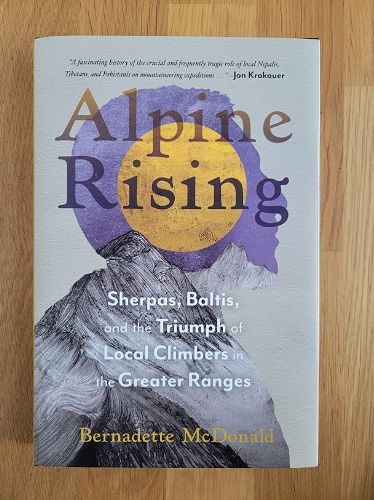
The result was Alpine Rising: Sherpas, Baltis, and the Triumph of Local Climbers in the Greater Ranges by Bernadette McDonald and was released by The Mountaineers Books on February 20, 2024. (I appreciate the Oxford comma in the subtitle.) In the acknowledgements section at the end, you can see that she had a cast of many helping interview and gather the information that created the context of their world and the stories of how mountaineering shaped them and, now, how local climbers are shaping mountaineering.
McDonald applies the term local climbers to distinguish those born in and living around the high mountains of the Himalayas and Karakorum, from the foreign or international climbers form elsewhere. Sherpa is one group of people has been the most widely used, both generously with merit and fraudulently, but there are also Ladakhi, Balti, Hunza, Astori, Magar, Bhotia, Rai, and Gurung. McDonald also defines some terms from used in past historical works, from “coolies” (now a demeaning term for hired help or porter,) porter, high-altitude porter (or HAP,) Gurkha (British soldiers now hired from Nepal,) and sahib (a term of respect, once all foreign climbers including Fritz Wiessner, but no longer used today.)
McDonald structures here story chronologically, after introducing the subject, by telling the story of the local climbers involved in the early attempts on Himalayan and Karakorum peaks. Then she shifts to tell the some stories by theme, from a particular climber, like Mingma G., to the widows who started to climb, like Furi Diki, Jangma Sherpa, and Sherki Lamu. In all, she shares the lives of 20-30 local climbers to varying degrees.
She chose the term “mass market climbing” to describe the large commercial climbs that employee many local climbers, especially on Everest and now even on K2 in Pakistan. Multiple generations of local climbers participate, mostly fathers and sons and uncles and nephews, earning their money for their grit and later their skills and tenacity at the heights. While I dislike that style of climbing, it has given birth to Ali Sadpara and Mingma G., who are not just local climbers, HAPs, or Sherpas, but respected climbers.
Overall, I found the book more subtle in its conveying new information. For instance, this wasn’t shedding light on ascents unseen or climbers completely unknown to knowledgeable readers, but this was the first survey course, so to speak, on the local climber’s work, perspective, and how they also had their own ambitious. Many of those ambitions were easy to relate to: The well being of their family, financial success through a growing resume of expertise, and the sheer joy of being in nature and attempting to reach summits.
Alpine Rising is not a comprehensive history of local climbers, and McDonald acknowledges that. It is still full of helpful historical and contemporary contexts. For instance, understanding why Sherpas were eagerly looking for work when the early British explorations started, and how HAPs (High-Altitude Porters) came to be. In the end, they are increasingly climbers, whether they are working to pay for their mother’s medical care, or aspiring to reach the summit for their country. (HAPs, I was interested to learn was first coined by Willi Unsoeld.)
My sole complaint about Alpine Rising was in McDonald’s handling of Nims. McDonald recounts Nirmal “Nims” Purja’s six month-attack on the 8,000ers well. He hadn’t spent time working his way through the mass market climbing business, and he stepped in, seemingly out of nowhere, to climb all fourteen of the world’s highest peaks in a unique style of a modern military assault with helicopters. Nims flew and climbed, and the world watched, as the fourteen mountains were ticked off. Except, today, in this environment of competitive-record climbing, Nims did not reach the actual or true summits of Manaslu and Dhaulagiri.
This may be nitpicking, but when I read this McDonald’s take on it, she finishes the first account on this effectively stating the record was six months and six days. I knew that it had actually been two years, five months, and fifteen days. Yet most popular opinions orbit around a six-month record, when it wasn’t true. I read through the book and never found a satisfying explanation, which I expected would be more blunt than it was. His six-month record is listed under “Purja, Nirmal” in the index, but the story of his return was not (it’s actually on pages 202-203.) It was retold with the story of Mingma G., which makes logical sense since it was Mingma G.’s attention to detail about true summits, particularly Manaslu, but clarifying Nims’ record under emphasized, in my opinion.
(This was relevant to Nims’ story. It is also a relevant topic in Himalayan and Karakorum climbing today. The actual summits are now better understood, and the number of people taking shortcuts to say they reached the top have grown from either error, omission, or outright lying. This would need to be explained in greater detail in Alpine Rising to get the general reader up to speed, but it is an issue that speaks to the true challenge of Nims accomplishment. It is remarkable, but it wasn’t six months and six days, and McDonald does not perpetuate the myth.)
Alpine Rising does not exhaustively break new ground, but as a book deemed as “significant” is fundamentally about what needed to be said. I expect to be referring to it from time to time as the perspectives on these events need to be remembered. McDonald’s Alpine Rising tells a story of climbers that needed to be said.
And while I still like to think about Wiessner and Pasang Dawa Lama on K2 in 1939. If they were in the same position, Pasang would not have called Fritz “sahib.” They would have had a different conversation, probably one of peers. Or perhaps, Pasang would have his own local team.
Rating: 4/5
Was it a climbing classic? I think it needs more time to age, like a wine. I think it’s certainly groundbreaking for a full book. I am doubtful that a journalistic retrospective like this will stand on a list of top 10 or 20 nonfiction climbing books. But I could be wrong. And I could change my mind (everyone should be free to change their opinion.) It could be a lasting title, if it is referred to regularly too, I suppose.
Well, thanks for dropping by. If you enjoyed this post, please sign up for my newsletter, which is the best way to get updates. And please tell a friend too; I am a humble hobbyist and don’t pay for advertising so organic search engine traffic and word-of-mouth referrals are all I’ve got. I just believe that climbing matters and you do too.
 The Suburban Mountaineer
Pingback: Current Trends in Mountain Lit | The Suburban Mountaineer