What makes a great climbing book? Well, my formula is still being considered, but in many instances in the books I and others enjoyed most they involve moments in between the climbing where the climber deals with self-doubt, and themselves in sections literary buffs know as longueurs. But there are always exceptions and reasons for greatness and significance can vary. This new book has no longueurs, and yet I am very excited about this book. Why? Because it changes our perception of humans and mountains for the better.
How can our perception of mountains get even better? Well, these days, I’m not sure; we love mountains today and recreate among them in all sorts of fun and exciting ways and styles. However, today we also believe that there was a time that mountains — before mountaineering, in fact — were unattractive wastelands to be avoided. Arguments in favor of this suggest that the Industrial Revolution prompted new wealth and the opportunity to explore, as well as a completely new way of thinking about them. Well, Dawn Hollis, a historian has effectively shattered that idea. It was only a myth. And that myth was deliberately created and perpetuated by many.
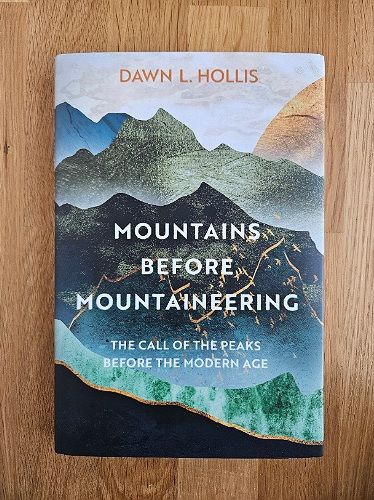
Dawn Hollis has written Mountains Before Mountaineering: The Call of the Peaks Before the Modern Age, released May 1, 2024 by The History Press out of Gloucestershire. It opens our minds, and changes the way we thought humans interacted with the mountains. Hollis stumbled onto this subject through her graduate studies. Her findings upset some members of the Alpine Club with her discovery. She talks about that, and shared some of her evidence and tales of resistance to it, in Alpinist Magazine (Issue 57 in March 2017).
Hollis might be the only mountain historian working on subjects before the 1800s, and I was fascinated by her work. I reached out to Dawn over social media soon after her article in Alpinist was published. After a few exchanges she sent me her graduate thesis. I believe she was trying to find a publisher back then, though academic responsibilities and family life were competing priorities. I printed the thesis, punched it for a binder and read it on my commutes on the Metro back and forth to downtown Washington, DC. Since then, I think I have read her work, in various forms three times since 2017, including her thesis and the book manuscript. Now, you have full access to the best of what she learned.
Hollis’ researched European’s relationship with mountains before the modern age, which she defines as before the early 1800s. She focuses on the European experience, because to Westerners like me, that’s where the myth that something in the modern age, after mountaineering, made everything related to mountains beautiful. She could have covered many other cultures’ views of mountains, but this is a European and Western issue that she is addressing.
Hollis makes her main point through the retelling of historical figure’s adventures and explorations, and does it in her own unique Dawn Hollis way. During her academic research she became quite familiar with historical characters, from Andrew “Sandy” Irvine to Tom Coryate. She thought of them as “friends,” though Dawn and her friends were separated by time, not space. She traversed a respectable amount of ground Irvine also walked. Hollis’ descriptions are both full of intimate and relevant details as well as the author-researcher’s own charm.
In a way, it’s Hollis’ friends that make us realize our assumption that mountains were undesirable previously, is not true. The evidence is actually overwhelming. From travelers, to artists, mountains were in-fact a draw. My favorite example, which left me dumbfounded, were the many paintings before the modern age of mountains, and the ones of Madonna and Christ with a mountain in the background. Those weren’t accidents and they were meant to be beautiful and symbolic of larger and higher things.
I also found her discussion of Thenvenot’s observations about mountain size to be much more like mine when I started hiking in the Adirondacks. To Thenvenot, mountains were about the rise and ascent, rather than the more-technical altitude of the summit. In fact, he valued mountain prominence, for that is what they knew. We may grow up in the Scottish Highland or the Adirondack High Peaks and consider them large locally, but such precision of elevation only comes in thanks to maps. But the human, basic, unexplored and un-measured perspective, is different. It is innocent adventure for the experience and self-discovery over the tick-list of elevation and high-points.
Hollis also investigated and discusses in her book whether the modern-age myth that she debunks was a deliberate act and even a conspiracy. Her central premise is not about a cover up, but rather an unveiling of the authentic evidence of how Europeans interacted with the mountain landscape and what they really thought about mountains and what mountains represented to them. As she explains, there were individuals and institutions, including the Alpine Club, that had things to gain.
Most of the mountaineering literature I read I can put on my bed stand and read in the evenings. For Mountains before Mountaineering, I think some of the historical details and explanations, even despite the new characters in mountain history Hollis introduces us to, make a good book to read for most people with a cup of coffee. It’s immensely readable, but not the adventure chapter book of most mountaineering stories for before bedtime. It is similar to format to Mark Synnott’s books, where he tells his story and integrates journalism. Hollis tells the story of her discoveries and integrates her research.
I’ll wrap up with the endorsement I sent to The History Press back in January:
From studying mountain stories for 25 years, I’ve learned that authors and mountaineers believe that they are the lucky ones. Ice axes and sticky rubber enabled them to climb. They also believed that those before them were blind to mountains’ beauty or incapable of fathoming their sublime. Even I accepted it as dogma. But Dawn L. Hollis’ thorough research strips the myth down to uncover our longer human respect, curiosity, and affection for the mountains that predates mountaineering. Hollis’ Mountains before Mountaineering challenges us to reconsider our human relationship with mountains and who we are as adventurers and people.
Well, thanks for dropping by. If you enjoyed this post, please sign up for my newsletter, which is the best way to get updates. And please tell a friend too; I am a humble hobbyist and don’t pay for advertising so organic search engine traffic and word-of-mouth referrals are all I’ve got. I just believe that climbing matters and you do too.
 The Suburban Mountaineer