For books about mountaineering on Everest, the predominant focus is on climbers telling their personal climbing stories, or a climber or historian looking back at previous climbs or eras and being nostalgic. If you read through Into Thin Air, High Adventure, Everest: The West Ridge, and, more recently, Everest, Inc. they all tell climbers stories and try to shed light on its unique and peculiar qualities. But three books have been published in 2024 that have taken a different approach, and one opens up the door to many other perspectives.
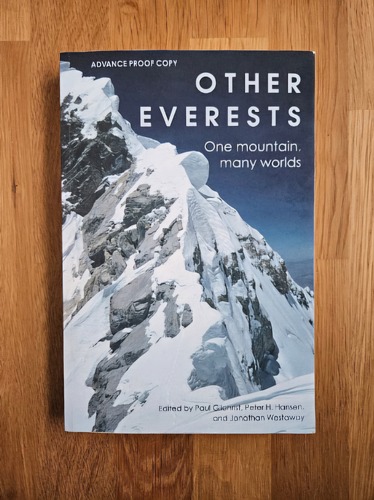
The first two books are Headstrap by Nandini Purandare and Deepa Balsavar and Alpine Rising by Bernadette McDonald. Both are award winning books, and they both focus on Sherpa and other indigenous climbers and their families and local communities in the Himalaya and Karakoram, which have been underrepresented in mountain literature. The third book is — which is the subject of my review — Other Everests: One Mountain, Many Worlds, edited by Paul Gilchrist, Peter Hansen and Jonathan Westaway is unique in the number of new perspectives the book provides. Although the promotions undersell its broad content by focusing around the trending topics of the indigenous climbers and the significant contributions of women, yet Other Everests covers many more Everest-adjacent issues, including climate change, industrialization, visitors to the region, and nationalism.
Many of the the contributors expressed that their articles are the result of looking at the materials the explorers and climbers, especially from the 19th and 20th Centuries, and looking beyond the photos, correspondence, and logistics records and into the “shadows” they created about the stories and world beyond the adventurers’ personal stories from a Western perspective. I am pleased to read Other Everests and find a story that gives me something new and much more than “man-against-mountain” stories, such as bringing Sherpa into the forefront and explaining to me why the name Chomolungma was unseen to Westerners for so long.
I was particularly intrigued by the new insight on Wanda Rutkiewicz’s success in the Himalayas. A lot of the discussion in other books spaces on gender and climbing have also been repetitive about women filling nontraditional roles. Agnieszka Irena Kaczmarek researched and contributed an article about Rutkiewicz and she explains a surprising nuance. Rutkiewicz was different than the other contemporary women that climbed; Kaczmarek pinpoints that it was more than her drive to climb or talent, but that Rutkiewicz adopted a more masculine identity to climb in the Himalaya, which is because the climbing culture the Westerners brought with them were all hyper-masculine. By joining in the bravado, Rutkiewicz gained access.

For better or worse, it’s fundamentally an academic book. For the broader audience that the book has been promoted to, I would have preferred that editors would have right-leveled the language. I love learning new words, but some were used much in the way context clues, such as sopsistic, typonymical, ontologies, and terms like “porter remittance economy,” which seem to have a lot more meaning than just the three words. I found some points difficult to smoothly read without my hard-bound Collegiate Dictionary by my side. Even then, I think the contributing author had a lot of assumptions and meaning packed into their intended use of the word.
There were some illustrations or images in the book to demonstrate points and examples. I enjoyed the images in the book but wish they would have put them on a higher-quality paper in the middle of the book, or interspersed. I realize that paper and printing is more costly today, but the book would have been well served from some more dignified treatment than the images sometimes blurry printing on paper meant for a black type alone.
I will confess that I hoped Other Everests would renew my interest in contemporary climbing on Everest despite the large commercial expeditions and occasional stunts for publicity. Everest has its own subset of climbing news tallying the number of expeditions and reporting on summit attempts and the number of successful climbers. I’ve considered it all a waste and not truly mountaineering. If anything, the historical retrospectives and new perspectives have only reinforced that view. Of course, after reading Other Everests, I have new lenses to understand the background and context of many perspectives of the mountain and activities around it. I think they are best applied in looking back at the old stories I have known and read.
Well, thanks for dropping by. If you enjoyed this post, please sign up for my newsletter, which is the best way to get updates. And please tell a friend too; I am a humble hobbyist and don’t pay for advertising so organic search engine traffic and word-of-mouth referrals are all I’ve got. I just believe that climbing matters and you do too.
 The Suburban Mountaineer
Pingback: Current Trends in Mountain Lit | The Suburban Mountaineer