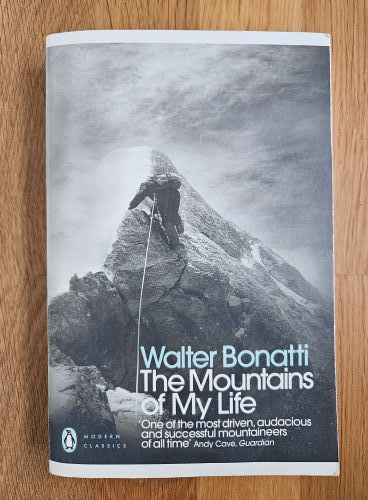
One of the most accomplished climbers in history was Walter Bonatti (1930-2011). Europe was in awe of him after the first ascent of Southwest Pillar of Petit Dru, alone. Even the French celebrated the Italian climbing prodigy.
However, after reading his memoir, The Mountains of My Life (2001), I have been questioning why I have held him with reverence. I once listed him as a top five climber in history. I am not ready to reevaluate that list, but this book and my thoughts about Bonatti have been making me reconsider my conclusion. His climbing talent may keep him there, but his book will not be on my list of climbing classics.
Bonatti wrote two books in his native Italian: Le Mie Montagne and I Giorni Grande. The Mountains of My Life is the English translation by Robert Marshall of portions from both books. There are earlier English translations are not trustworthy; Bonatti and Marshall corrected what were polar opposites of what Bonatti actually said.
The Mountains of My Life covers a lot of ground from his early climbing and his many adventures solo and on a team. He was part of the first ascent of Gasherbrum IV, which elevated his status further to be a legend. Bonatti was also at the center of the oxygen tank controversy during the first ascent of K2, and part of the drama on the Central Pillar of Freny, both of which are too lengthy to recap with any justice here.
I started reading it several years ago and stopped. Things were busy at work and life and I attributed my stopping to my personal distractions rather than listing it as DNF (did not finish) and I always intended to complete reading it. I started over from the beginning this spring and persevered, but I never said to myself or anyone else, “Let me finish just one more page,” whenever I was interrupted. It took me longer to read than most other books of similar length.
I checked the reviews and they were strong and heavily weighted to the four and five stars out of five. The written reviews expressed love for the details and his amazing accomplishments, and how unfairly he was treated over the K2 scandal. I didn’t feel the same way about either. The language was the language of a knowledgeable and skilled climber, describing the environment and the technical aspects, and I could detect passion, but there wasn’t a great deal or excitement or emotional connection.
The events on K2 have always left me a little puzzled. Bonatti often said he wasn’t sure why he was left stranded on the mountain overnight and after the expedition. I don’t know, but after reading his personal account, which was a little dry, I wonder if he neglected the competition among his teammates to be part of the historical first ascent, and he was more egotistical with a false sense of humility, that the rest of the team found inauthentic. Could his charm, which he was known for, and insistence of innocence, was a factor in the social dynamics that worked against him?
The current version in print is by Penguin and it’s under its “Modern Classics” line of reprints. That label probably helps sell copies, and draws people in by the allure of name of the author, an intriguing cover, and a reputable publisher classifying it a classic.
Not all climbing books that readers praise are well written. I am certainly guilty of this; I would celebrate the “significance” of the work rather than how it was crafted and told. And, of course, I have read other sports memoirs and biographies of athletes before my time where I desired to connect with the figure and those that remembered them fondly. Those biographies also were not always successful and I wonder if I would like this book more had I read the news stories of his exploits in real time. Unfortunately, the stories are there but it is a bland read.
The Mountains of My Life is not going to change you, even though you may love it, especially if you’re climbing-hungry, but it is not going to be on my list of classics.
 The Suburban Mountaineer