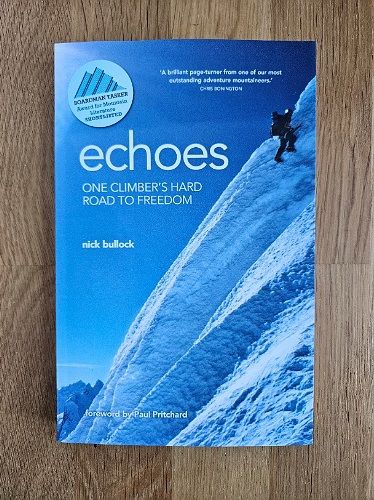
For years I had wanted to read Nick Bullock’s first book, Echoes: One Climber’s Hard Road to Freedom published by Vertebrate Publishing in 2012. It was short listed for a Boardman Tasker Award for mountain literature. That might be why even used copies still went for upwards of $30US, which I kept waiting for it to drop below $15. It just did recently and I finally read it. I should have spent more sooner.
I think I first read Bullock’s voice in Alpinist 57. His article, “Threshold Shift,” is one of those pieces I remember almost by atmosphere. Reading it was had a hook on why I need climbing, hiking, and seeking wilderness. When I started reading Echoes, I was hoping for that tug and I wasn’t disappointed.
Bullock started climbing late, well after he started in Britain’s Prison Service. While I discovered rock climbing and later mountaineering through movies in the 1990s as a way of varying up the dullness of suburban living, Bullock latched onto it at a training camp for prison officers. It quickly consumed his life outside of the prison walls. The mountains became a place to grow, and redefine who he was.
(On one of the training trips in Scotland, Bullock and other prison officers went kayaking. He was frightened by the challenge and the quick thinking required. But he found the Type 2 fun in the midst of it when he capsized, because under the water he thought: “I also felt at peace, in a world away from violence and hate.” I shared this because feeling alive is often facing fear, because fearlessness is really just courage, and Bullock and I both seek the calm or Zen in the chaos. Do you do that, too?)
What makes Echoes a special book is how Bullock approaches his climbing autobiography. He’s not starting in the climbing action or isolating it to the expeditions. Rather, he’s taking us up from ground up and every nurturing and humbling step along the way. Bullock said on one podcast interview, though I forget which one, that writing is cathartic for him. I am sure, because he writes very personally. It’s not a climbing memoirs like Joe Simpson’s Touching the Void or even parts of Krakauer’s Into Thin Air. His prose can be terse, but he’s unrestrained and authentic.
The pace of the book is slower than nearly every other climbing book. But that’s part of it’s value. In fact, if a young person asks how they can progress to climb big objectives, I would direct them to this book. It’s not a manual but anecdote.
Finding the treasure of Echoes is in reading to the end and taking it wholly in. He asks what freedom costs, whether climbing itself can become another kind of prison, and what it means to take such risks repeatedly. His terseness comes through authentically, even if it’s not conveniently simple.
For readers of Alpinist who were moved by “Threshold Shift,” Echoes feels like the deeper well from which that essay was drawn. It is not an easy read—it is sometimes violent, often unsettling, and always honest. But it lingers in the mind long after the final page. I highly recommend you read it, if you haven’t already.
 The Suburban Mountaineer