How to Start Healing Everest

image

Everest ought to be a pure temple or iconic symbol of dreams and lofty objectives that only the committed obtain. Unfortunately, it’s been spoiled, and exploited at the expense of the Sherpa.

Last season, I had hopes that Ueli Steck and company would put up a new route to the top, redeeming the pure style of climbing on Everest — done in small teams of experienced climbers, mostly alone and unsupported. But that ended in a dangerous fistfight and appears to be a precursor to the events that we are watching this year.

Since then, over the winter, the Nepali government seized the opportunity to reform how the climbs are run — including who was eligible to make an attempt. However, the government prioritized crowd control and enhancing revenue over everything else. Personally, I hoped that aspirants’ qualifications would be required, regardless whether fee increases were involved. That was unlikely to happen despite its merits.

Here in lies the biggest conflict with the dream of a pure mountain that I want and what Nepal and the Sherpa desire: The Sherpa want respect and Nepal wants foreign income (a very lucrative source). Nepal won’t get it without the Sherpa workforce. The cattle call of climbers can’t come and even make a modest attempt without the Sherpa. And to turn back the clock to the days before Mountain Madness, Adventure Consultants, IMG and Rainier Mountaineering, Inc. and other guides brought their clients wouldn’t help anyone. Except the Everest purist.

With 16 Sherpa dead from preparing the way for climbers, followed by a well-timed strike, I think everyone needs to do some soul searching. Maybe working as a porter is too dangerous. Maybe commercial “expeditions” are inappropriate. Maybe Nepal’s government needs to examine its priorities.

I regularly call the contemporary experience on Everest a circus. Via ferrata and zip lines wouldn’t be out of place. I once believed that there were no real victims on Everest climbs, but the events of the last few years, and even Freddie Wilkinson’s book about similar trends on K2, have shown me that the Sherpa are both super climbers and vulnerable people.

There have been expressions of respect for the Sherpa since the English explored Nepal, but they need more than adoring words. The we have complicated their existence, which was already a difficult one marked by hard conditions and poverty.

New ways to help the Sherpa, particularly the families of the 16 lost, have been emerging. Several artists, like Renan Ozturk, are offering limited edition prints this week only to raise funds to help the people the 16 Sherpa supported. The American Alpine Club is collecting funds for the Sherpa Support Fund. I urge you to give by clicking here.

Thanks again for stopping by. If you enjoyed this post, please consider following The Suburban Mountaineer on Twitter and Facebook.

Gear, Stuff and What We Need

image

I’m on the lookout to buy a pair of belay gloves and two cool child-sized fleece sweaters, possibly from Patagonia, for my little kids. This year’s Gear Guide from Climbing magazine had a good breathable pair of gloves but no kids clothes (but why would they?)

I would probably send an Instagram around of both finds if I get them. I might even hash tag Gear Addiction or gearaddition just for amusement.

Since Natalie and I started our hopscotch move to a townhouse and back to our condo, we have let go of belongings and made rules about what new things can come into our home to stay permanently (such as decorations, books and magazines.) We’ve read that such habits can keep things tidy too.

The process of moving twice in just over a year, and reducing our collection of stuff, also made us examine why we want new things. It quickly became obvious to us: If it wasn’t something we needed or enhanced how we lived, that thing we thought we needed was merely emblematic of what we wanted our life to be. It indicated what we would rather be doing. It begged the question: Why not just do it or get rid of it?

I guess we were filling voids. For me, that meant gear for the kind of climbing and hiking I wanted to do but wouldn’t be able to commit to, if at all. I suddenly felt like I was forcing a square peg into a round hole.

What we really needed to do is go out and do what we are day dreaming about. Get out and do it. We’ll figure out what we really need, and in some cases what we don’t.

Take for instance my Uncle Tom. (He was my mentor and guide for getting into outdoors pursuits. I joined him on his quest to climb the Adirondack Mountains’ 46 highest peaks on several backpacking trips, mostly on trailess routes.) After every trip, he returned home and emptied out his old REI external framepack. He did so to ventilate the contents and sort everything into two distinct piles: 1) Stuff he used, and 2) Stuff he didn’t.

He cussed over the stuff he didn’t need. It weighed him down.

But we both learned something after these exercises. Sometimes things we needed we didn’t even bring. A hatchet would have been helpful. The pillow was unnecessary. And maybe we should take less food.

What I really remember are what shines through in the photos. The landscape. The smiles. The rocky trail and the feel of stepping stone to stone under a weighted pack.

I think we learn more from doing than shopping. We figure out what we need from trying. We find who we are out there.

Good luck.

Thanks again for stopping by. If you enjoyed this post, please consider following The Suburban Mountaineer on Twitter and Facebook.
The Climbing Life with Chris Kalman

Chris_Kalman_avatar

Chris Kalman has made his life climbing. But there is no such thing as a perfect climbing life, “only a perfect life.”

Brewing hot coffee from melted snow in the dark is a chore, yet it’s part of a familiar early morning ritual. It’s an ideal period for taking in where you are: outside at play.

The climbing life is full of these moments and they are a little different for everyone. Still, I imagine Chris Kalman and his partners, Austin Siadak, Matthew Van Biene, Tad McCrea, on their upcoming attempt on Cerro Catedral in Patagonia doing something like this somewhere along the way. Together, they will be working to complete a new route on the 3,000-foot east face in Chilean Patagonia.

If you read Alpinist in the last year or seen the list of grant recipients for the Copp-Dash Inspire Award from the American Alpine Club, you might have already been introduced to Chris Kalman. He and I recently got to know each other over a long-spread-out email exchange during this Austral summer season in Patagonia. It turns out, despite having never met, our background had gone beyond both being from Northern Virginia, except he’s taken a very different fork in the road.

Kalman is fully embracing a climbing life and climbing full time. Our emails turned into a bit of an interview so we worked out this Q&A to share with you to share how the climbing life can become real.

TSM: Where are you climbing now and who are your partners?

Chris Kalman: Now I spend summers in Washington state, where I climb mostly at Index – an awesome crag of world-class granite – and winters in Cochamo, Chile, which features a variety of 1000 meter walls and cirques of beautiful granite.  My favorite partners are still my first climbing partners I ever had, Grant Simmons and Miranda Oakley.  We all went to college together at St. Mary’s College of Maryland, where we really started to learn to climb outdoors.  That said, Grant lives in North Conway (New Hampshire) now, and Miranda in Yosemite – so I am branching out in the Washington state climbing scene more and more.

When did you start climbing? Was it hiking? An indoor gym?

I first climbed rocks at my dad’s cousin’s summer camp in the sierra nevada when I was 6 or 7 years old.  I remember loving it instantly, but never thought about climbing again until my friend Colin Tharp, growing up in Northern Virginia, invited me to the Sportrock [climbing] gym [in Sterling, Virginia] with him when I was about 17 years old.  At the time, I was kind of a punk skateboarder (which is definitely more dangerous than rock climbing!), and my aching limbs welcomed the change in disciplines.

When did you recognize that it was more than a recreational activity or hobby?

This is a really interesting question, with really no clear answer.  Even though I am starting to carve out a career in the climbing industry now, it still feels recreational to me.  I was brought up with a very strong ethic of community service and selflessness stressed from an early age.  So for me, there have always been two kinds of activities: those you do for fun, and those you do for the betterment of people around you.  I suppose the real answer to your question is that when I saw those two things could be one and the same, that’s when climbing went from hobby to … to something more.  Now, I am very interested in climbing as a means: as a means to conservation, as a means to therapy (it has shown to be very helpful to post-war sufferers of PTSD), as a means to improving upon oneself.  When climbing can move into these more selfless, service-oriented realms, then it becomes more than recreation.

Did you turn down a traditional career path outright?

I distinctly remember thinking when I decided to major in philosophy that at the very least, it should make it difficult for me to “sell out” and get a job working in an office.  In reality, I think I knew more coming out of high school than I realized, and probably could have saved a lot of money by not going to college.  For me, the “traditional” career path never felt correct.

Coming out of college, I started working for the national park service in Rocky Mountain National Park in Colorado, and kind of instantly adopted the “climbing bum” lifestyle.  I spent my first two paychecks on a plane ticket to Thailand for the end of the season, and have been working and traveling for climbing on and off ever since.

I would definitely stress to people that it is possible to work in a nontraditional career path while still working in a traditional discipline with a traditional degree.  Biologists can find work in cliffside ecosystem analysis; engineers chemists and physicists are ideal candidates for jobs with gear companies (who are often sympathetic to climbing dreams and the need for time off); writers, photographers and videographers are the backbone of the climbing media, and can often find work for gear companies as well.  It took me years to get up the courage to test the waters of the climbing industry, because I believed it was something just for the super-elite.  In reality, the climbing industry is more of a “traditional career path” than you might think, and will often welcome good-hearted climbers with open arms.

Did a mentor guide you?

A lot of the joy of climbing for me has been figuring it out on my own.  That said, I can clearly remember a few mentors.  Scott Esser first showed me how to equalize a 3-point anchor at the Suzuki boulders in RMNP (I haven’t seen or talked to him in years, but I still remember that).  Jess Asmussen – one of RMNP’s lead climbing rangers – took me on my first multi-pitch, was there for my first trad leads, and has

been a long-time hero of mine not just as a climber but as a role-model.  He’s just a great human.  Jeremy Long – one of the trail crew leaders of old at RMNP – took me on my first alpine route, Pervertical Sanctuary on the diamond.  There were times in my naivete, especially when hail was falling on us and lightning was striking with frightening proximity, that I thought we’d probably die up there.  He smoked cigarettes and smiled through the whole experience, and patiently explained crack climbing and french-freeing to me at 13,000 feet as I grovelled my way up the crux pitch first crack before we bailed.

Who’s your hero in the climbing world? Messner? Tackle? Honnold? Kennedy?

Those guys are all amazing.  John Muir has to be high on my list.  Peter Croft is an incomparable badass.  But really, I have to say my climbing heros are my friends Grant Simmons and Miranda Oakley.  Those two embody all the best things about climbing: joy, skill in movement, sharing their love with others, and selflessness; and none of the worst: ego humping, derision of other climbers, anger at the crag or gym when you fall off your project, posing.  I’d rather be a good human than a good climber any day.  My hope is that climbing can help in that regard.  After all, every time you fall, you remember how much you have to learn, right?

I don’t know if you heard about the death of Mark Hesse. He lead an active life climbing and supporting the community. What does it mean to have a full climbing life?

I did hear about this.  I don’t know if this was a bad year for climbing, or if I have just taken more notice of climbing deaths, but it seems the grim reaper has been lurking around every corner lately.  To me, there is no full climbing life, there is only a full life.  And a full life is not a destination, or an end-goal, but a process and a pursuit.  For those who choose to make climbing part of their pursuit of fullness, I would urge them to recall that the real work is not in sending five-point-whatever, but in bringing light to yourself and those around you by constantly trying, constantly falling, constantly smiling, and laughing, and trying again.

Chris Kalman climbs in  Cochamo, Chile in winter and spends his summers in Seattle where he is starting up a Pacific Northwest branch of the guiding company Treks and Tracks. As a 24-seven climber, he is also supported by Cilo Gear, Madrock Climbing and NW Alpine.

Thanks again for stopping by. If you enjoyed this post, please consider following The Suburban Mountaineer on Twitter and Facebook.

Autographs from the Climbing Community and Other Notes

Autographs from Mendi (Szalay 2014)

Mine got lost in the mail. Everyone received their copy weeks earlier. I wasn’t even sure what I was waiting for but I was convinced it was special because it was coming from Bob Schelfhout-Aubertijn.

Before Bob left Bilbao, Spain and the Mendi Mountain Film Festival for home in The Netherlands, he had asked a few friends for their current address. I gave him mine right away.

Whether it’s in Banff, Canada, Kendall, United Kingdom, Bilbao or someplace else, the mountain film festivals bring the climbing community together, and their reach goes beyond the gatherings at climbing events like the Ouray Ice Festival or Red Rock Rendezvous. Active climbers show up at the climber meets, but active climbers, artists, filmmakers, authors, and armchair mountaineers go to the mountain film festivals.

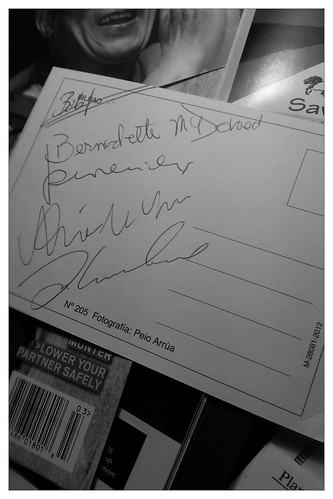
The postcard I received was an illustration of the broad gathering at Mendi, and also its status.

After some prolonged waiting, I got mine. What we all received was a picture of the Guggenheim Museum, which was near the Mendi festival that was held all over Balbao. On the other side there was no message, only the signatures of four extraordinary members of the climbing community: Award winning author Bernadette McDonald, legendary Polish alpinist Krzysztof Wielicki, Polish climbing star Adam Bielecki, and leading Kazakh mountain climber Denis Urubko. Most of their marks were barely readable.

At the top, in the return address space, signed with only his first name, is Bob himself. He and I joked about how it devalues the postcard’s value with the other four autographs (how it’s gone from several hundreds of dollars to mere cents with his pen stroke).

In reality, in my opinion, Bob has played a valuable role in telling and retelling some of climbing’s greatest tales. He is a historian with a incredible memory for detail and he has a collection of climbing autographs and memorabilia you might not believe. Yet, his name only appears in footnotes in some of the books and periodicals you might read, particularly from National Geographic and Alpinist.

The fact that Bob thought to send me one of his several signed postcards from Mendi has sent me soaring. When I learned the other recipients I blushed; those I knew are people that I admire. It was good company.

Thanks, Bob, for making me feel like a part of your community.

As a total aside, there has been a lot of climbing news worthy singling out or at least a mention. I’ve mentioned them all through my Twitter feed (@SuburbanMtnr) but I can touch on them a bit more here:

The biggest and saddest news from the past couple of weeks has been the loss of Chad Kellogg, the well known speed climber and less well known alpinist. He ascended Fitz Roy’s Northwest Ridge with Jens Holsten and was killed by rock fall on the descent in the Supercanaleta, only three rappels below the summit. Jens descended alone. I didn’t want Chad’s story to be over yet.

The opposite side of the coin of sadness yielded this development: The same week Kellogg was lost, American rock climbers Tommy Caldwell and Alex Honnold tried some Patagonia alpine rock and were the first to complete a full traverse of the Fitz Roy massif via a unified ridge with an ascent of 4,000 meters. It’s been dubbed the Fitz Traverse.

Several climbers continue to work toward making the first winter ascent of Nanga Parbat. As March 21 looms, the ascent just gets more exciting. Raheel Adnan has been covering the details on his blog, Altitude Pakistan. I also post much of his material on my Twitter feed.

Lastly, I conducted a few brief interviews with some of the leading climbers in Alaska today and asked them about some of the boldest ascents to remember. Well, it’s not pretty, but the list is longer than I thought it would be and the climbs are more daunting than I originally considered them (when the leaders are impressed, you have to be more scared than they are, right?) So look for the first post on that later this month.

Thanks again for stopping by. If you enjoyed this post, please consider following The Suburban Mountaineer on Twitter and Facebook.

The Olympic Mountains of Sochi

On Friday, I spent the day with several other parents waiting in line to register our children for what we believe is the best preschool in the area. Registration was at 6:00 p.m. During a tour of the school, Natalie learned that the parents of prospective students showed up early in the morning to get in line to secure a space. I arrived at 5:00 a.m. believing that I would be at least second, or maybe third in line. Instead, there were already eight other eager parents already in line.

I got to know the eight other parents well, and they got to know me and that I ran TSM. The Winter Olympics, happening in Sochi, Russia, came up and I realized that people thought Sochi was in Northern Russia. I remember having to explain where Whistler was to several neighbors four years ago during the Vancouver Winter Games.

While my mental map of this region of Russia isn’t perfect, I was right when I said Sochi was near the homeland of one of my high school classmate, an exchange student of Georgia — that’s the in the Caucasus Mountains.

Sochi, Russia is a major ski resort in Russia located on the Black Sea, which is a popular vacation destination any time of year, according to my old friend.

North American’s probably don’t think of this area unless they hear a news story about Russia and Chechnya (which is further east anyway). However, it’s geographically significant if you’re interested in the highest peaks on each of the seven continents: While many believe that Europe’s highest point is Mont Blanc (15,781 ft./4,810 m. and the birthplace of mountaineering as we know it) in the Alps, it’s actually a mountain around the border between Europe and Asia. The Ural Mountains are accepted as the division between the adjoining continent, but where the Caucasus to the south lay in the equation is a matter for debate.

Let me settle this by simple national pride and self-identity: One day while I was in high school I said to my Georgian friend that he was technically Asian. I relied on the fact that most Europeans didn’t even want Turkey joining the EU. Georgia was to the east, so it made sense in a weird way. His reaction was passionate and I haven’t forgotten. With a fist pump in the air and a bright, proud smile he corrected me, “I am European.” Got it.

Why is this important? Well, the Caucasus Mountains are higher than the Alps. No question. And a mere 150 miles away from Sochi is Europe’s true highest peak, Mount Elbrus (18,510 ft./5,642 m.), which stands in the center of the range that runs northwest-southeast.

Last year’s American Alpine Journal included only one entry for the Caucasus. That’s most likely because they are well trampled. Still, there is some opportunity to making new paths. The climb described on page 261 of the 2013 AAJ was of a new route — performed in winter.

Thanks again for stopping by. If you enjoyed this post, please consider following The Suburban Mountaineer on Twitter and Facebook.

Bernard Amy Defends Alpinism

Bernard Amy was recently awarded an honorary membership to the Italian Academic Alpine Club. I must fit the stereotype of an ignorant American because I had no idea there was such a club until I heard the news.

Amy, a French mountaineer and a writer is best known among American climbers for his short story “The Greatest Climber in the World.” I became aware of that piece and Amy himself last year when a reader from the place of Amy’s birth — Lebanon — brought them to my attention.

Amy’s acceptance speech, which he gave at a ceremony in Turin, Italy, was well worded and extremely timely. He addresses the criticisms of climbing, particularly of mountaineering and alpinism, most of which revolve around the notion that climbing is a dangerous, frivolous activity.

The speech is brief and worth reading but if there is one key take away in his remarks that defends climbing, it’s that we must not try to explain why we climb but rather what we get from climbing. As Kelly Cordes put it in Alpinist 41, we should stop asking the unenlightened question of why, and instead ask what do you seek?

Thanks again for stopping by. If you enjoyed this post, please consider following The Suburban Mountaineer on Twitter and Facebook.