Your Time to Climb Niagara Falls

UPDATED: January 29, 2015.

Niagara Falls almost froze once in your lifetime. It may never freeze again for you. If it does, will you be ready?

Of course, Niagara Falls isn’t a typical ice climbing destination.

By comparison, water ice in Hyalite Canyon, Montana and the Adirondack Mountains, New York are usually pretty reliable each winter. Albeit some routes form better than others year to year. However, even consistency has off years: This season in Chamonix, France is unseasonably warm, which has precluded any of the water flows from slowing down and stopping firmly in place. With the normal consistency of these locations, you can take for granted the reliability of the quality of the climbing.

Generally, those routes, like Dave’s Snotsicle (love that name) in Smuggler’s Notch, Vermont, are attractions for their length, challenge and setting reasonably far from any town. Sometimes the word ephemeral is used to describe them. Except there is no route more ephemeral than Niagara Falls; the last time it actually froze was in 1938.

Niagara Falls is amazing. It pours 5.5 billion gallons of water down its wall every hour. My dad told me about the people that rode a barrel over the falls; then I day dreamed about being one of those nuts climbing into a capsule and waiting for the river to carry me away. Yet it never crossed my mind to go in the other direction.

I grew up in the Buffalo, New York area just a 25-minute drive from the falls. I took girls on dates there when I was in high school, gambled there, been grossed out at Ripley’s Believe it or Not, drank a respectable quantity of Labatt’s Blue and Molson and other northern beers just above the gorge, and I have seen the falls from both borders in all seasons.

The typical ice buildup on the gorge walls is substantial most winters. It grows somewhat thick alongside on the gorge walls adjacent to the flow, mostly from spray and mist, but I have never seen the falls itself freeze solid like it nearly did during the 2013 North American Polar Vortex. Will Gadd and Sarah Hueniken ice climbed the adjacent wall by the Horseshoe Falls on January 29, 2015, but that’s not the falls proper.

The attraction for ice climbing this fleeting icicle is not about its height or serene outdoor qualities, like the ice crags I mentioned. You have to ignore the tourist traps, factories, casinos and tackiness and just focus on the ice. This likely won’t be worthy of an entry in the American Alpine Journal. I originally thought that this event will be more likely to be covered by Geraldo Rivera, but after seeing the coverage of Tommy Caldwell and Kevin Jorgeson on the Dawn Wall in January 2015, perhaps the New York Times would want a piece of it. But public attention isn’t why you should pursue this climb.

Niagara Falls is the unicorn of ice climbing. If you’re an ice climber and it freezes again, you better have a plan. A drop-everything, call-in-sick, postpone-your-wedding and drive, fly or hitch to the Canadian border -plan.

Someone, one day, so long as ice climbing maintains a grip on restless souls seeking something they often can’t put into words, will be the opportunist. They may be the only person to ever attempt to climb Niagara Falls.

Maybe it’s you. Make a plan now. You have to take these photos and print large versions to study and become familiar with what may be in your future. You need to have gear and a way to get to Upstate New York/southern Ontario. You’ll need help getting to the base of the ice. Or maybe you rapel down.

When you’re done, if it happens in my lifetime, I’ll meet you on the Canadian side at Falls and Firkin (cheeky tagline: “Want a little Firkin more?”) and I’ll toast to you. There may not be another to follow your path. Ever.

Thanks again for stopping by. If you enjoyed this post, please consider following The Suburban Mountaineer on Twitter and Facebook.
Polar Vortex and Winter First Ascents

I just read where someone described a route in Patagonia by claiming it required some “Alaska style groveling.” I now think that I haven’t been outside enough and haven’t climbed often enough because I wanted to know if he needed a partner.

Well, here in most of the United States, most of us will be on our own to deal with this bout of arctic air (from the “polar vortex” phenomena) that has swept over North America. We’re all forced to be a little more self reliant by bundling up, keeping pipes from freezing and dealing with dead car batteries on our own. The utility company cannot help you. It sounds miserable to some, maybe most people, but for this moment we’ll feel alive in the moment and not just on auto pilot cruising through our daily routine.

However, the cold that has come south of the arctic circle is only a taste of the prolonged cold several climbers in three expedition teams are facing on Nanga Parbat, the ninth highest mountain in the world. Of the 14 eight-thousand meter peaks in the Himalayas and Karakorum, only two have not yet been summited in winter:

2. K2 (28,250 ft./8,611 m.)
9. Nanga Parbat (26,660 ft./8,125 m)

The last to “fall” in winter were the eleventh highest mountain, Gasherbrum I (26,470 ft./8,068 m.), as well as the twelfth highest, Broad Peak (26,401 ft./8,047 m.) The story of the Broad Peak ascent was shared in the short movie Cold.

In alpine climbing, what is a matter of official record are the firsts: The first ascent, first ascents by new original routes, and the first winter ascent. There are a lot of these winter objectives to set out on a quest.

Still, others try for firsts that are a little more of a particular challenge; Arctic explorer-turned-mountaineer Lonnie Dupres had tried to get up Denali solo these past three seasons during the height of winter (January, really.) However, based on the latest news available no one has announced plan to try for the top “Big Mac” in the darkest days of the year.

I’ll report on these climbs as I read read the news. For now, stay warm and enjoy feeling alive.

Thanks again for stopping by. If you enjoyed this post, please consider following The Suburban Mountaineer on Twitter and Facebook.

American Alpine Journal: In Memoriam

In addition to the records of first ascents, new routes and other significant climbs, the American Alpine Journal also contains a section in the back that may be more valuable in certain ways. The In Memoriam section is extremely brief, compared to the rest of the entries, but it captures climbing in a more global way.

The In Memoriam section is a tribute to the notable climbers that we lost the previous year. They are also mini biographies of climbing’s leaders. Role models and bad examples. Heroes and villains. Flawed like us and yet still impressive.

The main output of the obituaries isn’t to call out the climber’s greatest route or contribution to the mountaineering community — often summed up as singular events — rather to share the life that lead them to their accomplishments and what kind of life they lead as a result. Whether it was a bona fide gateway to another level of life seems to be rare, but the climbing lifestyle always seems to be perpetuated in some fashion.

Last fall, the American Alpine Club solicited applicants to be the next editor of the In Memoriam section of the American Alpine Journal. There were many applicants for the volunteer position, and David Wilkes of New York got the job. I actually met David over two years ago at an unrelated business meeting in Washington, DC (our roles in two separate organizations crossed briefly.) We didn’t know the other was a climber and we hardly thought the encounter was memorable beyond the business of the meeting. Another friend recently reconnected us because of our mutual interest in climbing.

Later I had the opportunity to ask David about overseeing production of the section as editor and managing the process with the writers. In the end, the AAJ included 14 obituaries, though he said there could have been more.

Not surprisingly, David described several complexities and complications that arose while putting the section together: “Each person that was profiled was a bit of a different story in terms of how the obit came about,” he explained. “For some, long-time friends or a relative were thrilled to write, in many cases providing far more stories and recollections than I could include and I needed to do some very difficult but substantial cutting.”

Some of the entries were obligatory. Had even one profile of the significant climbers been absent, the omission would have detracted from the section’s and the AAJ’s overall quality.

The tribute to Maurice Herzog that appeared in this year’s edition, was one of the mandatory profiles. However, finding the right person to write a true tribute, fitting the man’s life proved to be the most significant hurdle. I took that to mean that the seedier side of Herzog often overshadowed or unnecessarily threatened to cloud the man’s legacy.

On the potential for omissions, David said, “For some climbers’ obituaries it was more difficult to find an author – or when I did, to get them to complete the task.” Then he added, for some “we ended up with nothing.” For Herzog, being left with nothing would not be satisfactory.

“Maurice Isserman was the only person I found who could do the job right,” said David. “In the end, it made sense to include a line or two that pointed to the darker aspects of Herzog’s climbing legacy.”

Like Herzog’s obituary, much of the section was about balancing the content, particularly what needed to be said and what should be said to honor those notable climbers that we lost the previous year. American Alpine Club members can read the digital edition of the In Memoriam section in the 2013 AAJ section by clicking here. Nonmembers may also purchase it through the same link.

2013 Obituaries

  • Bjorn-Eivind Artun, 1966-2012
  • Bean Bowers, 1973-2011
  • Harvey Carter, 1932-2012
  • Herbert William Conn, 1920-2012
  • Bill Forrest, 1939-2012
  • Maurice Herzog, 1919-2012
  • Ben Horne, 1980-2012
  • Dale Johnson, 1931-2012
  • Ann Dodge Middleton, 1928-2012
  • Roger Payne, 1956-2012
  • Jack Roberts, 1952-2012
  • Gil Weiss, 1983-2012
  • Yan Dongdong, 1984-2012
  • Michael Ybarra, 1966-2012

I appreciate you stopping by for a read once again. If you enjoyed this post, please consider following the Suburban Mountaineer on Facebook and Twitter.

Revelation Mountains and Roberts’ Pitons

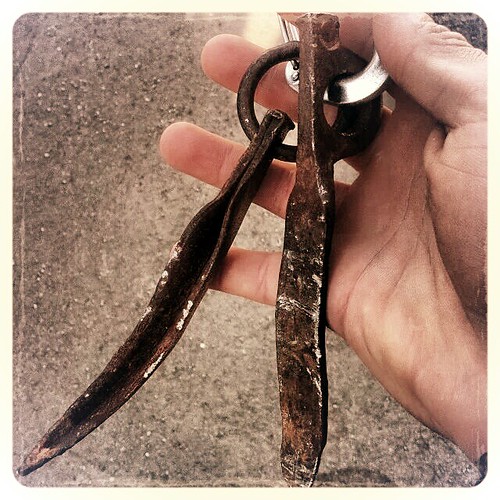
Roberts’ pitons from Vanishing Pinnacle, recovered by Helander (courtesy Clint Helander 2013)

Unless someone has climbed it in the last year or so, Vanishing Pinnacle in the Revelation Mountains, a remote subrange of the Alaska Range, has only been summited three times. First in 1966, the second in 1985, and most recently in 2012. It’s a 400-foot needle that, as the first ascentionist said, is only detected in profile.

If you read the features in the 2013 American Alpine Journal the last one before the general entries was part of the new Recon section, which covers virtually untapped mountain climbing areas, Clint Helander wrote this one about the Revelations. They are rarely visited and still have peaks that, to the best of our collective knowledge, are unclimbed. The Revs are not giants, most are about 9,000 feet above sea level, but they are ripe for pioneering a new route and taking in big Alaska in solitude.

Helander is the contemporary expert on the region and has more first ascents there than anyone else. I’ve covered his most recent climbs in the Revs here on TSM before.

Helander and Ben Trocki were the third to climb Vanishing Pinnacle. The first ascent was lead by the first explorer in this range, who also happens to be my favorite alpine climbing author, David Roberts. (John Long is the best rock climbing author, for the record.)

Regarding the second ascent, Thomas Walter reported in the 1988 American Alpine Journal that, “On the top we found rusty pins slung together with a nylon belt left two decades earlier.” Walter and his would-be long-time climbing partner Greg Collins left the pins and rated the crux pitch as 5.11, even though Roberts’ team said the overall climb was F6 (i.e. 5.6), A3.

In 2012, Helander and Trocki, after climbing for 18 days on the more serious peaks and running out of food, thought what-the-heck and decided to dash up the Pinnacle. They found the pitons. For whatever reason, Helander loosened two, clipped them into a carabiner and descended with souvenirs. It wasn’t hard to guess who they might belong to.

Helander took the photo above shortly before shipping one back to its original owner. If nothing else, Roberts deserved it for his pioneering in the Revelations. Helander deserved the other for reopening the range to climbing, and even completing some unfinished business, like the second ascent of the Angel and the first ascent of Golgotha.

Roberts named them, Helander made his name through them.

It’s also worth mentioning that the Revs saw little more traffic among explorers of any kind until Helander’s arrival, and few have covered as much ground — vertical and horizontal.

Thanks goes to Clint for his repeated generosity and for sharing this story with me.

I appreciate you stopping by for a read once again. If you enjoyed this post, please consider following the Suburban Mountaineer on Facebook and Twitter.

Sources: 1) Clint Helander, 2) Alpinist online, 3) 1968 American Alpine Journal; and 4) 1988 American Alpine Journal.

Various Notes: Annapurna, Steve House Etc.

image

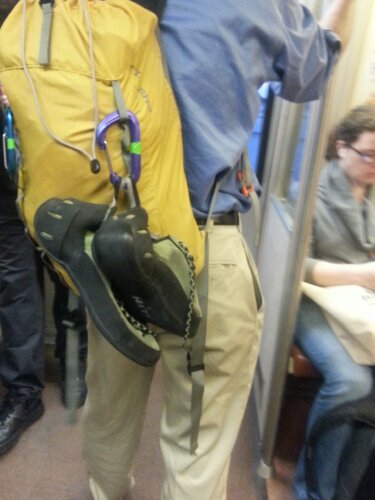
Every Wednesday evening, or another night during the week, I see this person carry his ultralite pack and his rock climbing shoes ride the Washington subway to meet his girlfriend at the climbing gym. He doesn’t climb outdoors much and he doesn’t know the route names of those he’s been on. But that’s not the point.

He and I haven’t spoken since the first time we met in a slightly belabored conversation, but I like seeing him on the train. Maybe climbing doesn’t end when you live far from real mountains; maybe it just takes on different forms.

Sometimes it’s just about following the news and living vicariously. The news from the last several weeks has been centered on one big alpine route: The south face of Annapurna. On October 9th, Ueli Steck summited Annapurna via an incomplete line first attempted by Jean-Christophe Lafaille and Pierre Beghin of France in 1992. He did so alone and at a lightening pace during a mere 28 hours.

Then, only days later on October 24th, French climbers Yannick Graziani and Stephane Benoist went up the same way (but that is unconfirmed), though no where near the same pace Steck traveled. They took eight days to climb.

I started thinking that the conditions (including the rock, snow, ice, weather, stability, etc.) on the south face must have been ideal to allow Steck to climb so swiftly and for a second team of two to ascend this wall. Ed Viesturs and David Roberts talk about the challenge and appeal of the wall in their book on Annapurna, The Will to Climb. If you have copy it’s worth going back and reading that chapter on the first ascent of the south face. (I’ve been carrying my copy in my bag on my commute these past few days.)

Now knowing that Graziani and Benoist struggled their way up, unlike Steck’s apparent saunter to the top. The pair experienced some cold nights with at least one spent without a shelter. Benoist suffered with significant frostbite and was evacuated once the they neared the base of the mountain.

What may seem like a stable route in ideal conditions can change quickly. It can also be subject to so many other factors, such as how a climber matches up to the challenge. Can they overcome the rock band? If their rope is too short, do you descend? If you run low on food, can you keep going?

It makes Steck’s ascent more impressive. But it also makes the climb by Graziani and Benoist stand for its own characteristics. They didn’t saunter, and their story will likely be a more compelling epic, especially in that they followed Steck’s lightning first ascent.

As a final note, the training guidebook that Steve House has been working on with Scott Johnston will be available to the general public in February 2014, and sooner if you can get to the Patagonia booth at the Outdoor Retailer Winter Market on January 24 in Salt Lake City. Its title is Training for the New Alpinism: A Manual for the Climber as Athlete. The forward is written by Mark Twight.

Well, Happy Halloween. I’m looking forward to leaving work a little early to take Wunderkind trick or treating for the first time. What costume do you think her father will wear?

I appreciate you stopping by for a read once again. If you enjoyed this post, please consider following the Suburban Mountaineer on Facebook and Twitter.

From Gongga Shan to Mount Everest

Here are some final notes about the adventure surrounding the first ascent of Minya Konka in 1932 and even a reflection on the government shutdown in America. But first, here is a factoid that a friend and reader in Seattle highlighted for me.

Sizing Up

Minya Konka, the Tibetan name for the mountain in Sichuan Province, China, where it is better known as Gongga Shan, has a spectacular rise. Our friend in Seattle is knowledgeable about prominent mountains like Gongga Shan or Mount St. Elias in Alaska, for example. Despite the mountain’s status in this regard, he says he has never heard anyone say that they’re dreaming of climbing Gongga Shan. It’s a shame; PeakBagger.com says, “It is one of only eight peaks in the world that rank in the 50 highest and 50 most prominent peaks on earth, and only 6 are both higher and more prominent.”

It’s points like this that make the original, sloppy measurement of 30,000 feet by Joseph Rock appear, if not forgiveable, at least understandable. It certainly appeared to dominate the sky. It lends some sense, based on his observations, of why he thought it could be true. Perhaps he wanted it to be true.

While I have retold the story of Burdsall and Moore climbing to the top of Minya Konka in 1932 in terms of a single-minded mission, it was, in fact, more complex. The full expedition was indeed determined to attempt the mountain, but there was widespread skepticism on the mountain’s actual elevation. While the possibility that Rock was right, there was no way to be certain except by going there and finding out for themselves.

Even Rock wrote, “Not being supplied with a theodolite, I could not take the actual height…” The chief cartographer at National Geographic later learned that Rock didn’t even use a mercurial barometer, and that he only used a simple pocket sighting compass and an aneroid for setting his baseline. However, when Rock published an article in National Geographic, Minya Konka was marked at 28,000 feet. In fact, it was the editorial revision; because of the tools he used, 28,000 feet was as high as they felt comfortable publishing.

The expedition, as commissioned by the Explorers Club under the leadership of Gene Lamb, would explore the region up close, determine the elevation using the most modern technique, and attempt to reach the summit. And there was one more thing…

Ulterior Motives

The expedition also served as a probe or trial balloon for another purpose. If the climbers could obtain official permission to cross China, Lamb believed, it may be possible to also cross Tibet and make the first American attempt of Everest, thereby skirting India and Nepal, which the English held through a mountaineering monopoly.

This was a significant reason why obtaining permission to climb Minya Konka was critical to the process. And if you recall, when the elusive right to climb it was granted there was a condition attached: The Americans would be allowed to attempt Minya Konka if, and only if, they promised not to proceed beyond Sichuan Province, enter Tibet and attempt Mount Everest.

This was 1932. The English had a hold on Everest. Conspiracy theories aside, China aided in that strangle hold. I don’t believe there was any arrangement between those nations’ governments, but the Chinese interest in controlling foreigners and access to their land, was a valued piece to their public policy.

Government Influences

Politics and policy processes (which is how I make my living) is how we express society’s values. It’s also a force that can limit our freedom of the hills. The Chinese and English interests, while for different values, worked in concert to limit access. It was also an era of strong feelings of nationalism. Today, I think of climbing and hiking as so innocent, but it’s not when national pride is at stake.

Here in the United States, our national government has been shutdown for 13 days. It’s not the record (the American government shutdown for 21 days in 1995 for the longest in history,) but access to public lands, like Yosemite has been limited. Roads are closed and backcountry activity is strictly prohibited.

I don’t think this is entirely bad; the land and animals will be left alone to be wild. When things reopen (and they will eventually,) I hope that it gives us a glimpse into what Burdsall, Moore, Emmons, and Young experienced crossing into the unknown.

I appreciate you stopping by for a read once again. If you enjoyed this post, please consider following the Suburban Mountaineer on Facebook and Twitter.

Climbing matters, even though we work nine to five.