Hueco Rock Ranch “It Lives” Tee Winner

Happy election day, to my American neighbors. With hope, we’ll know who will occupy the White House on January 21 by late tonight.

The Hueco Rock Ranch, now owned by the American Alpine Club, has been open for a little less than a week. To celebrate I was giving away, courtesy of the AAC, a limited edition Hueco Rock Ranch “It Lives” tee. It was only available during the one day membership drive held in celebration of the ranch.

Entries closed last night and the winner of the raffle was Stuart Reeves. Congrats, Stuart. I’ll be in touch about getting one in your size to you.

As a total aside, I’m working on an article for a friend’s magazine on Baffin Island. Some of it’s earlier drafts may end up in a post soon. Well, ’till then…

Hueco Rock Ranch Opens and Giveaway Contest

This Thursday is a big day and I want to help you and the American Alpine Club celebrate. When I heard the news initially, I didn’t care. I wasn’t focused on bouldering destinations. Yet, Hueco Tanks has taken my imagination.

As someone that has emphasized ice climbing and dreamed of first ascents in Alaska, climbing outside El Paso and staying at the Hueco Rock Ranch didn’t interest me. But living in the Mid-Atlantic for work — and enduring my first real Category-level hurricane — I’ve had to adapt to other kinds of climbing. And strangely, the appeal of rock destinations — including Hueco Tanks — has taken on a whole new realm of bright thoughts of opportunity, fun and exploration.

However, I wouldn’t have had my attention drawn to it so much these last few months if it hadn’t been for the AAC’s purchase of the Hueco Rock Ranch and all of the publicity around it. I’ve been lured in and I have learned more about Hueco Tanks’ natural features and how the destination got its name, about the preservation of the native art on the stone and the ranch’s founder and builder, Todd Skinner.

Here’s the part to celebrate: This Thursday, November 1st, the Hueco Rock Ranch reopens for business under the management of the AAC. It will remain an inexpensive shelter for climbers for a long time to come. It will keep you off the ground , access to a shower and a place to share some beers and talk about the day’s work. I spoke with Trish Boomhower of the AAC staff and she says there has been a “TON” of work done on the house and additional work on the barn will be done soon too.

Now, here is the contest: It’s a raffle. Earlier this year, the AAC held a membership drive to celebrate the acquisition of the ranch. Everyone that joined that day received a commemorative tee shirt. If you already have your tee, great, but I am raffling off one “Hueco Rock Ranch / It Lives” (your size, courtesy of the AAC) to one of my followers on Facebook or Twitter. Followers on Facebook get two entries and Twitter followers get one — follow The Suburban Mountaineer on both and you’ll get three entries. Contest ends Monday, November 5th so enter now!

Click Here to Enter the Hueco Rock Ranch Tee Contest

Good luck, I’ll talk to you on Facebook and/or Twitter. Maybe we can meet at the ranch one day and talk about how we never thought we’d go bouldering.

Mountain Drool: Overlooked Torre Egger

Good morning and happy Friday! September is always a tough month for me to keep up with my climbing reading and research — my preferred way to relax. September is probably the busiest month of the year at my job in Peaklessburg where there are more deadlines, planning for the new fiscal year and monitoring and controlling the work of my teammates; the effort needed to succeed involves a lot of energy and some steady nerves. Add baseball’s pennant races to the mix and I’m usually spent by the end of the week.

Still, as I recently explained to one regular reader, my mind has been drifting to the mountains of Patagonia. I expect to be posting on them for a bit before I return to writing more about Alaska, British Colombia and other parts of North America.

If you read the climbing magazines and blogs even occasionally, you know that Cerro Torre was featured in nearly every one. They covered the shock and celebration (take your pick) at Hayden Kennedy and Jason Kruk’s fair means ascent of the Compressor Route where they knocked off a quarter of Cesare Maestri’s bolts. It also covered what happened days later on the same route, where David Lama freed the vast majority of the route — the first to do so. Lama’s accomplishment also followed his own controversy on Cerro Torre in the previous years.

While Cerro Torre is iconic in Patagonia — a sharp spire neighboring other distinguished peaks like Fitz Roy and Poincenot — it’s immediate neighbor, Torre Egger (8,809 ft./ 2,685m.), might be easily overlooked. In 1993 Alan Kearney wrote in his history Mountaineering in Patagonia that while Patagonia is a common destination for many climbers and hikers, there are places that are less traveled and still seem like old, remote Patagonia, and the minor neighbors of major peaks are often a way to find that experience. I recall Jim Donini, who later became an American Alpine Club President (2006-09) by the way, writing in an issue of Climbing that even today Torre Egger remains one of the most challenging climbs in the Americas.

Torre Egger was named for Maestri’s partner, Toni Egger, who died while descending Cerro Torre. He fell with their only camera, leaving the alleged proof that Maestri claimed they mad the first ascent of Cerro Torre in 1959.

The mountain spire was first climbed by American alpinists John Bragg, Jay Wilson and Donini, whom I mentioned before. Their ascent was made in the southern-hemispheric summer of 1975-76. Their route creation was frequently interrupted by the famously bad Patagonia weather with its harsh winds referred to as the broom of God. For these reasons, the work stretched from mid-December to late February.

The first winter ascent was completed only recently in 2010. Swiss climbers Stephen Siegrist and Dani Arnold (Arnold also recently made a fast and furious ascent of the Eiger Norwand) and German climber Thomas Senf. A fourth was part of the team, Austrian Mario Walder, but knee trouble held him back from reaching the top. After some load ferrying to the base of the wall a weather window opened and allowed them to the summit in a three-day ascent. Like everything in climbing, nothing is certain until you’ve made the accomplishment and are safely in basecamp. According to Alpinist.com’s report, the team had their doubts even in their last bivy; would the weather window close and thwart their hopes. The weather held and they navigated the ice and cracks to the top. After three days they arrived on top in calendar winter.

The story that has drawn me to this mountain, however, was the new route put up by the late Bjorn-Eivind Artun and his climbing parnter Ole Lied over Christmas day and December 26. The route on the south face was called “ephemeral” in PlanetMountain.com and the climbers named it Venas Azules (6b+ A1 AI6, 950m). It earned elevated attention of the judges for the 2012 Piolet D’Or who gave it an honorable mention. What gets me the most about this climb is Artun. I’m sorry we lost him too soon, evidently hit by rockfall earlier this year. Artun sought challenges that were ambitious and pure — long, hard, and in a beautiful, minimalist style.

I called Baffin Island my Patagonia recently, and in many ways it is. But Patagonia is unique. So is Torre Egger and its stories.

Thanks coming by once again. If you enjoyed this post, please consider following the Suburban Mountaineer on Facebook or Twitter if you haven’t already because I believe climbing matters, even though we work nine to five.

Meru and the Piolet d’Or

26629509131_01bb487fe1

The Magic Line Up the Shark’s Fin. (All rights reserved)

The international judges collected by Montagnes magazine gave the 2012 Piolet d’Or to two climbs and gave an honorable mention to a third. You probably already knew that, since the awards were given in March. One climb I thought ought to have won wasn’t even mentioned and one that was actually awarded I don’t find completely worthy.

So I have been bothered by this for half the year, it would seem. It’s clear to me that judges made a mistake. I’ve become more convinced with time and reading up on the other ascents.

The award was given to Slovenian amateur alpinists Nejc Marcic and Luka Strazer for their ascent of K7 West (21,702 ft./6,615 m.) in the Karakorum and American veteran alpinists Mark Richey, Steve Swenson and Freddie Wilkinson for their ascent of Saser Kangri II (24,665 ft./7,518 m.) in a remote part of the southern Himalayas. The honorable mention was given to the late alpine hard man Bjorn-Eivind Aartun and his climbing partner Ole Lied for their ascent of Torre Egger (8,809 ft./2,685 m.) in Patagonia.

The K7 West team had never previously climbed in the greater Himalaya. They were young, ambitious climbers on the adventure of their lives. Their new route up the to the western of four peaks on the mountain climbed 1,600 meters and they rated it VI/5 M5 A2. They faced large, looming seracs along the ridge and dehydration over the three-day climb; they descended to BC on the fourth. Being their first trip to the range, they managed to get in several other climbs. The adventure went well and they were successful on a peak that has a glowing reputation for unsolved problems on an enormous scale.

The Torre Egger ascent by Aartun and Lied that earned them the honorable mention was a new line of mixed climbing that was described as “ephemeral” and “imaginative” by PlanetMountain.com. Reading the accounts in Alpinist 39 and the 2012 American Alpine Journal its plain to see why. Their line was relatively direct and they climbed light, efficiently as though the risks we face on our own cliffs didn’t exist, without being reckless. More to the point, the climb was about the climb, and the objective just happened to be somewhat iconic.

The first ascent of Saser Kangri II ticked it off the list as the world’s second highest unclimbed peak. (The first, Ghanker Puensom, is in Bhutan where climbing is forbidden.) It was also one of one of the longest alpine ascents of sustain vertical ice and rock in the Himalayas for a first ascent. The team even devised of a special hammock for collecting snow to pack it and create artificial ledges as no natural rest areas were on the smooth southwest face. After two nights in the two hammocks, they went for the top but had to endure a night hanging in their harnesses — never a pleasant way to catch some shut eye or, er, find relief. PlanetMountain.com said, “A wealth of experience enabled the team to take a very minimal lightweight alpine style approach in achieving the first ascent of the peak.”

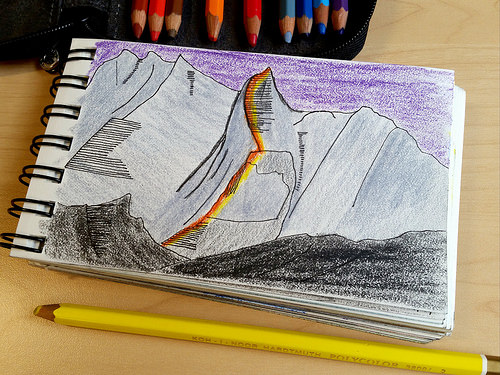
The climb that was nominated but received no notable accolades from the judges, including from American Michael Kennedy, was the ascent of one of Meru’s sub-summits, Meru Central (20,702 ft./6,310 m.), often referred to as the shark’s fin because of the shape of the final section. It had been climbed once before by Russian Valeri Babanov — but well to the right of the shark’s fin ridge. The Shark’s fin has been the objective of several expeditions over 30 years; only two teams have stood on the top consisting of four climbers total. Only one team made it up the fin’s knife edge, which included leader Conrad Anker, Jimmy Chin, and Renan Ozturk (one of my favorite artists, by the way.)

Over 30 years, the ascent of the Shark’s Fin grew to legendary proportions. Failed attempt after failed attempt, only skilled, experienced climbers could even think of being so ambitious. As Chin explained at National Geographic Live in 2011, “It requires every kind of climbing,” meaning rock, ice, mixed and various styles. The three-man team employed a hybrid style to get over physical and psychological “hump” of the fin: Big wall technique with an alpine-light set of gear. That sounds a like an oxymoron and it is to large extent; they aided portions of the route with minimal gear.

The route was coveted by Anker’s climbing mentor, the late, legendary Mugs Stump. He never completed the fin. Anker went three times. Anker took Chin and Ozturk on his second attempt in 2010. After the endless tunneling, days on the wall with less than adequate food, bad weather, it left them wasted. Chin vowed never to come back. The dream was over and Meru’s Shark’s Fin persisted as one of those last great problems.

Some mountains, after failed attempts, grow larger and larger until the wall is thoght to be twice its size. If that has been the case for Anker, Chin, Ozturk and even Stump, then Meru likely grew bigger than Mallory’s unclimbed Everest.

As it is obvious, the team did indeed return and they almost miraculously climbed the Shark’s Fin’s knife edge ridge to Meru Central’s pinnacle. The achievement was emotional particularly for Anker and Chin but also for Ozturk; Ozturk nearly died months earlier in a skiing accident and underwent brain surgery due to the severity of the crash, which also may have risked his life in the high altitude. They didn’t know what his condition would do to his ability to climb or what that would mean for his teammates. Fortunately, only his words, and not his skills or judgment, were occasionally obscured.

The alpinism that I hold in high esteem is about climbing amazing, steep routes in small teams with high exposure and with as little gear as possible. It’s also about the challenge of getting deep within ourselves by attempting ambitious and often intimidating objectives. I think the Shark’s Fin team deserved one of the 2012 Piolet D’Or awards. While I appreciated the Saser Kangri II ascent, it did not present the challenges, test of character, or the intimidation factor that weighed on anyone even contemplating an ascent of Central Meru by the Shark’s Fin ridge.

I realize that the ascent by Anker, Chin and Ozturk was not a bona fide first ascent and that it was a variation of an existing route and that the other winners we’re clearly new routes with one true first ascent. Are first ascents of unclimbed mountains and new routes valued higher than significant variations? Usually not, but this might be the grand exception. And the publicity around the Shark’s Fin ascent in the major climbing publications featured it in dramatic fashion. Still, I believe the climb — and the story — needed no embellishment. It was the climb of the year.

Steve House once criticized the Piolet D’Or for not awarding the most progressive ascents. The judges later recognized that House and his partner were in fact among those worthy. Still, I think the judges made a mistake concerning the Meru climb. The ascents they recognized are admirable at a high level, but Anker, Chin and Ozturk deserved much more. It’s Meru’s Shark’s Fin that will inspire climbers to dream, perhaps more than many others.

Thanks again for dropping by. If you enjoyed this post, please consider following the Suburban Mountaineer on Facebook or Twitter if you haven’t already because I believe climbing matters, even though we work nine to five.

Books on Bolts, New Routes and Other News

Do you know that feeling when you get back from a long vacation in which you disengaged from responsibilities of the working world? It’s a kind of euphoria. I’m fighting to stay in that state right now; having returned to work at the beginning of last week. Plus I’ve been given more responsibilities while I was away, which is great but challenging my ability to remain in that high. Still, if I close my eyes and concentrate I can still imagine myself being up early, sitting in an Adirondack chair, sipping coffee and watching the fog lift off the valley below as the sun rised.

While I was away a lot of stories about new routes came out and few other things struck me that I wanted to share:

Activity in the Waddington Range — I have a soft spot for northwestern North America (AK, YK, BC AB, WA, OR) and it’s vertical rock and glaciated terrain, so the news of these five climbers sounds nearly epic. First, Colin Haley — who never does anything small nor sits around for long — soloed Mount Waddington (13,186 ft./ 4,019 m.) and continued over several other peaks in British Colombia’s Coast Mountains. Click here for Colin’s take on his blog, Skagit Alpinism.

Separately, the new routes and attempts on The Blade (10,840 ft./ 3,304 m.), Combatant Mountain (12,327 ft./ 3 ,756 m.) and Mount Asperity (12,191 ft./ 3,716 m.) also caught my attention. For two weeks in August the four-man expedition dealt with route issues, such as frequent changes in the rock that effectively created dead ends. This made free routes difficult but the quest was epic. Click here for more.

New Route the Vampire Peaks — Pat Goodman, who is a thoughtful climber, climbed with Jeff Achey, Jeremy Collins and James Q. Martin in the Northwest Terrritories to put up a new route they named The Phreenix (VI 5.11, 18 pitches) on the Vampire Spire (5,225 ft./ 1,593 m.) For geographic reference, Vampire Spire is very close to the breathtaking yet forboding Cirque of the Unclimbables. You can check out more by clicking here.

Cerro Torre’s 2012 Season — The literature contemplating and comparing the controversies with Cerro Torre’s 2012 season has been in blogs and magazine articles; In fact, I’ve learned a lot since January, including more details of Cesare Maestri’s climb in 1970, where he finished the job of placing 400 or so bolts up Cerro Torre. Jason Kruk’s and Hayden Kennedy’s controversial climb “by fair means” where they knocked off about 100 of Maestri’s bolts, not to mention David Lama’s free climb that came days later, will now be the subject of a new book. According to the 2012 American Alpine Journal, writer Kelly Cordes “is writing a book about Cerro Torre and its 2012 de-bolting.” I’ll be pre-ording that one.

There was a lot of other news too, including climbs on K7 and Great Trango, but the America’s have enough for my imagination to run wild. These aren’t keeping me in the high completely, but they help.

Thanks for dropping by again. If you enjoyed this post, please consider following the Suburban Mountaineer on Facebook or Twitter. Climbing matters, even though we work nine to five.

Clint Helander and Alaska’s Revelation Mountains

I received my 2012 American Alpine Journal in the mail shortly before I left for vacation with my family. It barely made it. I’d been planning on dropping whatever I was working through and taking the journal with me as my sole reading material. It was delivered just days before we drove north and I was thrilled to find several features that I had already been seriously daydreaming about (obsessing might be more appropriate.)

One of those topics was the first ascent of Mount Mausolus (9,170 ft. / 2,795 m.) in the Revelation Mountains, a southern section of the Alaska Range. It’s relatively little known and remote, though I suspect more ambitious alpinists seeking first ascents — the kind on virgin peaks, not virgin lines — are becoming tuned in to the history and opportunities of the region.

There have only been two key figures for the “Revs,” including author and climber David Roberts, who was the first to explore the region, and the current and active expert, Clint Helander. Helander wrote a featured article on his FA on Mausolus and I caught up with him earlier in the season over email after another FA in the Revs — Golgotha (7,930 ft. / 2,417 m.), which David Roberts essentially called his secret climb. Helander has had some significant first ascents in the Revs, in addition to Mount Mausolus including the Ice Pyramid (9,250 ft, / 2,902 m.) and Exodus (8,385 ft / 2,556 m.), Golgotha, a notable second ascent on the Angel, as well as several new ice and mixed routes in the Chugach Range.

I wanted to know a little bit more about what made him who he is and how he has become a leader in this range so I reached out to him and he consented to answer a few questions. You can learned more about his climbing accomplishments on Alpinist.com and in the American Alpine Journal, but here are some answers that give us insight into the influences that lead him to be a first ascentionist. Here’s our brief conversation:

TSM: Your climbs could be characterized as aggressive. Did you have mentors lead the way?

CH: I have always had an IMMENSE amount of respect for Mark Westman and Joe Puryear. It brings me endless amounts of pride to have been able to call Joe and Mark friends. They just accomplished so much in Alaska, no one else can really even compete with the overall volume of climbs they have completed. They learned together, climbed the hardest routes of their lives together and always remained humble and clear to their morals. They didn’t seek fame or self-promotion. They both climb(ed) for the pure love of the endeavor itself.

TSM: You have a core group of friends. Were they influential?

CH: My group of friends in Alaska is so unique. I met them in college as part of the Outdoor Club. I was 18 years old and didn’t know two shits about anything when it came to the outdoors. They took me out rafting, sea kayaking, ice climbing, mountaineering, rock climbing, hiking, etc. They had climbed Denali, traveled around the world. They were all so accomplished in my eyes. Now in many ways I have surpassed many of them in technical pursuits, but it is purely because of them that I am who I am today.

TSM: Who are your heroes?

CH: My friends are my heroes. From those who shaped me from a know nothing 18 year old punk to the Mark Westmans of the world. It makes me beam with excitement to be in so much awe of my friends. I love sharing laughs with Westman and then looking down and thinking to myself “why is this guy climbing with me? Am I worthy???”

TSM: What does alpine climbing mean to you?

CH: I feel like alpine climbing has given me a different perspective on every day life. My heart sings when I am in the mountains. My body pulses with a feeling of complete happiness. I love the bite of the cold air, the ice, the extreme vertical relief, the risk, and the reward. I love going into the unknown and pushing myself in the mountains. I love confronting my fears and doubts. I hate the failure in the moment, but I love the desire it gives me to better myself for the future. I love succeeding at a long awaited goal. It is the most meaningful form of personal expression that I have.

TSM: Will you climb forever?

CH: At this point, I honestly cannot see outgrowing climbing. I have no intentions of slowing down. I want to find a way to work seasonally or on my own time and still make a decent living, while still being able to devote a significant amount of time to climbing in Alaska and beyond.

TSM: What is your next big challenge?

CH: After my Revelations trip, I attempted the Moonflower Buttress on Mount Hunter. We climbed very well, but a broken crampon and core-shot rope forced a retreat from 15 pitches up. I plan on returning next year stronger, faster, and with more time to succeed on the Moonflower. There is another route in the Alaska Range that terrifies me, but I think that with a year of training, I will be ready to give it a shot if I maintain my focus on training.  I also will return to the Revelations and attempt what I imagine will be my most difficult route yet. I plan to go to Yosemite in the fall. In the winter I will enter some endurance ski races and perhaps the Winter Alaska Wilderness Classic.

TSM: Thanks for indulging my curiosities, Clint. Keep up the great work, and stay safe out there.

Thank you for dropping by yet again. If you got something out of this post, you might want to consider following me on Facebook or Twitter because I believe climbing matters, even though we work nine to five.