What’s too Little Snow to Snowshoe?

I got out on the snow this week (which was fantastic!) and thought with the two-to-three inches of snow on the ground that it was not worth strapping on the snowshoes.  Walking was the only effort required, right!?  Well, I was wrong.

Walking in the lighter snow on the yard and the trails seemed like my boots were all that was necessary.  Moving through it was easy enough, but it was a bit wet and lumpy so it had the texture of clumpy sand at the beach under my feet.  My heel sunk and toes dug in deeper to push off.  It was not exactly an ordinary walk in the park.

Until now, I thought snowshoes were strictly for deeper snow (say six-plus inches, depending on your height and weight).  Snowshoes are meant to give the winter hiker the ability to float higher in the snow.  They prevent post holing in the snow and exerting more energy from high stepping it through the deep white stuff.

Now I think that even a bit of moderate depths, hiked over a longer distance as I have in the last couple of days, it is easier (requiring less effort) to do so in my slabs.  It might look a bit silly, but it is actually pretty efficient.  I sunk less and pushing off was less straining in the calve and ankle.

Anyway, those are just some thoughts for the snowshoers.  Have a Happy New Year and remember you can follow the Suburban Mountaineer on Facebook and Twitter.

Trail Restoration and its Contradition

The American Alpine Club (AAC) is currently supporting a trail restoration project in Los Glaciares National Park in Argentina.  For we hikers and climbers, this type of effort should be up there in our priorities for giving financially right after general efforts to preserve wilderness, like the work by the Alaska Wilderness League or Friends of Clayoquot Sound, for instance.  However, the idea of the need for such work is contrary to our sense of simplicity and enjoyment of the outdoors.

Trail restoration is odd when juxtaposed to our notion of valuing wilderness.  In an extreme position, wild places ought to be untouched, sacred from society or civilization and man in general, except for perhaps spiritual sojourns.  But more reasonably, we want to enjoy our wild spaces and geographical and biologically unique places on Earth.  So we permit modest intrusions, like foot paths, bridges and the occasional ladder.  It allows us access natural wonders without trampling them to oblivion.  God forbid that the land and biological things change too quickly because we visited, rather than by natural forces like tectonics, wind and water.

In the same way that a society requires rules and rights for the people to be free, our wild places need paths and limited infrastructure in order for we trekkers and mountaineers to roam wild.

Think about your favorite wild place and consider the infrastructure as part of your assurance that that place will be there for you in the future, even as the trails encourage more to come.

Well, thanks again for visiting.  If you enjoyed this post, please consider joining the new community and becoming a fan of the Suburban Mountaineer on Facebook.

Why Do I Sink Even in My Snowshoes?

A hunting guide in Greenville, Maine explained to me his complaint about the modern snowshoes, like those from Tubbs, MSR or Atlas brands; even if they are rated properly for him based on his weight, he still sinks slightly in the snow.  Granted, he did not sink more than an inch and a half – he admittedly did not have to put in the effort of high stepping it through deep snow post-holing!

Regardless, he blamed the contemporary-style snowshoes and preferred his old wood-frame and rawhide snowshoes.  They were, after all, larger and provided more floatation.  So is there something fundamentally wrong with the modern aluminum snowshoe?

Modern aluminum-framed snowshoes are popular items listed in the holiday and winter outfitters’ catalogues.  These contemporary snowshoes are, for the most part (but not exclusively), the only snowshoes you can buy new today.  I own an older pair of Tubbs Ventures; they are easy to put on and take off and maintain (mostly worry free).  My uncle used a beaver tail-style wooden frame snowshoe he bought from an antique store.  Both work to my satisfaction in the northeast.

The issue has to do with the snow walker’s tolerance for sinkage and demand for floatation.  Floatation is the snowshoe’s ability to keep the walker atop the snow.  This is accomplished by the size and shape of the snowshoe.  Snowshoes are designed to spread the weight of the snowshoer out so that walking over deep piles of snowflakes can be done with less effort.

Gene Prater explains in Snowshoeing: From Novice to Master on page 38 of the fifth edition (yes, I buy and read these books), in different regions, different snowshoes are appropriate in different parts of the winter season.  For instance, in the Cascades or Coast Range on the western part of the continent where snow often turns to a firm solid swiftly, a person the size of my uncle – around two-hundred pounds with his daypack – should do fine with a smaller type snowshoe, like the Tubbs Venture.

However, in Maine, the snow can be interchangeable fluffy and dry depending whether the moisture is coming from the north or the east.  The fluffy stuff from the east may require the snow walker to want more float and therefore a bigger snowshoe.

In the end, snowshoeing today is mostly recreational and for day hikes.  When it becomes miserable or difficult we tend to turn around.  But if you plan to do more extensive work in the backcountry, including camping and heading to higher elevations, the larger aluminum snowshoes – rated above your weight – will serve you well and are still less maintenance than is required for the wooden-framed snowshoes.

Well, thanks again for visiting.  If you enjoyed this post, please consider following the Suburban Mountaineer on Facebook or on Twitter (@SuburbanMtnr).

Simplifying the Crampon Selection Process

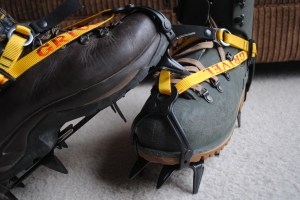
G-10 Crampons

Whatever crampons you choose, they should fit the boots you will wear on the mountain (Szalay 2010).

I took for granted how easy it was to go climbing with a guide in the Adirondacks that does all the outfitting for you.  I never had the complicated task of selecting the appropriate crampon for the trip.  Those guys just handed me everything! 

Then, before my trip to Alaska, I went to purchase my own pair — just in case.  Do you want rigid or flexible, straps or clips, horizontal or vertical teeth?  The options were overwhelming and the prices varied widely.  Because of the specialization, the choices can be overwhelming.  Let me try to get at some fundamentals of this gear to help you simplify your research. 

Purpose of Crampons

Crampons were the improvement upon the hobnail boot – which was literally nails placed in the boot’s sole for traction.  Oscar Eckenstein, a climber in the Scottish Highlands invented the 10-point crampon to give improved grip.  The French and the Germans embraced them in the Alps and adopted their own style of using them – the French flatfooted their way while the Germans tended to step in with their toes.  This was before front points, or “teeth,” so the proper technique needed to be practiced.  The whole point of crampons until the advent of front points and Yvon Chouinard was to improve a climbers grip on icy and snowy surfaces.  But when ice climbing was introduced, things got complex and the sport went in a new direction.  Waterfall ice and “mixed” routes became pursuits in their own right. 

While ice climbing crampons may be used for general mountaineering, and some of us have a tendency for overkill (for instance getting the all-wheel drive even when your car never leaves suburbia) they really are not necessary.  If you expect or want to be prepared for the sole 40-foot vertical ice cliff you encounter on an escape route from your intended route, your general mountaineering crampons can still do the job. 

Making Sense of the Choices

Figuring out which crampon suits you requires you to familiarize yourself with the gear and its functions.  REI’s website provides a helpful page on this by Nancy Prichard Bouchard.  Read it with an eye to what you will be doing in your crampons – not what you want to do.  There is way too much used and unused gear on Ebay for this reason!  Because of the specialization of crampons, you may need to buy the Grivel G-12s for your ascent up Algonquin Peak in January but then need something with more aggressive front points for the Ouray Ice Park in March. 

I used several pairs from Black Diamond from the Adirondack rental shop, and most of them were the step-in (with a clamp at the heel) type or a combination of using the step-in and straps.  Because I was mainly ice climbing, they all had front points and were made of steel, versus aluminum. 

Steel is preferred and stainless is the Cadillac of materials, however aluminum may be suitable for “light” mountaineering.  Aluminum, while less weight, it is not strong enough for unrelenting vertical routes when you’re standing on the teeth all the time. 

Practical Thought

The "tool box."

Whether you are considering strap or step-in models, bring your boots with you to make certain they work right together.  The crampon is an extension of the boot’s sole, and step-in crampons require the boot to have certain features to grip on and stay on.  If the crampon you prefer does not work with the boots you own, consider budgeting for new boots to go with your new spikes. 

Also, be sure to purchase a “tool box” or heavy-fabric cordura bag to fit just your crampons and maybe a few ice screws.  The bag will protect your luggage, favorite fleece and shell from being impaled by your new gear while on the airline to Alaska. 

Well, thanks again for visiting.  If you enjoyed this post, please consider following the Suburban Mountaineer on Facebook or on Twitter (@SuburbanMtnr).

Winter Fun: Pack Well to Prevent Calamity

Xcountry skiers

Winter is coming -- do you have what you need?

 The World Series starts next week and the hockey season is already here.  You know what that means for our favorite mountains?  Snow and ice! 

Taking the Ten Essentials is a start, but in general, winter calls for some other necessities too.  In addition to layers, such as a long base layer, fleece and shells, be sure you’re ready to traverse the terrain ahead and that you have key spare items. 

Below is a list of the key items and items to consider packing for a day-long journey, broken down through a winter hike, say in the valley, or some light mountaineering (non-vertical alpine) up a winter trail in the Adirondacks or some parts of the Cascades, for example. 

Winter Hike:

  • Sturdy boots (a full-grain leather boot should be worn with extra socks at a minimum, but insulated winter boots are preferred, and rigid-soled boots, such as mountaineering boots, may also be practical)
  • Gaiters
  • Long Underwear
  • Extra pair of gloves/mittens (it’s a terrible situation when one or both of your original pair are lost)
  • Extra hat with ear coverings
  • Extra flashlight (and keep the batteries insulated and warm)
  • Thermos
  • Pocket/toe warmers
  • Snowshoes or skis

Alpine Ascent:

In addition to the items on the Winter Hike list, take…

  • Insulated jacket
  • Insulated pants
  • Crampons (a pair of 10-point tie-in/strap-on crampons should suffice for bald summits and sloped ice; clip-in crampons for rigid mountaineering boots are better for encountering vertical ice.) 
  • General Mountaineering Ice Axe (choose an axe by the traditional method where by holding the head at your side, the spike should reach your ankle, though some today disagree with me.  See my article on this here.)
  • Ski goggles
  • Sleeping bag (this is for an emergency and may be worth packing!)
  • Altimeter

And as a refresher, these are the Ten Essentials that the Mountaineers organization out of Seattle recommend everyone bring, at a minimum, when they venture into the backcountry:

  1. Compass
  2. Extra Food (take more than the trip calls for)
  3. Fire Starter (such as a candle or magnesium block)
  4. First Aid Kit (with any necessary medication)
  5. Flashlight (with extra batteries)
  6. Jacket (keep out wind and precipitation)
  7. Knife (pocket knife usually does well enough)
  8. Map
  9. Matches (store in water tight container)
  10. Whistle 

And lastly, tell someone where you are going and when you intend to be back and stick to it by setting a turnaround time for yourself.  Also be sure that your friend or family member knows who to call if you are late.  We want you to come back in one piece and frostbite free! 

Well, thanks again for visiting.  If you enjoyed this post, please consider following the Suburban Mountaineer on Facebook or on Twitter (@SuburbanMtnr).
Seattle Times: Mountaineers Books Celebrates Golden Anniversary

Happy Friday and congratulations to the Mountaineers Books, the publishing arm of the Mountaineers in the Pacific Northwest.  It turns 50 this year!

This publisher is the best provider of english langauge print information on mountaineering knowledge and general outdoors skills.  This article in the Seattle Times reports on their celebration and that the organization is in good financial shape so it will continue to provide the information we need (and crave!) for some time to come.