That’s It… For Now

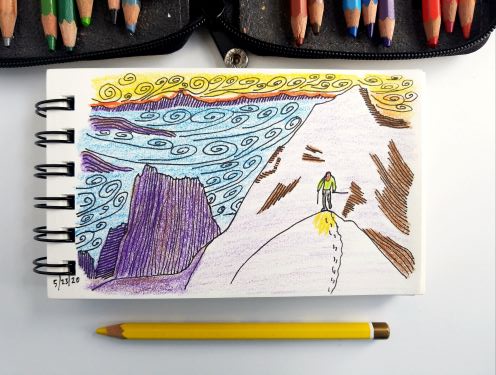
Dusk Descent, inspired by the cover of Alpinist 69 (All rights reserved)

After 15 years, this is my last entry here on The Suburban Mountaineer, and it’s official channels like the newer T.S.M. Newsletter.

In 2010, I did not intend to start reviewing so many mountain books and making book reviews the most common entry here. That just came naturally. At first people started sending me their books. Some of those submissions were bad, too. Somewhere then I realized I just wanted to do a reader response. I think the most fun was reflecting on passages in articles from Alpinist Magazine.

This blog has opened lot of opportunities. Its best output has been making friendships and acquaintances with Katie Ives, Bob Schelfhout-Aubertijn, Elizabeth McDonald, Dawn Hollis, Joanna Croston, David Smart, David Stevenson, among others. Well, we’ve talked more than shop, I have their email, and conversed multiple times initiated by me at times and sometimes they reached out. That has meant a lot to me. I am still in awe that I–an out-of-shape climber–have contributed to Alpinist Magazine multiple times and was included on the damn dust jacket of Hollis’ Mountains Before Mountaineering (2024). I am going to bore my grandchildren telling them about these accomplishments. They’ll say “so what, granddad,” or whatever kids will say in the future, but I won’t care.

Coincidentally, yesterday afternoon, I received the Black Diamond catalog for Winter 2025, which I only mention because it’s fun, but I also received the 2025 American Alpine Journal. In this AAJ, I finally have an entry. No, not a route, gosh darn it. (Wouldn’t that have been something?) I have contributed a book review, of course. You can find it starting on page 369.
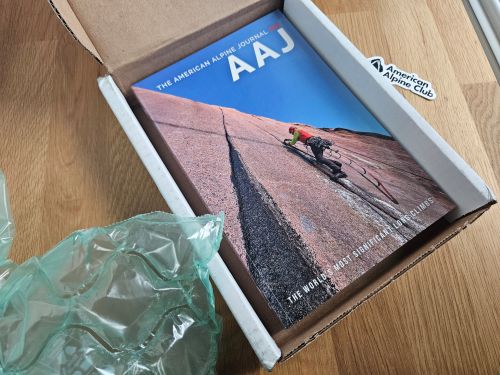
The 2025 AAJ in the shipping packaging with green bubble wrap to the left and the AAC sticker on the table to the right with the book in the middle of an aid climber on a big wall contrasting blue sky.
2025 American Alpine Journal.

So where does the list of climbing and mountaineering book classics that I have been developing and talking about all these years currently stand? Well, it’s practically done. I have the list. I know what the classics are. But I am not sharing it now. I’m personally satisfied with it (as of autumn 2025, I mean, things change, right?) If you recall, the impetus for that quest was that I wanted to know what were the limited titles that belonged on my small, limited bookshelf when Natalie and I owned a small condo in Alexandria, Virginia. I have the list, but not the time to write about it and give it the justice it deserves to be publicized. Walter Bonatti’s book is not on there, so please stop calling it a damn classic. It’s not. Into Thin Air, is that on there, you ask? Well… Maybe I will share one day. But not right now.

So what am I doing next? My kids have gotten older and they need me more and in different ways than when they would play on our wall-to-wall carpet of the living room, just glad I was in the room with them, and let me sit on the couch sipping coffee from my green mug and read Alpinist. Also, the nonprofit I run has grown and needs me at a greater capacity. Unfortunately, I rarely have a peaceful interlude between appointments where I can draft a blog post at a cafe, like I often did in the early years of writing here. Gosh, I really miss those days. (I loved the stops at Caribou Coffee in Washington, DC the most, when there was Caribou Coffee locations in DC.)

And staying fit is taking up more and more time. It’s harder to be even moderately thin and strong over 45. I might make it to my climbing gym more frequently, actually. That would be delightful, wouldn’t it? I’ll be happy to belay twice for you for one for me, too. I have a brand new BD harness and my friend Nathan still hasn’t asked me to give him back his Gri Gri, so I have that handy. Hit me up if you’re in Lancaster, Pennsylvania.

I hope to still contribute to Alpinist, the AAJ, and other publications from time to time, when I am invited or inspired. The Suburban Mountaineer on Facebook and my profile on BlueSky will still bring up mountain climbing book content from now and then; I’ll never get away from it. It’s wonderful and really consuming, isn’t it?

Thanks for reading. Sincerely: Thanks for reading my humble hobby blog. You really enhanced my life.

One last thing… Please don’t forget to subscribe to a climbing magazine and if you already do, please renew your subscription. It supports the climbing community and climbing writing in print. And print has way more magical powers than any social media post or stream, am I right? Go subscribe and be well.
The Demise of the Climbing Guidebook

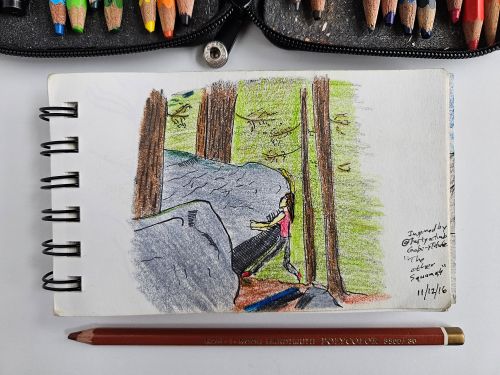
Wooded scene with large boulder a female in red top is climbing.
The Other Squamish (All rights reserved)

Earlier this month, Gavin Feek had an article on Outside, Inc’s Climbing dot com: “Can Climbing Guidebooks Survive the Digital Age–and Do They Need To?” It considered the threat crowdsourced online guides and the future of printed guidebooks through the example of KAYA owner David Gurman offering to buy the rights to the content of the Wind River Range guidebook from author David Lloyd.

Authoring a climbing guidebook is a special task. It’s not generally profitable. Takes years to gather the content. Lloyd said things that I have heard from other guidebook authors, particularly from the Adirondack and New England guidebook authors: The crowdsourcing of information, including on Mountain Project dot com, can be wrong. The work of some guidebook authors is also an act of service, which is a love language and thereby an act of love, to the community of climbers. Wiki-type guides are susceptible to poor fact checking, or a lack of fact checking, and don’t convey a broader history or embrace for the local area and its flora and fauna, like commentary of some guidebooks through the opining of the author.

I mostly climb in a gym these days, so I don’t use climbing beta apps, but I use apps for bicycling and hiking trails. I enjoy them for all the reasons Feek says: Fits in my pocket and it’s easy to find via the geolocation feature.

The dilemma of whether a climbing guidebook author should willingly sell the rights to their guide to a Wiki guide provider, like KAYA, is the authors alone, but I agree with Gurman that the print guidebook won’t go away.

Guidebooks have already noticeably changed from guidebooks before fifteen or so years ago, because of self-publishing service advances and the information online in Mountain Project and connecting with frequent climbers of a guidebook area that don’t reside at the epicenter. Falcon Guides should have been interviewed as part of this article, in my opinion. They have unified their model, published more local guidebooks, sometimes hyper-local guidebooks including for various audiences, and there are more color maps and photos than ever. Look at my review of this Adirondack region trail guide by Jonathan Zaharek. Even Wolverine Publishing has followed the same path. One of my favorite recent guidebooks is by Tim Kemple and is original home climbing region, New England Bouldering (2018). It’s just fun to page through and day dream.

When you go to a book shop, outfitter, or show up at your destination, there are often several guidebooks, and sometimes climbing guides. There always were guides available in the Adirondack and New England destinations I frequented since my youth and there still are to this day. I recently bought a copy of Jon Sykes Secrets of the Notch (2001) from Huntington Graphics about Franconia Notch in New Hampshire in a local cafe with some select local books including guidebooks. People like exploring and “briefing” themselves on an area from these books; the writer is their guide, regardless of the publishing method.

While I do not believe guidebooks at large are under threat as Feek’s article gives seed to, guidebooks are changing. They are increasingly like coffee table books. In a way they are technical coffee table books, that could fit in your backpack. But they’re also books I sit down with when I am looking for an escape. And the photos and highlight boxes of the newer guides are informative and, heck, entertaining.

But there is a difference in a self-published labor of love and when Falcon Guides or Wolverine Publishing comes to a knowledgeable climber in the region about writing one of their new books. Feek is telling a story about the heartache and the dilemma from Gurman’s offer. The guidebook business is much more, and a little more complicated than this example. Falcon has their books available as ebooks, but not on an app. Wolverine Publishing guidebook content is available via the Rakkup app. There is some synergy between the print guidebook and a digital

In the end, like a lot of things from Outside dot com’s products and headlines, there’s more too. Click bait, even. Guidebooks are here to stay, even as they face new challenges.

Thoughts on ‘Echoes’ by Nick Bullock

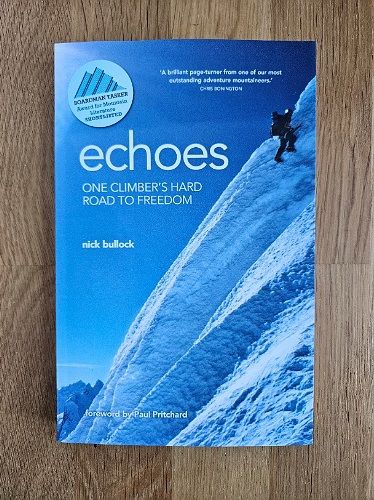
A portrait of the cover of Bullock's book 'Echoes' on a wood surface. The cover is blue showing a climber on a steep snow slope.
Echoes by Nick Bullock (2012)

For years I had wanted to read Nick Bullock’s first book, Echoes: One Climber’s Hard Road to Freedom published by Vertebrate Publishing in 2012. It was short listed for a Boardman Tasker Award for mountain literature. That might be why even used copies still went for upwards of $30US, which I kept waiting for it to drop below $15. It just did recently and I finally read it. I should have spent more sooner.

I think I first read Bullock’s voice in Alpinist 57. His article, “Threshold Shift,” is one of those pieces I remember almost by atmosphere. Reading it was had a hook on why I need climbing, hiking, and seeking wilderness. When I started reading Echoes, I was hoping for that tug and I wasn’t disappointed.

Bullock started climbing late, well after he started in Britain’s Prison Service. While I discovered rock climbing and later mountaineering through movies in the 1990s as a way of varying up the dullness of suburban living, Bullock latched onto it at a training camp for prison officers. It quickly consumed his life outside of the prison walls. The mountains became a place to grow, and redefine who he was.

(On one of the training trips in Scotland, Bullock and other prison officers went kayaking. He was frightened by the challenge and the quick thinking required. But he found the Type 2 fun in the midst of it when he capsized, because under the water he thought: “I also felt at peace, in a world away from violence and hate.” I shared this because feeling alive is often facing fear, because fearlessness is really just courage, and Bullock and I both seek the calm or Zen in the chaos. Do you do that, too?)

What makes Echoes a special book is how Bullock approaches his climbing autobiography. He’s not starting in the climbing action or isolating it to the expeditions. Rather, he’s taking us up from ground up and every nurturing and humbling step along the way. Bullock said on one podcast interview, though I forget which one, that writing is cathartic for him. I am sure, because he writes very personally. It’s not a climbing memoirs like Joe Simpson’s Touching the Void or even parts of Krakauer’s Into Thin Air. His prose can be terse, but he’s unrestrained and authentic.

The pace of the book is slower than nearly every other climbing book. But that’s part of it’s value. In fact, if a young person asks how they can progress to climb big objectives, I would direct them to this book. It’s not a manual but anecdote.

Finding the treasure of Echoes is in reading to the end and taking it wholly in. He asks what freedom costs, whether climbing itself can become another kind of prison, and what it means to take such risks repeatedly. His terseness comes through authentically, even if it’s not conveniently simple.

For readers of Alpinist who were moved by “Threshold Shift,” Echoes feels like the deeper well from which that essay was drawn. It is not an easy read—it is sometimes violent, often unsettling, and always honest. But it lingers in the mind long after the final page. I highly recommend you read it, if you haven’t already.

It’s Not a Classic: ‘The Mountains of My Life’ by Walter Bonatti

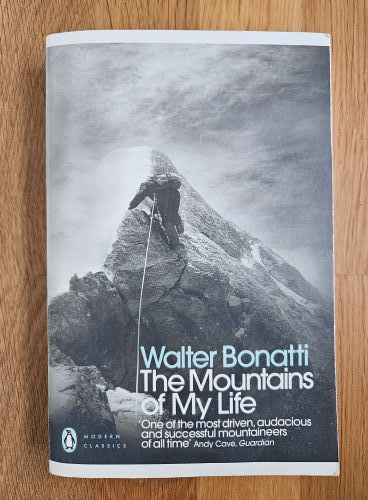
Walter Bonatti’s The Mountains of My Life (2001)

One of the most accomplished climbers in history was Walter Bonatti (1930-2011). Europe was in awe of him after the first ascent of Southwest Pillar of Petit Dru, alone. Even the French celebrated the Italian climbing prodigy.

However, after reading his memoir, The Mountains of My Life (2001), I have been questioning why I have held him with reverence. I once listed him as a top five climber in history. I am not ready to reevaluate that list, but this book and my thoughts about Bonatti have been making me reconsider my conclusion. His climbing talent may keep him there, but his book will not be on my list of climbing classics.

Bonatti wrote two books in his native Italian: Le Mie Montagne and I Giorni Grande. The Mountains of My Life is the English translation by Robert Marshall of portions from both books. There are earlier English translations are not trustworthy; Bonatti and Marshall corrected what were polar opposites of what Bonatti actually said.

The Mountains of My Life covers a lot of ground from his early climbing and his many adventures solo and on a team. He was part of the first ascent of Gasherbrum IV, which elevated his status further to be a legend. Bonatti was also at the center of the oxygen tank controversy during the first ascent of K2, and part of the drama on the Central Pillar of Freny, both of which are too lengthy to recap with any justice here.

I started reading it several years ago and stopped. Things were busy at work and life and I attributed my stopping to my personal distractions rather than listing it as DNF (did not finish) and I always intended to complete reading it. I started over from the beginning this spring and persevered, but I never said to myself or anyone else, “Let me finish just one more page,” whenever I was interrupted. It took me longer to read than most other books of similar length.

I checked the reviews and they were strong and heavily weighted to the four and five stars out of five. The written reviews expressed love for the details and his amazing accomplishments, and how unfairly he was treated over the K2 scandal. I didn’t feel the same way about either. The language was the language of a knowledgeable and skilled climber, describing the environment and the technical aspects, and I could detect passion, but there wasn’t a great deal or excitement or emotional connection.

The events on K2 have always left me a little puzzled. Bonatti often said he wasn’t sure why he was left stranded on the mountain overnight and after the expedition. I don’t know, but after reading his personal account, which was a little dry, I wonder if he neglected the competition among his teammates to be part of the historical first ascent, and he was more egotistical with a false sense of humility, that the rest of the team found inauthentic. Could his charm, which he was known for, and insistence of innocence, was a factor in the social dynamics that worked against him?

The current version in print is by Penguin and it’s under its “Modern Classics” line of reprints. That label probably helps sell copies, and draws people in by the allure of name of the author, an intriguing cover, and a reputable publisher classifying it a classic.

Not all climbing books that readers praise are well written. I am certainly guilty of this; I would celebrate the “significance” of the work rather than how it was crafted and told. And, of course, I have read other sports memoirs and biographies of athletes before my time where I desired to connect with the figure and those that remembered them fondly. Those biographies also were not always successful and I wonder if I would like this book more had I read the news stories of his exploits in real time. Unfortunately, the stories are there but it is a bland read.

The Mountains of My Life is not going to change you, even though you may love it, especially if you’re climbing-hungry, but it is not going to be on my list of classics.

Francis Sanzaro, Author of ‘Zen of Climbing,’ on Bouldering

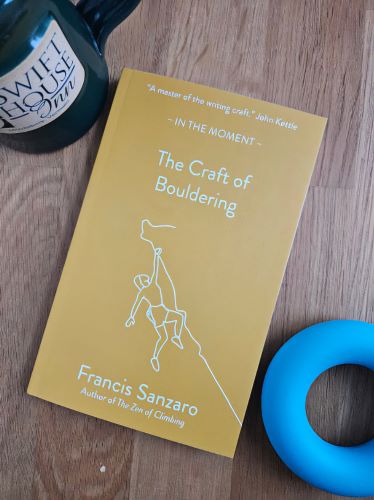
The cover of 'The Craft of Bouldering' by Francis Sanzaro with a coffee mug and blue grip training ring.
‘The Craft of Bouldering’ by Sanzaro (2013, 2024)

Do you know who Francis Sanzaro is? I think of him as a climber and climbing magazine editor, but I only recently learned that he is also an author. He has written several books. I heard him on the Climbing Beta and The Runout podcasts talking about his book The Zen of Climbing, published by Saraband in 2022. Then I learned something else about Sanzaro.

I thought The Zen of Climbing appeared to have the lasting qualities to be as influential as Arno Ilgner’s book The Rock Warriors Way. So, I went online to order a copy of Zen on Bookshop.org and found that Sanzaro had written several more books, all around philosophy, because, as I learned from his website, he has a doctorate in philosophy. Sanzaro writes, climbs, and considers our world philosophically. It wasn’t his education that surprised me, rather it was what his first love of climbing was and what his first book was all about.

The first book Sanzaro published in 2013 was titled The Boulder: A Philosophy for Bouldering. John Gill, the father of bouldering, or at least the guy that made bouldering a discipline, wrote a book its origin and history, called Bouldering & the Vertical Path in 2009. There is nothing like it on the market. There is nothing like Sanzaro’s book either. But it went the way of used books and neither title republished. Well, The Boulder went unpublished until it was grouped by Saraband with The Zen of Climbing and the The Zen of the Wild, and revised and renamed The Craft of Bouldering (2023).

The Craft of Bouldering is this form of climbing’s only piece of literature, in the grandest sense, even compared to John Gill’s Bouldering and the Vertical Path (2009). Sanzaro presents the unique place of bouldering as a subset of climbing and does so with a trained academic but also as a practitioner of the craft. Lots of sports and art forms have celebratory pieces archiving the way it’s done with excellence and milestones  as well as critiques. Bouldering’s bookshelf is short, especially after any guidebooks.

I love bouldering and have felt that it brings me unique joys. I don’t usually talk about bouldering, but reading Sanzaro’s book I realized that my feelings, approach, and interest were not weird or unique. I felt vindicated by many of his statements, such as “…every boulderer should have a problem that is a secret,” and that, “Bouldering is the art of contact.”

On rare occasions, I couldn’t always follow what he was saying. I could say the same thing about philosophy books I read for college classes, so it might just be me. Or, more precisely, I liked it, but wasn’t always sure that I understood it. I still ponder this one: “Joy must be the a priori condition of possibility in bouldering—joy that I produced by the body but in which the body captures from its movement.” It’s true, in my opinion.

Sanzaro even acknowledges that bouldering won’t matter one day; it’s young, and it didn’t matter over 100 years ago and likely won’t be a long-lived activity in the scope of human history, he predicts. Despite this or because of it, Sanzaro gives bouldering expression and a record beyond photos, videos, and guidebooks: An explanation of the craft. It’s a beautiful book and if you or someone you know is passionate about bouldering and being a boulderer, they really should read it.

Xenon Everest Climb Timeline and More Questions

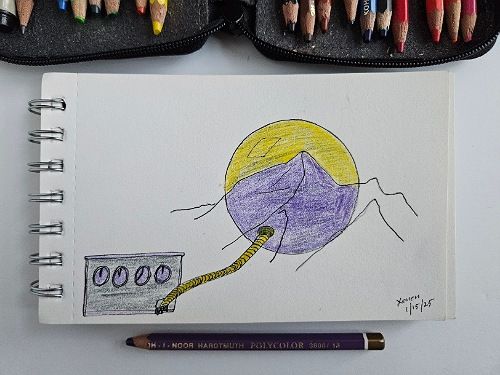
Xenon Ascent (All rights reserved)

Last Tuesday, May 20th, I checked on the news of the “xenon climbers” attempting to reach the top of Chomolungma and be back home in the UK within a week. They had just left London by plane the previous Friday and they were in Camp IV. Reports of heavy winds threatened the goal. As climber and author Mark Horrell commented:

Love ’em or hate’ em, 4 days from the UK to Camp 4 on Everest is definitely a first 😲–via BlueSky

That day I was thinking, Great, now they’ll get delayed and we’ll have to watch another London-to-Chomolungma-to-London attempt. But they pulled it off: Expedition organizer Lukas Furtenbach told the BBC, they summited “on the morning of the 21st, taking four days and approximately 18 hours.”

There have been at least two other claims to have done it faster or the same thing, but Furtenbach’s is the most credible to date. He announced it back in January, though some details were sparse. The others seem to be publicity chasers and copycats. But I could be wrong, we’ll see.

Only time will tell how significant and lasting this event will be, but it’s worth keeping in mind. This is different than a fastest known time of the typical sense. Beating the clock from base camp to the summit is akin to a track meet. If xenon has a benefit, and I don’t know if it does, then it could influence climbs, high altitude rescues.

WHAT WE’VE BEEN TOLD

I have several questions about all this xenon stuff, but first I wanted to put down some of the essential facts about the preparation and the ascent, including a timeline first. So here we go:

Furtenbach is an established commercial expedition guide service. He’s in Everest, Inc by Will Cockrell (2024) (my review of which will be in the 2025 AAJ.) He wasn’t the first to guide on Everest, of course, but he has been running a steady business. In January 2025, he announced that four climbers would climb Everest within a week using xenon gas. These are the four climbers:

  • Garth Miller
  • Alastair Carns
  • Anthony Stazicker
  • Kev Godlington

More recently we learned that the climbers would be highly fit and conditioned athletes, would be sleeping in hypoxic tents for two months, use supplemental oxygen on the climb, and be supported by a team of climbers that acclimatized the traditional way. This was the support team, and five of which, accompanied the four UK climbers to the top:

  • Pasang Tendi Sherpa, Guide
  • Pemba Rinji Sherpa
  • Nima Nuru Sherpa
  • Gelu Sherpa
  • Pemba Rickchhen Sherpa
  • Karma Sherpa
  • Mingma Chhiri Sherpa
  • Phu Dorji Sherpa

Photographer Sandro Gromen-Hayes, who did not undergo the special treatment, also accompanied the climbers and the support team.

Lastly, for two weeks prior to the attempt, the four climbers underwent a “xenon therapy,” breathing in the gas. The purpose of the gas, Furtenbach says, is to minimize the effects of altitude sickness in the rapid ascent. (Also see this from BBC.)

Here was the final timeline of the airport-to-summit-to-airport ascent:

  • Miller, Carns, Stazicker, and Godlington boarded a plane in London’s Heathrow airport bound for Everest on Friday, May 16, 2025.
  • Reached camp IV on Monday, May 19, 2025.
  • Summited at 7:15 a.m. Nepal time on Wednesday, May 21, 2025.
  • Returned to Heathrow Airport at 6:05 a.m. on May 23, 2025.

This amounts to an elapsed time of six days and 13 hours since departure, according to ExplorersWeb dot com.

OUTSTANDING QUESTIONS

First, I am glad nobody was hurt in this. I mean, I’m glad that it didn’t seem to be an outright stunt. It was more responsible than I feared when we heard Furtenbach’s announcement back in January. It also makes some sense to me that xenon was in addition to employing several other tactics, such as hypoxic tents and supplemental oxygen. So for some questions:

  • Could the ascent have been successful with their pre-acclimatization program, mainly with hypoxic tents and strong fitness regimen, without the xenon?
  • Supplemental oxygen is a well-established performance enhancer, but to what degree would this fend off altitude sickness?
  • Does the May ascent with xenon prove anything about xenon? I don’t think so, and I think we need more samples.

This “xenon climb” was a demonstration, but hardly a scientific exercise. I wish there was another team that would have done everything Miller, Carns, Stazicker, and Godlington did, minus the xenon therapy, to compare it to.

If we wanted to spend a longer duration at altitude, would xenon therapy help beyond this Everest smash-and-grab?

I don’t know the answers and won’t for a while, but this still has potential. Potential for what? I am not sure, because it could become another list of forgettable firsts.