Thoughts on ‘The White Spider’ by Heinrich Harrer

The White Spider by Harrer (1959, 1998)

Under ordinary circumstances, I would post a headline on this blog like this one: “‘The White Spider’ by Heinrich Harrer Reviewed.” That is if I were to review The White Spider, so many years after it’s initial publication. It’s popularity hasn’t waned. If I were to claim to review the work, it would be like having the gall to review Into Thin Air and accuse Jon Krakauer of deceit and lies 30 years later. Not that I am a Krakauer fan, but who in God’s world would do such a mean thing?

All I am doing, really, is sharing my notes and thoughts on the climbing books anyway, which is in itself a review. They all deserve some criticism, I’ve realized, not because I didn’t enjoy it, but because nothing is perfect and I want you to know when I praise something, I mean it. I am also trying to be authentic.

So, Andrew, if this book has been available in English since 1959, before you were born, why are you just now sharing your thoughts about it? Good question; there has been so many good summaries recounting the first attempts of the Eiger’s North Face, including the failures, success, and the tragedies, that I have felt like I didn’t need to. Alpinist’s Mountain Profile across Issues 40 and 41 in two parts covered everything from the pioneers to Clint Eastwood. I even bought a print of the dazzling route map from Alpinist 41. The mountain’s North Face, the Eigerwand, has captured the imagination of climbers and armchair mountaineers alike.

Hugh Merrick translated Harrer’s work from German, and it’s charming. Some people think Harrer’s/Merrick’s 1950s contemporary colloquialisms are corny or make it distasteful to read. That’s fair, and possibly true, but part of me wants to write so that the reader is waiting just to see how I say what they expect. Of course, Harrer was probably took the windy way to get to the summit, but that’s what I like about a good walk. It’s only because of the invention of clocks and family and work expecting me to be someplace by a certain time.

The book also spends only a little bit of time on the first direct line ascent of the Eiger’s North Face in 1938. Harrer spends more time on 1936 and the tragedy of Tony Kurz, plus the unfortunate events that left Claudio Corto to unjustly suffer with being a climbing group’s sole survivor. Why not focus on those other stories? There was a lot of existing historical coverage and whisperings about the attempts then. The 1938 ascent was the result or climax of the earlier failures that everyone were fascinated by. It’s as if the Dawn Wall had failures and deaths widely publicized for years prior to Tommy Caldwell finally finding the successful attempt all the way across the vertical line.

Harrer does something really well and, however, he also does something terrible. He retells the saga — and it was a saga — of the first and early ascents of the Norwand. He makes it suspenseful and makes us care about the historical climbers, many of which were his partners or contemporaries. On the other hand, he botches the story of Claudio Corto’s climb. Apparently, even after evidence contrary to Harrer’s accusations were discovered, Harrer refused to retract his statements or amend his record. It’s made his chronicle inaccurate and incomplete.

Can a book, with widely accepted flaws, remain a classic? Annapurna, Into Thin Air, and others remain influential, in-print, and widely referenced, too. Does a classic mean it has to remain authoritative? I don’t think so, because they are often still being read and worth reasons despite the shortcomings and flaws and, even then, they are part of what makes them worth reading for years to come. There is an argument to be made that the old fights packaged up in these volumes allows the reader to engage in time travel and spar with the matter regardless of when they found the squabble.

This book seems to be widely accepted as a classic “in the genre,” though it’s not always clear what genre they are referring to. Most of the time they are talking about other mountaineering books, so that’s the genre. Other times they lump it in the stories of the Poles and Shackleton’s Endurance, so it’s categorized with polar and cold-weather adventure. I think cases can be made here, but its not truly exploratory, like a Sven Hedin tale.

If you’ve read Barry Blanchard’s climbing autobiography The Calling: A Life Rocked by Mountains, and even if you haven’t, Barry gets started into climbing by taking a long cross country bus ride alone as a kid. An older girl noticed him alone and lent him a copy of Harrer’s book. Blanchard was impressionable, had the time, and Harrer had all the language and storytelling to be spellbinding, especially for a young man.

Blanchard didn’t stand a chance. And if it catches the reader at the right time in their life, they won’t either.

Well, thanks for dropping by. If you enjoyed this post, please sign up for my newsletter, which is the best way to get updates. And please tell a friend too; I am a humble hobbyist and don’t pay for advertising so organic search engine traffic and word-of-mouth referrals are all I’ve got. I just believe that climbing matters and you do too.
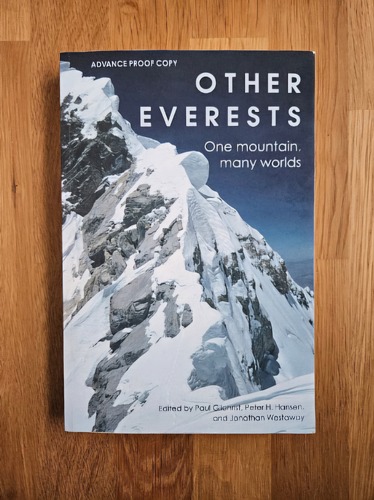
Chomolungma is Interesting Again in ‘Other Everests’

Other Everests edited by Gilchrest et al (2024)

For books about mountaineering on Everest, the predominant focus is on climbers telling their personal climbing stories, or a climber or historian looking back at previous climbs or eras and being nostalgic. If you read through Into Thin Air, High Adventure, Everest: The West Ridge, and, more recently, Everest, Inc. they all tell climbers stories and try to shed light on its unique and peculiar qualities. But three books have been published in 2024 that have taken a different approach, and one opens up the door to many other perspectives.

The first two books are Headstrap by Nandini Purandare and Deepa Balsavar and Alpine Rising by Bernadette McDonald. Both are award winning books, and they both focus on Sherpa and other indigenous climbers and their families and local communities in the Himalaya and Karakoram, which have been underrepresented in mountain literature. The third book is — which is the subject of my review — Other Everests: One Mountain, Many Worlds, edited by Paul Gilchrist, Peter Hansen and Jonathan Westaway is unique in the number of new perspectives the book provides. Although the promotions undersell its broad content by focusing around the trending topics of the indigenous climbers and the significant contributions of women, yet Other Everests covers many more Everest-adjacent issues, including climate change, industrialization, visitors to the region, and nationalism.

Many of the the contributors expressed that their articles are the result of looking at the materials the explorers and climbers, especially from the 19th and 20th Centuries, and looking beyond the photos, correspondence, and logistics records and into the “shadows” they created about the stories and world beyond the adventurers’ personal stories from a Western perspective. I am pleased to read Other Everests and find a story that gives me something new and much more than “man-against-mountain” stories, such as bringing Sherpa into the forefront and explaining to me why the name Chomolungma was unseen to Westerners for so long.

I was particularly intrigued by the new insight on Wanda Rutkiewicz’s success in the Himalayas. A lot of the discussion in other books spaces on gender and climbing have also been repetitive about women filling nontraditional roles. Agnieszka Irena Kaczmarek researched and contributed an article about Rutkiewicz and she explains a surprising nuance. Rutkiewicz was different than the other contemporary women that climbed; Kaczmarek pinpoints that it was more than her drive to climb or talent, but that Rutkiewicz adopted a more masculine identity to climb in the Himalaya, which is because the climbing culture the Westerners brought with them were all hyper-masculine. By joining in the bravado, Rutkiewicz gained access.

Prayer flags (All rights reserved)

For better or worse, it’s fundamentally an academic book. For the broader audience that the book has been promoted to, I would have preferred that editors would have right-leveled the language. I love learning new words, but some were used much in the way context clues, such as sopsistic, typonymical, ontologies, and terms like “porter remittance economy,” which seem to have a lot more meaning than just the three words. I found some points difficult to smoothly read without my hard-bound Collegiate Dictionary by my side. Even then, I think the contributing author had a lot of assumptions and meaning packed into their intended use of the word.

There were some illustrations or images in the book to demonstrate points and examples. I enjoyed the images in the book but wish they would have put them on a higher-quality paper in the middle of the book, or interspersed. I realize that paper and printing is more costly today, but the book would have been well served from some more dignified treatment than the images sometimes blurry printing on paper meant for a black type alone.

I will confess that I hoped Other Everests would renew my interest in contemporary climbing on Everest despite the large commercial expeditions and occasional stunts for publicity. Everest has its own subset of climbing news tallying the number of expeditions and reporting on summit attempts and the number of successful climbers. I’ve considered it all a waste and not truly mountaineering. If anything, the historical retrospectives and new perspectives have only reinforced that view. Of course, after reading Other Everests, I have new lenses to understand the background and context of many perspectives of the mountain and activities around it. I think they are best applied in looking back at the old stories I have known and read.

Well, thanks for dropping by. If you enjoyed this post, please sign up for my newsletter, which is the best way to get updates. And please tell a friend too; I am a humble hobbyist and don’t pay for advertising so organic search engine traffic and word-of-mouth referrals are all I’ve got. I just believe that climbing matters and you do too.
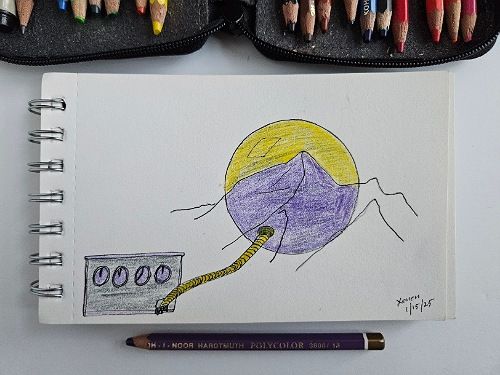
Xenon Gas for Everest: Annoyed and Fascinated

Xenon Ascent (All rights reserved)

As you have no doubt heard, Furtenbach Adventures is experimenting with using xenon gas treatments to shorten the time necessary for Everest guided clients to reach the summit in under a week. (Here is story that was in Financial Times, now on their website.) It would be rapid ascent without per-aclimatising on another high-altitude peak immediately beforehand: A true Everest smash and grab.

I am fascinated by this as much as I am annoyed.

Xenon gas when inhaled produces more red blood cells to carry more oxygen throughout the body. The World Anti-Doping Agency (WADA) prohibits noble gases argon and xenon because they give athletes an unfair advantage over their competitors.

(No one, so far, that I could find, has explained why Furtenbach chose xenon over argon. I presume athletes have used the substance to enhance their performance and maybe the confidential information from Furtenbach’s consultant might know about a safety or performance advantage over argon. I guess we’ll have to wait and see.)

Of course, climbing Everest is not competitive. Well, at least there are no judges or points or climber rankings. Except we all judge, even a little, when our values differ. And the style one approaches the mountain matters, and that climbers scrutinize. Did you have support, use supplemental oxygen, pre-aclimatise on another peak, pre-stock the route with cache, and what was your relationship with your sponsor that was making you carry a product or flag to the top?

I suspect the value underlying the Everest clients using xenon is that the summit matters ranks at the top of the list of priorities. Furtenbach Adventures promises xenon gas to be a shortcut to reaching the destination, skipping or altering the traditional journey. It’s valid for the many clients on Everest that read Into Thin Air and weren’t deterred from the mountain but saw it as a brochure and said, “I want to go to a deadly mountain, too, because I know I will be a survivor.”

I am annoyed at the use of xenon, because like my view of a lot of things in commercial guiding on Everest, because it disrupts my value of mountain. For me, climbing is a test of physical and mental preparation, skills and strategies, and an adventurous journey where the outcome and how it will play out is a mystery. Much of mountaineering is about learning a craft and mastering it.

I am fascinated because I am wondering whether this could actually be innovation that’s adopted for safety at altitude. We’ve ditched the idea of taking a mobile device with us into the backcountry; it was once thought of as a place to rough-it without contact. We’ve ditched pitons for clean climbing. Gear makes great improvements every decade. Our knowledge of fitness, and how to better prepare for the mountains, has improved tremendously over the last 15 years.

Although I don’t share an appreciation for the style of the Furtenbach Adventures clients, who are pioneering xenon gas on Everest, I am going to watch with curiosity. Waiting and seeing is probably the wisest strategy.

Well, thanks for dropping by. If you enjoyed this post, please sign up for my newsletter, which is the best way to get updates. And please tell a friend too; I am a humble hobbyist and don’t pay for advertising so organic search engine traffic and word-of-mouth referrals are all I’ve got. I just believe that climbing matters and you do too.

Skipping Passages and Your Climbing Style

I was reading a book and halfway through, I came to a passage I might have skipped and had bunch of things to nitpick. What’s a better way to ring in the New Year when you have a blog? Let’s go…

When you come to a passage, or even a chapter, in a book recapping the history of something you’re familiar, do you try to skim and skip over it? Usually, I do, so I can read faster. An example would be coming across the origin story of Rob Hall and Gary Ball of Adventure Consultants, and Ball’s tragic death. It’s in Jon Krakauer’s Into Thin Air and Ed Viesters’/David Roberts’ book (at least I am pretty sure it is,) No Shortcuts to the Top. It’s a mainstay of the genesis of commercial guiding on Mount Everest.

When I am reading a book to review, and it’s clear the author’s perspective is injecting the story with a new lens, rather than laying a foundation of background knowledge available elsewhere, I muddle through and try to grab the nuance. I am currently reading and reviewing Will Cockrell’s book Everest, Inc. (2024). Shy of midway through his book, Cockrell explains that climbers need to constantly add constraints to their climbs to keep it interesting, especially because it’s a game of firsts.

He’s right. Once the first ascent is done, he points out that climbers seek out the hardest line, or the winter ascent, or the first in a particular approach.

But I think he misses the notion of style, though he uses the word style in his brief example, we don’t use it in the same way. Cockrell substitutes it for approach, involving the expedition size, team, support, and tools, and sometimes the means or ethics. But style in climbing is all about the means and ethics foremost, and it dictates the route, tools, support, and other factors. News stories often talk about a news of a first ascent in terms of approach, or sound like they are talking about approach, but they are usually reporting on the information from the climbers and the style and values of those climbers placed on themselves. It was underlying the reporting or the Instagram post content.

Of course, not all climbers are style purists. I hear some interviews of climbers on podcasts while I am driving around Pennsylvania, and many were strong and free climbed routes, but that style wasn’t what drove them; they wanted to climb and that route inspired them and they were fortunate to free it. (Good job, you strong bastards.) And on purity, I am referring to a purist view of one’s own climbing. Applying one’s own values on other climbers wholesale is plain wrong. Judging whether a climber met his own self-described standard of style is different.

This also goes back to why climbing, fundamentally, is an experience done individually and shared through stories later. (Well, all outdoor climbing, these days. I guess that bears pointing out.) It’s all in our heads. Who you aspire to be as a climber is about our self image, dreams (if we let it,) and how we, well, would paint ourselves. The way we choose to climb, outside of competition climbs, perhaps, is art as much as the story we tell ourselves and our friends when we introduce ourselves to strangers.

But don’t get carried away with thinking you have to climb the hardest. I am over 45 and just want to climb for myself, belay my kids and my new climbing buddies. I don’t think our style has to be high caliber; I get great joy from my day-to-day adventure of working and being dad, and climbing is a the creme. Getting away from the office and my damn pocket device to do something physically harder than swinging a golf club, is my aim and maybe it will make me feel good because I impressed or inspired somebody, too. I am not in shape to do so yet, but I’ll get back to that.

Well, wow that it’s January 1, 2025, read fast, but carefully, and get outside and move all year. Heck, get outside every day rain or shine, even if you don’t climb. But whatever you do, be you and bring your style, and don’t be afraid to try to reach a little higher.

Well, thanks for dropping by. If you enjoyed this post, please sign up for my newsletter, which is the best way to get updates. And please tell a friend too; I am a humble hobbyist and don’t pay for advertising so organic search engine traffic and word-of-mouth referrals are all I’ve got. I just believe that climbing matters and you do too.

Book Orders and News About the Long-Short List

Advance Base Camp. (All rights reserved)

Yesterday, Natalie texted me while I was finishing my day at the office:

Do you need anything from Thriftbooks? I need another $9.50 for free shipping…

So I said I needed a copy of Herrar’s The White Spider. She replied she needed to spend $5 more; what else did I need? I looked at my list (the list) and typed back: “Minus 148° by Davidson.”

So Natalie got free shipping on me. And I suppose I got free shipping, too, on two titles I was going to buy regardless.

The list in question was the one I was updating earlier in the day during my lunchtime. It’s the Long-Short List I keep a link to on my Climbing Classics page.

I was finally making some dramatic changes to the Long-Short List of candidates for climbing classics after a prolonged holding pattern for a little over a year.

I pulled off all the books on Alaska and mountain-adjacent nature writing that I wanted to read for personal edification and added those to my growing personal list. I also removed some recent titles that I like but believe it’s too soon, for now, to call theme potential classics. In all, I moved 57 titles to other lists.

I left on three or four fiction titles, like The Ascent of Rum Doodle, though I am not sure that they will stay. Fiction is probably a separate category, but I don’t have a fiction list yet. And even then, I don’t think I will classify it as a list of classics of mountaineering fiction. It might just be the best of mountaineering fiction. I don’t know, we’ll see.

I currently have 47 books on the list. Well, that’s enough progress for now.

Have a Merry Christmas, happy holidays, a good rest of your week, and a great 2025.

Well, thanks for dropping by. If you enjoyed this post, please sign up for my newsletter, which is the best way to get updates. And please tell a friend too; I am a humble hobbyist and don’t pay for advertising so organic search engine traffic and word-of-mouth referrals are all I’ve got. I just believe that climbing matters and you do too.

Do Classics Have to be In Print?

Most of the narratives I own and some AAJs. (All rights reserved)

There is one organization, just one, that names a classic in outdoor literature. Among the Kendal, Banff, and others, only the National Outdoor Book Awards, or NOBA, has a category called “Outdoor Classic.” According to NOBA:

Books nominated for this award should be full length works related to outdoor adventure activities or nature and should be a work of unusual significance and lasting value in the outdoor field. The book must be in print.

Two criteria I share with them: First, by “significance,” my definition is that it’s unique in context but substantively relevant for the mountaineering genre. Second, by “lasting value,” I think it means that it would still convey meaning to the contemporary reader.

The last clause, “The book must be in print,” I literally just started mulling this idea loosely for about a year. When I saw it in the NOBA criteria I wondered if it was genius.

If the book is in print, that implies something about readers. They still want to read it, right? If the book isn’t in print or readily available, can it be a classic?

However, the decision to print the book is the decision of a publisher to reintroduce it. Paul Pritchard’s books, for instance, return to print and are sometimes printed by other printers. On this standard, some of David Roberts books are definitely classics.

However, there are books that are not still in print, that deserve, in my mind, consideration. Take the obvious one: Edward Whymper’s Scrambles Amongst the Alps. It’s available through on-demand printing because it’s in the public domain, but does that mean it’s in print? You won’t find it on a bookshop shelf.

I think there are other criteria, such as how long ago it was written, and other matters unique to climbing books, but whether it should be in print is intriguing me. I suspect that NOBA operates, like Boardman Tasker and Banff, around submissions of recently published books. Or in the case of the classic category, recently re-published books. Going back and looking back at each generation, like nominations to the Baseball Hall of Fame, is not what is going on here.

So what is the right approach? I’d love your input. Do you think a mountaineering or climbing classic needs to still be in print? Email me or message me on Facebook or Bluesky.

Well, thanks for dropping by. If you enjoyed this post, please sign up for my newsletter, which is the best way to get updates. And please tell a friend too; I am a humble hobbyist and don’t pay for advertising so organic search engine traffic and word-of-mouth referrals are all I’ve got. I just believe that climbing matters and you do too.