Are Climbing Gym Fees an Access Issue?

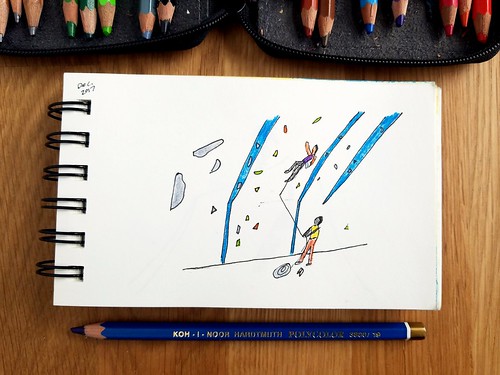
Pulling Plastic. (All rights reserved)

Like a lot of things from Outside, the headline is a little misleading and the article has a little unnecessary edge. And the following social media captions have claimed implied that gym access is the AAC’s top priority, and that elitist climbing gyms are turning climbing into golf clubs. Well, let’s sort this out. The AAC’s idea is a good idea. It’s a best practice I hope most if not all gyms adopt. But the headlines and arguments cast by MacIlwaine are a little out of proportion.

Climbing dot com of Outside Magazine published an article by Samantha MacIlwaine, Can Climbing Outrun Its Own Elitism with Inclusive Gym Pricing? The sub header reads: “Indoor climbing has gotten so expensive that the American Alpine Club officially considers it an ‘access issue.’ Is there anything we can do to stop climbing from becoming an elites-only pursuit like skiing or golf?”

MacIlwaine is responding to the AAC creation of a Pay What You Can Toolkit for climbing gyms to start their own “PWYC” program. It was shared in with AAC members in their “The Clubhouse” e-newsletter on or around July 23rd. I didn’t even read that newsletter until reading MacIlwaine’s article. If I had, I would have thought it was a nice idea, appreciated the AAC’s leadership, and moved on. But goodness has this generated a lot of discussion, and not all of it was accurate.

Our age of social media has also caused others to read the headlines in their feed and make it to be the biggest issue in climbing. Are you kidding me? Climate change and access to genuine public lands are still at the top, and should remain so. I initially re-tweeted a post on Twitter/X in solidarity for the angle of justice; I couldn’t afford the monthly dues, let alone the registration fee, when I lived in Alexandria, VA, and climbed occasionally via day passes. Here in Lancaster, PA I could afford to join my local gym for half the price and I showed up two-to-three times a week making it a bargain and I was stronger than ever. Then I thought about the differences in quality and experience, and deleted my re-post.

I think the data MacIlwaine shares about how little Americans spend on gym memberships and fitness is probably right. But I don’t think that it’s the right comparison. Climbing gyms are not fitness equipment gyms. They’re, and forgive me for this, more akin to tennis clubs. Tennis clubs are also sport-specific athletic and social clubs. They both have practices, matches, organized competitions, coaching, and sport-specific equipment. Some tennis clubs have PWYC programs, and many more do that don’t advertise them. Why? Having a dedicated players that grow are good for clubs, but they don’t talk about them because its political with its dues paying members. I have never heard of this at a ski resort or a golf club.

Then there are what parents spend on their kids sports. Have you looked into travel baseball or soccer teams? The costs of fees, uniforms, transportation, lodging, and coaching, all amount to big business for that investment companies are buying. It’s not a gym cost cited in the AAC toolkit or MacIlwaine’s article, but I think that it deserves some attention. My point is, there are households that value something more and are willing to spend more. Are there lower cost activities to get the same result; it comes down to getting scouted and supported by generosity, hence a PWYC model of a different sort.

The nuance here is that the AAC understands that gyms are how many climbers come to climbing in the first place. Gym-to-crag programs are essential today, and outdoor climbing stewards know that it’s key for safety and conservation. And the gym has effectively pushed the boundaries of climbing beyond the outfitter in mountain towns outward into nearly every community, regardless of the presence of mountains and crags. In my opinion, climbing at the gym is its own category of climbing and still, ultimately a simulation, but it has made some amazing performance gains for climbing the real thing.

I think the good people at the AAC could see the climbing gym world serving an increasingly affluent group, as is stereotypical image of skiing and golfing or even competitive tennis or swimming. I will say from experience, that the resistance to keeping prices elevated at indoor facilities will find support and an affordable option if there is advocacy and demand from a market. For an example from golf, Schnickelfritz competes in golf competitions but is one of the few that doesn’t belong to a golf or country club (which are different, by the way.) In fact, we have found ways to practice and save costs, and using similar PWYC or youth discount programs, like Youth of Course. It makes his rounds just $5.00.

The AAC has taken a policy and advocacy approach to support its members and it still comes higher than gym access. The institution focuses its advocacy on protecting public lands, ensuring lands are open to human-powered recreation, safeguarding fragile mountain and climbing environments, and combating climate change.

Of course, climbing is fundamentally and ultimately an outdoor activity. Climbing gyms may be the new gateway for new participants, but climbing will always be available to the climber. Pulling plastic, which I enjoy too, is a different activity and beneficial to outdoor climbing, but it’s not rock climbing. If gym access were to become inaccessible to a lower-income population, climbing gyms will change, but maybe the better climbers will be the adventurous ones outside at the crags and the mesmerizing big walls.

The AAC’s PWYC recommended best practice and toolkit is smart for inclusion, equity, and our climbing community. I support it. And it’s not the top new issue we need to spend all of our time focused on. Go climb, indoors or outside. And tell your gym about the toolkit, if they don’t have a PWYC program already.

Well, thanks for dropping by. If you enjoyed this post, please sign up for my newsletter, which is the best way to get updates. And please tell a friend too; I am a humble hobbyist and don’t pay for advertising so organic search engine traffic and word-of-mouth referrals are all I’ve got. I just believe that climbing matters and you do too.
New Adirondack Hiking Guide by Jonathan Zaharek

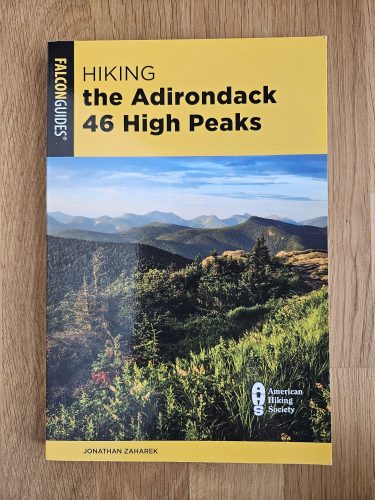
Hiking the Adirondack 46 High Peaks by Jonathan Zaharek (2024)

The Bible for hiking the trails of and around the Adirondack’s 46 “High Peaks” above 4,000 feet elevation was a volume of Adirondack Mountain Club’s own trail guides edited by Tony Goodwin. It was the kind of trail guide that was meant to be in your backpack: Sturdy binding, a map folded neatly in a pocket of the back cover, and thick but no room for photos, maps, or illustrations. It was purely prose meant to give you guidance, direction, and know what to expect from things like a stream crossing, where water near a camp site was located, and where things were steep enough that a ladder or cable was put in place.

Competing guidebooks were published by James Burnside (1996) and Lisa Ballard (2023). To me, those guides weren’t as sturdy or as official as the volume edited by Goodwin. But as time has passed, the ADK (the charming abbreviated moniker of the Club) High Peaks guide has not been updated and these books are available in the region’s bookstores. The latest guide seems to build on all of them and speeds up the education of the new Adirondack hiker.

Jonathan Zaharek’s new guidebook, published by Falcon Guides, Hiking the Adirondack 46 High Peaks was released in May 2024 and it speeds up the knowledge of the region including some local lore. And it’s beautiful for the photography and the sidebars about the peaks, trails, and intriguing trivia.

Zaharek was born in Ohio but grew up visiting the High Peaks regularly and, clearly, fell in love with the area. He made permanent move to Lake Placid, the largest town within the High Peaks (and where I would have probably moved if I hadn’t gone to Washington, DC — I know, seems a little silly in retrospect,) and became more intimate with the peaks and trail. He also covered every trail within the High Peaks — redlining the region — in both summer and winter. You might have seen Jonathan Zaharek’s contributions on YouTube.

I find going through Zaharek’s guide much more gratifying than re-paging through the Ole Goodwin guidebook. The maps, photos, and descriptions are there like a coffeetable book, without the pretense of trying to be a thing of art that you leave next to you sofa. This guidebook is one you might leave in the car, but it will ride with you at least to the trailhead.

I had to piece together some Adirondack lore from the guidebook, my uncle and hiking mentor, and picking up comments at the gear shop. Zaharek drops it all into his book. In sidebars about the multiple plane wreckages throughout the High Peaks to explaining the myth around the Trap Dike on Mount Colden. He includes guest essays and his own explanations. The High Peaks are a neighborhood an nearly a universe unto itself, and Zaharek knows this and immerses his readers in his adopted home.

On matter of editing and formatting made no sense to me. Early the book, the list of the 46 High Peaks — the Adirondack Mountains widely or traditionally accepted as being over 4,000 feet above sea level — could fit on one page or at least an open set of pages. Yet, they are not visible from the open book, and the reader is left flipping pages to see them at once… because you can’t. But, as always, Zaharak as writer and editor addresses the nuances of the various surveys and what compounds down to make the 46 High Peaks from various surveys.

Guidebooks unnecessarily carry a great deal of photos today, and this one does too. 208 photos, to be precise. This is a trademark of Falcon Guides’ newer guidebooks, and I wonder if they are more valuable for selling the book than using the book out of your backpack. I rarely complain about a map in a guidebook, even if I still need a full USGS topo, because the map is orienting. The images can be inspiring but on the trail become extra pages. (The publisher also says it has 249 illustrations, separate from photos and 41 maps. I am not sure what, having read through the book, the distinction from photo from illustration is. They seem to be either pictures or maps. Maybe you know and could email me?)

While a functional guidebook doesn’t require so many images, as someone that stomped those trails and knows the map extremely well, I love paging through Zaharek’s Hiking the Adirondack 46 High Peaks. It put the coffee-table book from my parent’s living room into a backpack-appropriate book, and gives me the sense of place that I want to share. Whether you’re planning the hike, or just need to daydream, I highly recommend this guidebook.

Well, thanks for dropping by. If you enjoyed this post, please sign up for my newsletter, which is the best way to get updates. And please tell a friend too; I am a humble hobbyist and don’t pay for advertising so organic search engine traffic and word-of-mouth referrals are all I’ve got. I just believe that climbing matters and you do too.

The Longest Climb by Paul Pritchard Reviewed

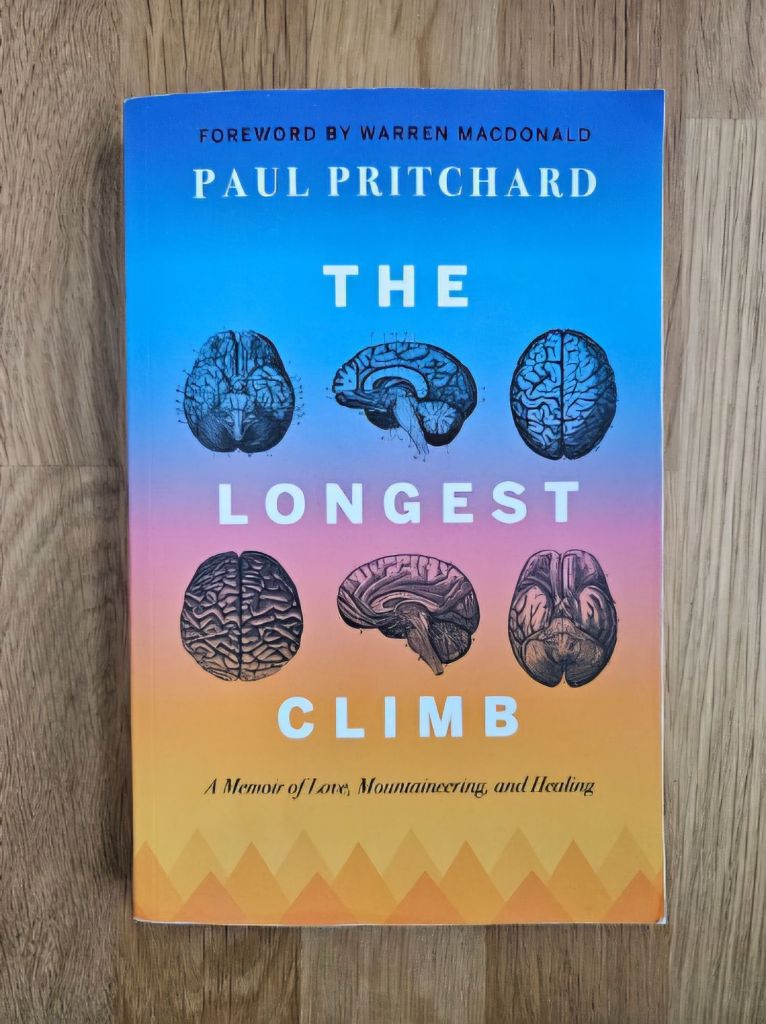
The Longest Climb by Paul Pritchard (2024, RMB)

Paul Pritchard is a climber, a diversity and inclusion educator, and an accomplished author. His first book, Deep Play, won the Boardman Tasker Prize for Mountain Literature in 1997 and his second, The Totem Pole, won the Boardman Tasker and the grand prize at the Banff Mountain Book Competition, held in conjunction with the famous film festival, in 1999. When his 2005 book, The Longest Climb, was republished here in North America this year, I immediately said I wanted to review it when asked.

The 2005 edition was published by Robinson with the subtitle Back from the Abyss. The 2024 edition from Rocky Mountain Books is A Memoir of Love, Mountaineering, and Healing. After reading it, and having gotten to know Pritchard through social media and direct messages, the newer subtitle is a more appropriate one for readers. The former subtitle is overly dramatic and less soft than the book actually comes across, though when he wrote it and when Robinson published it, the title had a shelf life of relevancy. Rocky Mountain Books’ change was smart and I am pleased with the Oxford comma (which, if my colleagues at work read this, will roll their eyes at me pointing that out. So there’s that.)

The Longest Climb: A Memoir of Love, Mountaineering, and Healing was Pritchard’s first book after his life-altering climbing accident on the Totem Pole in Tasmania in 1998. He incurred a traumatic head injury that left him paralyzed on his right side. He retells the story of coming home from rehab, discovering cycling, trying golf, diving, and pushing his limits on hiking up Jebel Toubkal and Kilimanjaro. During this journey, I am told that I am a TAB, which is a Temporarily Able Body, or said another way, a non-disabled human. I am given a new perspective on what prejudice toward disabilities means, and the urge inside many of us that keeps us going even when someone says it’s pointless because it is supposed to be impossible.

Before his injury, Pritchard was a well known climber embedded in the niche community. Despite earning his way in, like many climbers that aren’t pursuing the next route or summit, he didn’t feel like he was part of the community. Even when he want to the American Alpine Club dinner he was recognized more for his injury than his exploits. Later, as Pritchard grew in new skills and started plodding up Wales hills, he experienced resentment to the others around him going up too, also taking easier paths, including babies and the elderly. Hadn’t he earned more privilege. But a new sense was revealed to him that everyone belonged, and his heart grew for humanity.

Pritchard, as I learned in Deep Play, came from a tough upbringing and was quite rough himself. However, as he grew through climbing his heart increasingly opened up. After rehab, he learned that asking for help, often after he got himself into trouble from attempting to be independent, became a way to let go of his control freely and embrace the world through others. For Pritchard, not asking for help had kept him from community and left him unknowingly aloof. When he started asking for help, he didn’t feel alone and could express greater and greater amounts of gratitude and appreciation.

Making good decisions has always been a challenge for Pritchard. In Deep Play he took an unroped leap off his school stairs. In this book, he injured his elbow and it was at risk of infection, right before completing a life goal and swimming in the Great Barrier Reef. The doctor said do not swim, and he did anyway. The consequences took days to recover from, partly because he refused to pause life and address it. He gets extremely graphic, and my wife and kids would have ran out of the house as if their hair was on fire, had they read it too. I took pity on him through the ordeal and sympathized in some but not others. I love Paul, but he’s stubbornly foolish at times.

The Longest Climb culminates in two mountain climbs (significant journeys trekking and hiking) in Africa, and Pritchard does an excellent job of showing how he felt and his decisions along the way. On Jebel Toubkal, Pritchard falls ill and his partners continue up. Here was a longueur about the climb and his life since being injured and meeting his wife and caretaker, Jane, who was back home. He knows, like everything else in his life, his strength and patience are going to have to come from within.

Overall, I feel I grew from reading Pritchard’s story of recovery. I knew it previously, but not the immersive detail from this book. Through it all, I feel stronger. He quoted Helen Keller: “Life is either daring adventure or nothing.” He was emphatic through his actions and this book that the worst thing he could do was waste the rest of his life. His sense of insecurity generated a response that constantly pushed him to be more, and it taught him new lessons and perspectives, such as community from asking for help.

The Longest Climb was easier to read and follow than Deep Play. If you read my review of the latter, I said that the language was disjointed but surprisingly descriptive. This new book may have been edited more or differently to overcome that as a criticism.

The book made me feel uncomfortable many times, and even grossed out over his elbow injury before his dive. It was incredibly heartwarming and the new subtitle is true. I give the book a high score for the author and his story, but it’s not a climbing story. It’s a story of a climber’s recovery and life with a growing heart and overcoming uncertainty and insecurity. Reading it will change you, so be prepared.

For me, I now look at disabled acquaintances as people and am more cautious in how I can help them with dignity and respect. I also look at my time for myself, my wife, and my kids with a new sense of respect and willingness to say yes, let’s do that. I don’t know how complicated it will be should I not be physically able ever again.

Rating: 4/5

Is it a climbing classic? No. Primarily because it is not about climbing and climbing is not the central activity. Climbing made this book, like many great climbing stories, but it is foremost about recovery and resiliency of human spirit. These are important themes, but the story is not what I would seek for a climbing classic.

Well, thanks for dropping by. If you enjoyed this post, please sign up for my newsletter, which is the best way to get updates. And please tell a friend too; I am a humble hobbyist and don’t pay for advertising so organic search engine traffic and word-of-mouth referrals are all I’ve got. I just believe that climbing matters and you do too.
Writing is Not for Radio, and What I am Reading this Summer

Recording for the BBC from Peaklessburg.

Fiona Clampin, a producer in Scotland from BBC World Service emailed me about a program they were making about mountains. Dawn Hollis, my friend and the author of Mountains Before Mountaineering (which I wrote about previously,) recommended they interview me.

I don’t get the chance to chat about mountain literature very often. I write about it, comment on social media about it, respond to unsolicited emails, and journal about it, but I rarely get to have a conversation. In fact, as Natalie will tell you, I started this blog because I needed the outlet. Honestly, usually when tell people I read a lot of mountaineering books most people either don’t know what else to say or bring up a news story, usually about a mishap on Mount Everest, which isn’t in the same vein.

Dawn is being interviewed by BBC World Service along with other experts on humans and mountains. The producer wanted me to talk about the connection with mountains and mountain books. So Fiona and I spent some time over a virtual call planning a thirty minute interview, then, I visited recording studio to conduct the actual recorded interview.

Responding to Fiona’s basic questions designed for a wide, international, non-climbing audience was better than my own writing prompts. For example, I was asked, Are people mainly attracted to “disaster porn”? What a great starting point!

The answer is not really, but such titles like Jon Krakauer’s Into Thin Air are a common gateway to finding other mountaineering books. I liked putting things into perspective for her. I explained, verbally, how many people come to mountain literature through disaster stories.

It also made me wonder if I am too harsh on myself when I make lists of topics to blog about. I could probably use a little focus group to help me know what subjects are best to pursue.

I have to hand it to Stuart Rhodes, of Climbing on the Bookshelf, for starting a podcast. He gets to talk with his subjects, and I hope for his sake he can find the time to keep it up and make the time. It’s worthwhile.

On another topic, I just received the “package” of mountaineering articles submitted for the 2024 Banff Mountain Book Competition’s article category. I’ll be reading those as I finish Hiking Your Feelings by Sydney Williams, and turning in a late review of Paul Pritchard’s The Longest Climb. I should have a couple more too.

If you listen to BBC World Service, Dawn and her fellow panelists, with a snippet from me, will be on late in July.

Well, thanks for dropping by. If you enjoyed this post, please sign up for my newsletter, which is the best way to get updates. And please tell a friend too; I am a humble hobbyist and don’t pay for advertising so organic search engine traffic and word-of-mouth referrals are all I’ve got. I just believe that climbing matters and you do too.

Upending Our Relationship with Mountains

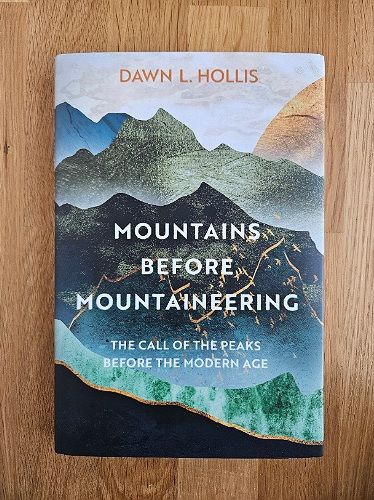
Mountains Before Mountains by Dawn Hollis (2024)

What makes a great climbing book? Well, my formula is still being considered, but in many instances in the books I and others enjoyed most they involve moments in between the climbing where the climber deals with self-doubt, and themselves in sections literary buffs know as longueurs. But there are always exceptions and reasons for greatness and significance can vary. This new book has no longueurs, and yet I am very excited about this book. Why? Because it changes our perception of humans and mountains for the better.

How can our perception of mountains get even better? Well, these days, I’m not sure; we love mountains today and recreate among them in all sorts of fun and exciting ways and styles. However, today we also believe that there was a time that mountains — before mountaineering, in fact — were unattractive wastelands to be avoided. Arguments in favor of this suggest that the Industrial Revolution prompted new wealth and the opportunity to explore, as well as a completely new way of thinking about them. Well, Dawn Hollis, a historian has effectively shattered that idea. It was only a myth. And that myth was deliberately created and perpetuated by many.

Dawn Hollis has written Mountains Before Mountaineering: The Call of the Peaks Before the Modern Age, released May 1, 2024 by The History Press out of Gloucestershire. It opens our minds, and changes the way we thought humans interacted with the mountains. Hollis stumbled onto this subject through her graduate studies. Her findings upset some members of the Alpine Club with her discovery. She talks about that, and shared some of her evidence and tales of resistance to it, in Alpinist Magazine (Issue 57 in March 2017).

Hollis might be the only mountain historian working on subjects before the 1800s, and I was fascinated by her work. I reached out to Dawn over social media soon after her article in Alpinist was published. After a few exchanges she sent me her graduate thesis. I believe she was trying to find a publisher back then, though academic responsibilities and family life were competing priorities. I printed the thesis, punched it for a binder and read it on my commutes on the Metro back and forth to downtown Washington, DC. Since then, I think I have read her work, in various forms three times since 2017, including her thesis and the book manuscript. Now, you have full access to the best of what she learned.

Hollis’ researched European’s relationship with mountains before the modern age, which she defines as before the early 1800s. She focuses on the European experience, because to Westerners like me, that’s where the myth that something in the modern age, after mountaineering, made everything related to mountains beautiful. She could have covered many other cultures’ views of mountains, but this is a European and Western issue that she is addressing.

Hollis makes her main point through the retelling of historical figure’s adventures and explorations, and does it in her own unique Dawn Hollis way. During her academic research she became quite familiar with historical characters, from Andrew “Sandy” Irvine to Tom Coryate. She thought of them as “friends,” though Dawn and her friends were separated by time, not space. She traversed a respectable amount of ground Irvine also walked. Hollis’ descriptions are both full of intimate and relevant details as well as the author-researcher’s own charm.

In a way, it’s Hollis’ friends that make us realize our assumption that mountains were undesirable previously, is not true. The evidence is actually overwhelming. From travelers, to artists, mountains were in-fact a draw. My favorite example, which left me dumbfounded, were the many paintings before the modern age of mountains, and the ones of Madonna and Christ with a mountain in the background. Those weren’t accidents and they were meant to be beautiful and symbolic of larger and higher things.

I also found her discussion of Thenvenot’s observations about mountain size to be much more like mine when I started hiking in the Adirondacks. To Thenvenot, mountains were about the rise and ascent, rather than the more-technical altitude of the summit. In fact, he valued mountain prominence, for that is what they knew. We may grow up in the Scottish Highland or the Adirondack High Peaks and consider them large locally, but such precision of elevation only comes in thanks to maps. But the human, basic, unexplored and un-measured perspective, is different. It is innocent adventure for the experience and self-discovery over the tick-list of elevation and high-points.

Hollis also investigated and discusses in her book whether the modern-age myth that she debunks was a deliberate act and even a conspiracy. Her central premise is not about a cover up, but rather an unveiling of the authentic evidence of how Europeans interacted with the mountain landscape and what they really thought about mountains and what mountains represented to them. As she explains, there were individuals and institutions, including the Alpine Club, that had things to gain.

Most of the mountaineering literature I read I can put on my bed stand and read in the evenings. For Mountains before Mountaineering, I think some of the historical details and explanations, even despite the new characters in mountain history Hollis introduces us to, make a good book to read for most people with a cup of coffee. It’s immensely readable, but not the adventure chapter book of most mountaineering stories for before bedtime. It is similar to format to Mark Synnott’s books, where he tells his story and integrates journalism. Hollis tells the story of her discoveries and integrates her research.

I’ll wrap up with the endorsement I sent to The History Press back in January:

From studying mountain stories for 25 years, I’ve learned that authors and mountaineers believe that they are the lucky ones. Ice axes and sticky rubber enabled them to climb. They also believed that those before them were blind to mountains’ beauty or incapable of fathoming their sublime. Even I accepted it as dogma. But Dawn L. Hollis’ thorough research strips the myth down to uncover our longer human respect, curiosity, and affection for the mountains that predates mountaineering. Hollis’ Mountains before Mountaineering challenges us to reconsider our human relationship with mountains and who we are as adventurers and people.

Well, thanks for dropping by. If you enjoyed this post, please sign up for my newsletter, which is the best way to get updates. And please tell a friend too; I am a humble hobbyist and don’t pay for advertising so organic search engine traffic and word-of-mouth referrals are all I’ve got. I just believe that climbing matters and you do too.

Is This All there Is? Climbing Magazines Currently in Print

Climbing periodicals. (All rights reserved.)

Updated 6/26/2025

As climbing has grown in popularity, the print magazines for climbing dwindled to a set that can pretty much be counted on one hand.

It’s kinda funny, isn’t it?

Look at this list of climbing magazines from 2013 from Weigh My Rack. Even when you take the non-English-language magazines away, that’s a dozen periodicals.

From that list, for me, I miss Urban Climber (I don’t think it was a redundant magazine), Climbing (preferred it in print and before Pocket Outdoor Media took over and put it under Outside Magazine and made it Climbing Online, so it was no longer Climbing Magazine, really), Rock & Ice (no thanks to Pocket Outdoor Media for simplifying the market, yet again), and Ascent. Ascent was a special annual periodical published by a few different magazines, most recently Outside in 2022, but I haven’t heard about it since. Have you?

I also lament these hard copies of magazines because I spend a lot of time on a device for work. And my work communications, calendar, to-do list, phone, notes, banking… everything is facilitated through my damn mobile device. (And I don’t think I am unusual in that regard, am I?) Hard copy has an advantage: Paper doesn’t pop up with a message from one of my kids or a teammate from work. It fosters focus on the article without distractions from other sources. By comparison, I feel like time can be eaten and wasted scrolling looking for news and content that interests me.

Here is all I could find from English language climbing periodicals that aren’t journals. Now, there are a few online magazines that I are worth mentioning, like UK Climbing and Common Climber, but these four are in print:

AlpinistThe award-winning long-form literature quarterly that focuses on alpinism, but excludes sport and competition climbing.

Climbing Zine — This is designed to be the refined messenger magazine, as the name suggests. It might be the most culturally authentic of the publications printing on paper today.

GrippedThe Canadian climbing magazine printing six-times annually and edited by climber and author David Smart. It has great reporting and connects you to the climbers, even if you live in the Toronto area, like David.

Climber — The UK’s in-print climbing magazine prints six times annually, and, like Gripped, covers the world of climbing news and technique.

Summit JournalAt least one title bounced back from the dead! The name and style is back, under the leadership of Michael Levy, and publishing two issues annually.

These five publications are those that haven’t or wouldn’t be sold, amalgamated, gutted, and shutdown. This all happened in 2022, principally to Climbing and Rock & Ice. The new owners didn’t want several publications and didn’t want them competing with each other once they owned them, and often decided that they didn’t care to invest in your market.

I get lean business decision making. I make cuts in my line of work. But I also am keenly aware of unserved and underserved markets. Well, maybe those are better suited for the smaller publishers of Alpinist, Gripped, The Climbing Zine, Gripped, and Summit Journal.

If you value these publications, bound with a spine and delivered to your mailbox — the one at the curb or in your lobby — then you should subscribe.

Well, thanks for dropping by. If you enjoyed this post, please sign up for my newsletter, which is the best way to get updates. And please tell a friend too; I am a humble hobbyist and don’t pay for advertising so organic search engine traffic and word-of-mouth referrals are all I’ve got. I just believe that climbing matters and you do too.