How to be in Two Places at Once

image

A couple of years ago Jason Stuckey shared with me his high-resolution photos from his first ascent with Clint Helander of Apocalypse Peak in Alaska’s Revelation Mountains. I recently stumbled upon them cleaning up some files. They’re dazzling. Dizzying.

I zoomed in on Clint. At first he appears as a mere stick figure on a steep snow field, but closer in I could see the contours of his helmet, and count the number of pickets and screws hanging on his harness. Then, I saw something I hadn’t noticed before: Clint was looking in the same direction Jason was, and I was, in taking in The Angel, another 9,000-foot tall mountain (9,260 to be precise) over the valley. He had made the second ascent a year earlier.

Looking at these photos from my laptop in my Washington, DC-area condo at 6:30 a.m., I feel a sharp, cold gust brushing my exposed skin, and a little where it isn’t. The clean, unfiltered sunlight is blindingly bright even though my lenses are dark, almost black. It’s a bluebird day, rays bouncing sharply off the snow. And I can imagine my calves stretching, getting oddly warm in an unwelcome way, as I’m standing on my front points.

Then I remember that I have to wake the kids in an hour, and I am supposed to cover a Congressional hearing on the Hill at 10:00. I must remember to wear a tie today. I need to be there to know what the tone of the meeting was and whether any promises were made so I can hold them accountable. If I don’t, no one else will. At least that’s what I strongly believe, even if it might not be entirely true, or necessary.

Damn it. I want to be here. Living with my family. Fighting for my cause. But I want to be in that photo too.

The Passionate Divide

Adam Campbell, an Arc’teryx ultra-marathoner, lawyer and reader, wrote an essay in the fall-winter issue of the brand’s Lithographica publication titled, “The Passionate Divide”.  Campbell loved three things: running, legal challenges, and reading. They are his passions and while he considers himself fortunate, as many people don’t have even one passion, he is simultaneously cursed by having more than one. His ambition made him want to do well at both. Except improving at one meant sacrificing time that could be used to improve on the other.

Campbell talks about the quest so many people talk about everywhere: elusive work-life balance. Natalie has learned, and sometimes reminds me that balance doesn’t mean 50-50; balance can be 70-30 if it makes sense and you accept it. She’s right. But I haven’t figured out what the right arrangement is either.

The conflicts Campbell faced broke up his marriage and ended his time at the law firm where he worked at the time. And he stopped racing. He worked to find his motivation again. Then he realized that the idea of balance is all wrong — which is more to Natalie’s point to me. Campbell wrote, “balance means that two things are in opposition with one another; they are counterweights with nothing in common.” But we both know that isn’t true. Campbell’s passions are part of his whole. My passions are part of me combined. As Campbell also wrote, “Integration was the path to less internal conflict… Be gone guilt.”

One Unresolved Matter

Is climbing still mainly an outdoor activity in the mountains? That’s the way I prefer it. But climbing is in just about every peakless metro area through gyms. Even when I go climbing these days, it’s mostly indoors. All that’s great except when it’s the outdoors that we crave. And this presents the issue that Campbell’s approach can’t resolve.

Campbell’s approach has shed a lot of light on my passions for being a stronger climber, better at my job, a better husband, a better father, a better fantasy baseball manager, and a better artist. I realized that I compartmentalize things too much. Which means I often played king of the mountain with my passions. Now I realize that it’s okay so long as I recognize that they are not competing against one another.

After contemplating this for a long time, I’ve realized that our self identity isn’t just made up of one thing, even if it’s one thing at a time. One word can’t describe most of us, whether it’s climber, friend, or guitarist. We’re the combination of many things. And though we may not be great at any of our roles, the sum total can be beautiful. In fact, for us flawed mortals, perhaps only through the whole can we be beautiful.

However, resolving the turmoil of the passions that I can enjoy in and around this city where I live is one thing. I even have to work at trying to be comfortable and embrace the urban lifestyle. (I think I am doing better than I was a few years ago.) It is the passion for a job in the city versus a more wild surrounding that I am still having trouble resolving. Resolving it for passions — which are, broadly speaking, hobbies — is a different matter than the environment.

Passion for Place

Looking again at Jason’s photographs, I sit quietly and feel the wind and absorb some of the sun’s rays. I imagine loosening the pic of an ice ax, being careful not to break it, and reaching higher to chip into a firm bite of ice.

But I’m not in Alaska. So maybe after the hearing, I’ll leave work early, get Natalie and the kids and go play by the river. That actually sounds pretty darn good too.

Thanks again for stopping by. If you enjoyed this post, please consider following The Suburban Mountaineer on Twitter and Facebook.
It is Down to K2, and Other News

26482605106_d2297ba3f7

Nanga Parbat Light. (All rights reserved)

I woke a short while ago and turned on my phone to read the news about the U.S. presidential debate held last night. Instead I was thrilled to hear this news:

At around 3:37 p.m. in the Karakorum, Alex Txikon, Ali Sadpara and Simone Moro radioed that they have made the first winter ascent of Nanga Parbat. According to sources reported through Raheel Adnan, of Altitude Pakistan, the day was beautiful without even a cloud.

The descent is underway right now. So while the first ascent has been made, the climb is only half done. Good luck on the descent!

So that leaves K2 as the only 8,000-meter peak left unclimbed in winter.

(I guess we know where Simone Moro and everyone else will be applying for permits next year.)

In other news, the American Alpine Club is holding it’s Annual Benefit Dinner this weekend right here in town (Washington, DC). It’s like a mini-conference. Tonight is a members only (free to attend) Climbers Gathering at a local indoor climbing gym (not my local one, unfortunately), where well-known climbers will speak and several awards will be given, including honoring Katie Ives for excellence in climbing literature. Tomorrow there will be panel.discussions, a silent auction, and the main event featuring Conrad Anker and Damien Gildea to celebrate the 50th anniversary of the 1966 American mountaineering expedition to Antarctica.

I can’t attend this year, but I am thrilled to be meeting up with a few of the attendees, mostly known for their writing. (I’m keeping these meetings all off-the record; sorry.)

Also, if you haven’t heard, this year’s Piolet d’Or will award present the lifetime achievement award in April to Voytek Kurtyka. His climbing accomplishments, such as his work on Gasherbrum IV, and other ascents and attempts, were spectacular, and deserving of the award. But he resonates with me, and other climbers, also because he has an almost mystic side and connection with nature (i.e it’s wild unpredictable side) that leaves himself open to the mountain.

This time, leading up to the award ceremony might be a good time take a closer look at him and the little bit of writing he’s contributed to see what’s there for us. More on that later.

Thanks again for stopping by. If you enjoyed this post, please consider following The Suburban Mountaineer on Twitter and Facebook.
Why We May Climb on Public Land is You

26312680282_626aab163c

The Creek. (All rights reserved)

The Bundy standoff in Burns, Oregon has lasted more than 40 days and the latest news says it may be coming to coming to a conclusion. It’s raised a lot of chatter about who controls the use of public lands. In fact, it’s inspired at least one of us: Over Facebook, Andrew Bisharat suggested learning from the Bundy clan’s effort and leading a crusade to take over the fish hatchery (which is actually on private land) so that we can climb the lower half of Rifle, CO, where it is currently prohibited. He was a joking.

At least I think he was joking.

There’s a lot of anger about government’s role today. It’s fueling the Bundy family and many like-minded ranchers. The anger, though over various topics, prompts many Presidential primary candidates’ supporters. Generally, the current system and values expressed by our laws and put into practice doesn’t work in their favor and they are frustrated.

When it comes to public lands, climbers are on the winning side these days. We can easily take for granted that we are allowed to climb most everywhere. Official land management plans allow for climbing in the most desirable locations. Bolting is permitted in the backcountry in some areas, within some guidelines. And, among climbers, most of us self-enforce good neighbor-policies through following Leave No Trace principals.

But there some real threats to that system. The balance could shift. And it might not be in your favor any longer.

Freedom to Climb at Risk

The freedom of climbing — whether that freedom is about movement over rock and hills or overcoming the idea that something seems impossible to climb — is about a specific approach freedom.

That application of freedom comes from how society values that kind of freedom. Most of us don’t think about it much, but we can climb in the Adirondacks, Yosemite, Red Rocks and everywhere in between because we’re allowed to. Every park has a management plan and that covers permissible and impermissible activities, from where you can make fires to fishing access, are covered and revised periodically.

However, who is making those land management plans would change if the public lands they address were owned by someone else, like the state or local governments. Members of the U.S. House of Representatives have bills to relinquish millions of acres of federally managed and protected land to states and local interests.

These are ongoing issues. And there have been ongoing issues like these that come and go onto our radar in climbing magazines and on social media. But these are real discussions that could shift who gets to graze their cattle where, how the ore beds are extracted, and where you can and cannot climb.

Speak Up

There are excellent advocates at the American Alpine Club and the Access Fund working to influence the outcome of discussions about the future of climbing in America. But they are empowered by you. Think about some other strong advocacy organizations:

  • NRA — It has a large membership that speaks up whenever their rights and freedoms feel threatened. And they contribute great deals of money.
  • AARP — This may be the largest national organization in size, and they are vocal on only two issues (Social Security and Medicare) for the most part, but it ensures the issues are protected and even considered sacred.
  • AIPAC — This group represents a small population of Americans, but it has an impressive infrastructure to mobilize advocates in nearly every Congressional district in the country with a reasonable amount of discipline.

All three of these examples have two things in common: They have dedicated members and they write and call their Members of Congress and other policymakers when summoned to do so.

So here is what you need to do:

  1. Join the AAC and the Access Fund, if you haven’t already. They are our watch dogs and our radar screen for threats to our way of life. And,
  2. Sign this petition from Protect Our Public Land, supported by the Outdoors Alliance, to go on the record that you support the protection of our public lands.

I believe compromise is always possible. While the lower-half of Rifle might be out of bounds, I think we can secure climbing and better land management for everyone. Hopefully will will do it without sacrificing what we hold dear and how we want to use the land.

Thanks again for stopping by. If you enjoyed this post, please consider following The Suburban Mountaineer on Twitter and Facebook.
Why Do We Climb Indoors?

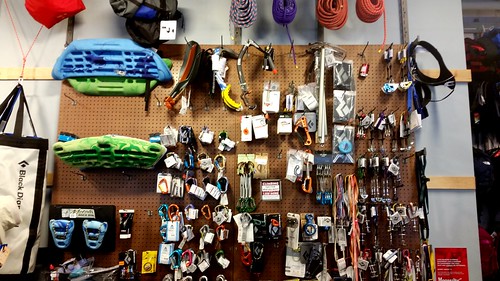
That’s a lot of climbing (and ice) gear for Kansas City!

I was waiting for the dentist and a headline on the cover of the October issue of Outside magazine caught my eye: “The Most Hated Men in Climbing.”

I don’t read Outside, mainly on principle. It’s headlines are made to make you pick it up and turn the pages, and I rarely feel edified for the content. When I finally found the article, which was under a completely different headline (damn it!), the most hated men turned out to be route setters at indoor gyms.

To a greater surprise, I kept reading. I’ve always climbed in gyms, but only recently embraced indoor climbing as a way for me to climb more regularly. Wait, no, accept it is a better word than embrace. I love mountains, not plastic. I get excited about snow and ice, sometimes big walls, but not warehouses separated from valleys and vistas. Still, I was getting into the article. What’s wrong with me?

Climbing Mystery

I just got back from a business trip to the greater Kansas City area in the American Midwest, which is one of those destinations that’s known for being flat. I met with a Kansas public official who has spent a lot of time in my home in the Washington, DC area and he said the biggest difference between there and Kansas was how we measure time: In Kansas they talk about miles driven, but in DC it’s about minutes spent in traffic jams. After covering 200-plus miles driving at mostly 70 mph in three days, I got it.

As with every trip, I try to squeeze in a little hiking or climbing, and these days all of the climbing is indoors. Still, I have found some interesting gyms. I liked the Great Western Power Company in Oakland, California. I was surprised that the greater Miami, Florida area had one well-kept gym let alone its two gyms. Kansas City has three. The greater Washington, DC area where I live has five. My hometown in Upstate New York only had one (albeit the Adirondacks and Gunks weren’t too far away either, so they probably weren’t needed).

I spent time in both the Kansas and Missouri side of Kansas City, but the Climbing Business Journal had an interesting story recently about how Kansas, which is one of America’s flattest states, has opened several indoor climbing gyms. This was a surprise to me; usually gyms open nearby traditional outdoor climbing destinations, so climbers can train regardless of the season or the weather. But the Midwest — America’s heartland — it seemed like a bit that there was something drawing people in that I didn’t understand.

Gritty and Underground

I stumbled upon a MooseJaw outfitter by happenstance after a meeting with the local Habitat for Humanity leaders, and saw a peg wall stocked high and wide with ‘biners, cams, slings and even a modest selection of ice tools. It turned out that the previous store manager was a native of Kansas City and he climbed ice. He recently took a promotion and moved to Chicago, but the gear was still prominently featured. It was then that I realized something about geography about Kansas City that I hadn’t thought about from living in Washington, DC — the Colorado Rockies weren’t really that far from Kansas City; less than nine hours away by car.

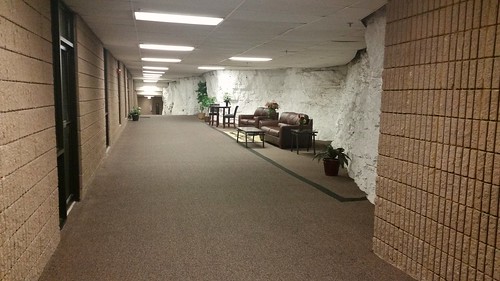
I didn’t have time to go to Colorado, so I asked about the local gyms. Ibex was the area’s full-service gym with long, high routes. The Cave, on the other hand, was a bit “gritty.” It’s what he said next that told me I had to check it out: “You have to take an elevator to get to it because it’s underground.”

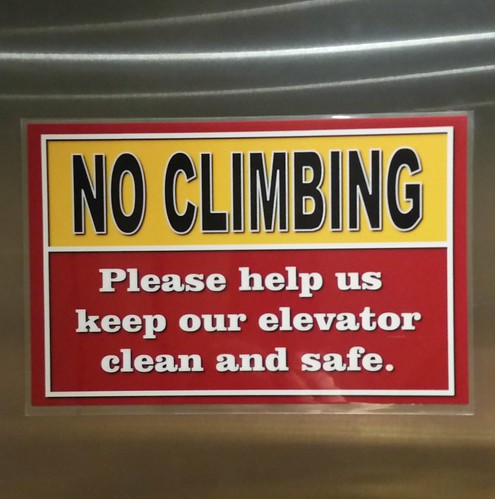
So I found directions to the The Cave. and the instructions on the website said, “Take the elevator down and follow the signs.” The elevator entrance stood alone in a parking lot and the inside had two signs. The first you couldn’t miss: “No Climbing: Please Help Us Keep Our Elevator Clean and Safe.” The other was smaller and said something urging riders to enjoy the ride down 10 stories underground.

After walking through a labyrinth of hallways, I was signing my waiver. I asked the guy, a 20-something running the place solo, what these tunnels were built for. He promptly replied, “It was a mine.” I said really? “Yeah, I mean it must be. What else could it be for?”

The facility, called Dean’s Downtown Underground, was actually built by Lester Dean, Sr. in 1954 with the help of a lot of surplus government explosives. He purchased land that had an incomplete railway tunnel that was started in 1873, drained it and got to work.

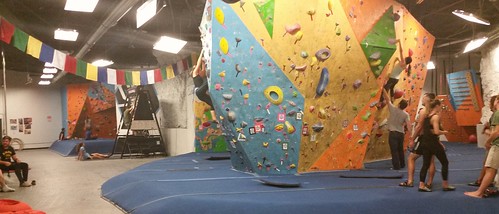
The gym had a plastic cave, 14-foot bouldering walls, a climbing treadmill, and a slackline setup. They used the standard V-scale but also had their own “VB” scale for beginners; I think it only went to VB2 before going to V0. I wasn’t too impressed by the 14-foot walls, though they managed to compress a lot of routes in a small space.

The cave was the gem. Well padded. Overhanging. And deep; it felt like the cave at it’s farthest point went about 15 feet in, which meant the wall was a ceiling.

The best part about The Cave was the other climbers. They were focused, knowledgeable, and very funny. I was about 15-years older than most of them and they even made me feel welcome and comfortable. But, then again, that was how I felt almost everywhere in Kansas City.

We Need Hobbies

Just before going to Kansas City, I took family my family apple picking near Shenandoah. Near Front Royal we passed the a warehouse that’s been there forever that has been the local Crossfit gym. It had a new banner this season: “Need a Hobby?” Maybe that was what was wrong with me.

I’ve read that climbing gyms are very popular among 20-somethings because of the appeal of the socialization. But I have recognized, that it’s a sport that encourages participation over excellence, even though excellence is a natural goal. It’s also an action sport that requires more socialization and more interaction and trust than say mountain biking or paddle sports.

The other thing is the nature of adventure. Yes, you can’t have adventure without the unknown, and the walls in a gym seem pretty obvious. But the unknown is personal performance, and trudging past your own fear. For me, it’s more adventure than I ever got playing soccer or basketball.

We need hobbies, and if that hobby offers some adventure… well, maybe that’s what gets us climbing indoors these days.

Thanks again for stopping by. If you enjoyed this post, please consider following The Suburban Mountaineer on Twitter and Facebook.
How Not to Share Your Climb or How to Be a Legend

26607269792_833972871a

The shriek that was turned to stone. (All rights reserved)

The golden issue of Alpinist (number 50), has several solid pieces but one article has been in my head for the past several weeks. David Pickford writes about what are we seeking as climbers in “The Heart of Nature.” He looks back not too long ago to how climbing was before we needed video and tweets to share what we did. He subtly (and not so subtly) attacks millennial climbers for their narcissism, but not before offering a way out:

Out there in cyberspace, there are tens of thousands of two-minute video-blogs of teenagers climbing hard problems to a tech-house soundtrack. The thing is, most of the “stories” just aren’t that interesting. But the tale of the unknown girl or guy who quietly solos a remote line miles from a road, leaving only fleeting trails of chalk on stone or axe and crampon marks on ice — now that’s an interesting story. This plot has all the key elements for a great narrative: mystery, uncertainty, enigma, suspense. But then, of course, it probably won’t get told. And maybe it’s better that way. Does the telling of a story dilute how true it is? Does it change what it means?

For those of us who’ve had a Facebook or Twitter account for several years there was a time when it was novel and we shared everything we did, from waiting in line at the cafe, getting a phone call from a sibling, to complaining about utility bills. Now the pendulum is shifting and we’re being encouraged to share less and just live — in the moment — more.

However, the temptation remains: It’s easy to record, proclaim and post publicly. It’s even satisfying in some ways, but there is something to be said about when you’re self-promoting and when someone else notices. Call it modesty, but doing something because you want to do it is important. To do it with commitment and excellence says even more. This is especially true when no one is looking and you’re not promoting it yourself.

Is Climbing Public or Private?

There was no where for me to share my climbing experiences when I was growing up in the 90s. And it never occurred to me. I didn’t talk about my… er, whatever it was I was doing. I called it rock climbing practice to myself. I didn’t know enough to call it bouldering. But I didn’t even want to talk about it. It was mysterious. It was something I was exploring, and it wasn’t the boulder.

I was 12 years old when I accidentally discovered bouldering. I truly didn’t know what I was doing. I didn’t know how to rock climb. I only saw Captain Kirk attempt to free climb El Capitan in Star Trek V: The Final Frontier. And Kirk fell. There were bigger cliffs than those boulders in my area of the ‘Dacks (much bigger), but these were right here and they felt like mine.

What was going on in my head made was what was important. I held on to the smallest nubs and pinched what was best described as mere texture. As I grew bolder, I went higher. Thoughts of “how do I get down” came in a rush near panic-mode. But through the veil of fear you realize that there is a peace if only you have the courage to open it like a curtain.

How do you share that? And in some ways, why would you want to?

Other climbers write about this in various ways. Even Reinold Messner often says the experience of the climb made him understand himself, though he never said what it was he saw and understood. (Knowing a little about Messner, he liked how ballsy he looked to himself in that situation. And heck, he was!)

None of this can be projected through a Tweet or a video.

What Are You Seeking?

I think some of us climb to validate ourselves. Or maybe encourage our self-being. Climbing certainly clears any fog in our head about what’s important to us.

But I recently discovered the joy of climbing in a large group or even among a crowd. There was definitely never crowd in the Adirondacks, which was perfect for an introvert-inclined person like me. Climbing at the indoor gym can be just as social as it is physically challenging. But the output is different than the goal and the overall experience compared to climbing at an outdoor crag or a backcountry route. Sharing it over social media is a different level than sharing it with your immediate company, or just basking in the moment itself.

A local publication around the south, including the Washington, DC region, Blue Ridge Outdoors, recently had an article by Jess Daddio called “Turn it Off: How Social Media is Changing The Way We Play, Or is It?” Daddio talks about going on an epic whitewater kayaking trip and forgetting his GoPro. The fundamental question Daddio ponders, was, if you kayaked it (or climbed it), and no one was there to see it, did it matter and who did it matter to?

What you seek out of the experience should be our guide. Sharing on social media has it’s place, but I think too often it distracts or overwhelms our ability to get at something more, like character development. If you’re seeking lasting accomplishment and respect, social media may not be necessary. Rather, be true to your real purpose. Seek excellence. Test your character. The cumulative effort of working on one’s own experience will yield far better results. It might even make you a mountain man or woman some else wants to share with others.

A little bit of mystery develops the legend.

Thanks again for stopping by. If you enjoyed this post, please consider following The Suburban Mountaineer on Twitter and Facebook.
Keeping the Mountain High Going

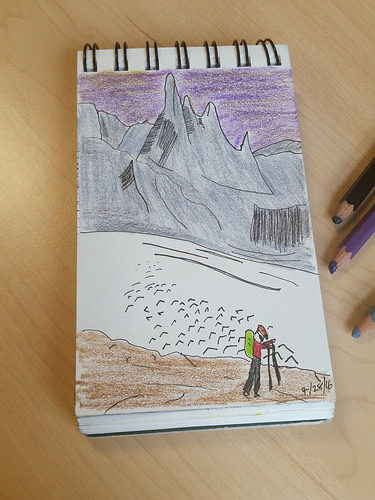
Reading Kelly Corde’s The Tower, and sometimes breaking to draw that spire.

I would like to live in a version of Chamonix. It would be a beautiful and green with the luxuries of society down in the valley, with a beautiful, high and jagged horizon underpinned by vast mountain slopes and teetering spires. I would work my own schedule, and hike, ski, or climb whenever the conditions and the mood suited me.

Or maybe I would just draw what I see.

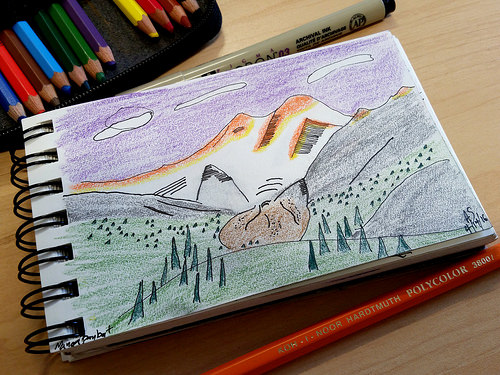
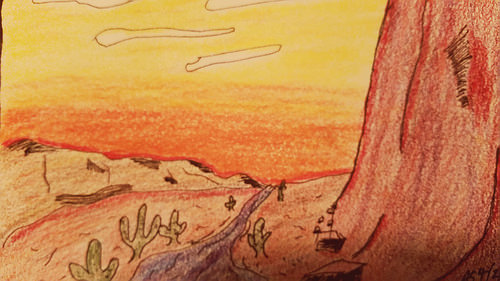
Drawing has once again become an outlet for me. I don’t draw what I see but what I wished I could see beyond a magazine photo. It’s been very satisfying in some ways, mainly because it’s relaxing and I like working towards a tangible product.

Twenty years ago I used to draw a lot more. I drew what I saw and what I imagined. I stopped because I got increasingly interested in sports and I didn’t like my high school art teacher. I never stopped because I didn’t enjoy it; now I wished I never stopped. My skills aren’t what they were, or they are inadequate for drawing peaks and shadowing icefalls.

Learning how to retrain my eye and my pencils to sketch a well-known mountain has been more difficult and frustrating that I thought it would be. This isn’t nearly the same thing as drawing spaceships and asteroids or great tall ships in the heat of battle. It’s more about lighting and shading.

I spent a lot of time looking for inspiration from other climbing artists. It seems like every climber worth following (be it on social media or tracking through the general climbing news) calls himself/herself a mountain photographer. Maybe the title is valid, but it seems that there are far fewer Jeremy Collins carrying lead pencils, or Renan Ozturks packing oversized brown paper rolls, paints and markers. Then again, even Ozturk has been taking more photographs and making more films recently. Coincidentally, Collins just came out with a new book: Drawn: The Art of Ascent.

Now, even with only a few role model for comparison, I feel very behind in my drawing skills. Of course, it doesn’t mean I don’t enjoy it.

If you’re like me — anchored to someplace with fewer features than what you need to be stimulated — then maybe some art focused on the higher ground you seek is part of the answer.

I’ll update you on my doodles later. (Maybe I’ll even gather the courage to share some more.) And I’ll be back in a little bit with some more of my discoveries about mountaineering history and adventure too.

Thanks again for stopping by. If you enjoyed this post, please consider following The Suburban Mountaineer on Twitter and Facebook.