Mountain Books Authors and Publishers

The Banff Mountain Film and Book Festival is underway! But unfortunately I’m not reporting from there. Instead I am in flat and un-glamorous Peaklessburg. That doesn’t stop me from getting in on the mountain book action though.

First off, I’m excited that the Banff Mountain Book Competition will be giving the grand prize to Bernadette McDonald for her book Freedom Climbers (Rocky Mountain Books, Canada , 2011.) McDonald will receive the $2,000 CA grand prize and read from her work at the presentation on Thursday evening. This is great — if for no other reason than because it celebrates the hardiness of mountaineering in the Polish tradition. As an American that had the Walia Christmas Eve traditions as an anchor to my Polish heritage, and something in common with all Catholic Poles, I’m always interested and take pride in what the Poles do in the hills anywhere. Plus, the stories of the Poles in the Himalayas always make those Polish jokes from when I was a school kid seem laughably naive. I have not read McDonald’s work yet, but I have to now!

Next off, there were a lot of other books nominated in this competition and only a handful became finalists. Even fewer, I’m sure, have you heard about. But if you enjoy this blog and mountaineering literature, you would probably enjoy many of them.

As you know, I am very supportive of mountain nonfiction, particularly stories of accomplishments in climbing, mountaineering history and climbing and hiking guidebooks. I also believe the authors need our support by buying the books new, reviewing them and recommending them whenever possible. This genre is a small corner among sports, travel and cultural writings. The authors rely on us as a loyal audience so they can climb and write again.

This is the idea behind the program
Suburban Mountaineers for Authors
. What I’ll be doing for the next several months is promoting some less popular but no less valuable mountain nonfiction. To start out, I’ll be going through some of works from the larger publishing houses’ books and feature their authors.

After we go through some of the select works from possibly The Mountaineers Books, Sharp End Publishing and others, we’ll turn exclusively to individual works, regardless of publisher. If you want to contribute a review, I would love to post your work as a guest on The Suburban Mountaineer!

Thanks for coming by again. If you enjoyed this post, please consider following the Suburban Mountaineer on Facebook or Twitter. Happy reading and carpe climb ’em!
What is Alpine Style?

26431015192_e9b6f75b6a

Alpine Style. (All rights reserved)

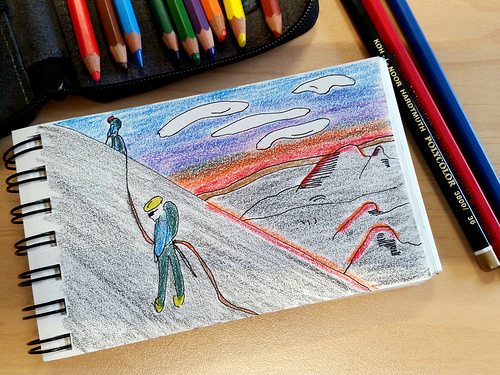
Alpine style is often mentioned and talked about in mountain climbing literature and guidebooks but it’s not always defined or understood by everyone except by alpinists and well-read armchair mountaineers. Let me try to explain it.

First off, it’s not about fashion. What you wear visiting Switzerland or Austria doesn’t get at the mountaineering matters that this blog discusses and certainly isn’t part of a mountaineer’s approach to alpine climbing.

Second, it’s important to recognize that there are a lot of different kinds of mountain climbing from various types of rock climbing to numerous types on routes covered in wintry conditions. Then there are subcategories for each based on the mountaineer’s style and approach to climbing the route. For example, with rock climbing some prefer sport climbing with pre-placed anchors while others prefer traditional or “trad” climbing where self-placed protection is set.

For big mountains and long routes, some climbers use a siege approach where camps are established and supplies are ferried and stashed along the way in caches. The route is connected by fixed ropes where climbing teams can ascend and descend as necessary to move a strong team on the summit. This method is often considered to be a conservative approach but is resource and time intensive. It can be applied to rock, wintry and mixed routes.

Alpine style climbing is contrasted to siege style ascents. The term originates from Europe’s Alps where the mountaineers of the 1800s ascended classic routes with the pack on their back, used one tent and moved camp as they went up and down the mountain. Today, some climbs are still considered alpine style in limited exceptions where alpinists use caches, fixed ropes in limited situations — such as around a bergschrund (where a glacier is separated from a mountain, often leaving a gap) — or acclimatizing high on another route on the same mountain. Climber and mountaineering historian Jonathan Waterman makes some of these limited exceptions in his reviews.

In it’s purest form, alpine style climbing is full of no-going-back commitments. This means climbing to the top, often with minimal gear, food and fuel, crossing thresholds, like severe overhangs where abseils are impossible, and sometimes sacrificing comfort, warmth, sleep and nourishment to obtain the objective. Walter Bonatti, Reinhold Messner and Steve House have all made such commitments on some of their most notable climbs. Climbers like House have even taken it to another level that some observers refer to as “fast and light” climbing.

I hope that helps explain it.

Thanks again for stopping by. If you enjoyed this post, please consider following The Suburban Mountaineer on Twitter and Facebook.

Trying on Some Rock Climbing Shoes

I just dropped by one of my local outfitters to try on some rock climbing shoes, with a lot of research and advice from friends and readers like you.

Keep in mind, I don’t climb these days and see that improving only marginally. The whole reason I’m shopping for them is so later I can have the pair of old, broken-in pair dad ought to have when he brings his child to the gym or crag when they older and so I don’t have to keep using rentals. After all, I write a climbing blog… It seems that I’m supposed to own a pair!

So I tried on and compared three all within an amazing 15 minutes. It was that short because I dropped into the shop on a whim while passing the store en route to more important errands, so my observations might have been rushed, but as a trial run to test out some rock climbing shoes it was a well used 15 minutes!

I tried on what they had available in my price range — under $100 US. The Mad Rock Phoenix is probably the most affordable shoe at this shop for men so I tried them on first. Mad Rock wearers either love them or hate them. They fit well. Plenty of room and could tighten them as needed by adjusting the laces.

I liked the Scarpa Thunder lace up the most. It fit my foot well and my toes had room, but I can’t decide if they were too snug in the toe box — I touched the end with a slight curl. Wasn’t intolerable. They certainly felt like a higher quality shoe compared to the Phoenix!

The La Sportiva Mythos was above my limit, so I tried on the Nago with the silver strip instead. That strip looks funny. A friend recommended these to me, so I’m glad they work for him. They were similar to the Thunders in fit.

Unfortunately they didn’t have anything else close to my size in the Five Ten Coyote and they only carried the lace-up model. They also did not carry the Evolv Defy… both of which I was hoping to don.

I tested each of them as best I could by taking a few short steps in them and also standing on the benches’ edge with my toes and insides of my foot. I don’t think that gave me any real solid observations, or at least nothing glaringly problematic came from trying these things.

I then tried them all on for a second time to compare them better and I made some judgments. First off, I preferred the Scarpa Thunders. They were clearly my favorite in this group. But I couldn’t decided whether I wanted a bigger size and I was wearing the largest in stock. I like my toes well surrounded by the shoe, but even that is left to interpretation. The Mad Rock Phoenix suddenly felt not only lesser quality to the Thunders, but also sloppier — at least in that they had more room for my foot to slide around in, even when I tried on a smaller size. The Nago… er… I still think they look funny to me so I’ll evaluate them again later if necessary.

Thanks for stopping off again. If you enjoyed this post, please consider following the Suburban Mountaineer on Facebook or Twitter. Happy reading and carpe climb ’em!

If you’re looking for a new pair of rock climbing shoes and want to check back on my experience, read my last post on this subject by clicking here.

Banff: Mountain Celebration and Books

The mountain festival scene could be a little suspect. Like ski resorts, they are hardly wilderness experiences — the very thing that most of us are seeking in the mountains. But one festival in particular has always taken a serious, respectful look at the mountain life and culture and celebrates it through much more than just film, making it worth our attention in terms of how we look at mountain wilderness.

At the Banff Mountain Film and Book Festival held in Banff, Alberta, everyone knows of the film competition. After the awards are distributed, the festival tours throughout North America. However, the festival is much more than just the movies. It also includes mountain arts and crafts, gear trade show, photography exhibits and competition, presentations by the climbers and artists, and — my favorite part — the Banff Mountain Book Competition.

For the English speaking and reading world in mountaineering, there is nothing equivalent to the exclusive honor brought by The Banff Mountain Book Competition, which has been building a solid reputation over the last 18 years.

Nominations for the competition are collected early in the year in several categories: 1) Adventur Travel; 2) Guidebooks; 3) Mountain and Wilderness Literature; 4) Mountain Image; and 5) Mountaineering History. The awards are not enormous sums. They are rather modest in value: $2,000 CA for the Grand Prize and $1,000 CA for most other categories. Receiving the award is more about the title, dignity and respect, especially coming from these judges.

Three judges will decide on who wins best book in each category as well as the Grand Prize, sponsored by the Alpine Club of Canada. This year, the judges will be Katie Ives, the accomplished American mountain writer and editor of Alpinist magazine, Baiba Marrow, Canadian world mountain traveler and story teller, and David Pickford, who is from the United Kingdom and is a climber and editor-in-chief of Climb magazine.

The festival is hosted annually by the Banff Centre and begins this year on Saturday, October 29th and runs through Sunday, November 6th. The book competition winners will be awarded at an event on Thursday, November 3rd. Click here to see the finalists.

Thanks again from dropping by. If you enjoyed this post, please consider following The Suburban Mountaineer on Facebook or Twitter. Happy reading and carpe climb ’em!

Troubles Finding the Right Rock Shoe

If you’ve been keeping up with my recent posts, you know I’m on a quest to find a new pair of rock climbing shoes. I’ve received some helpful advice from a variety of sources. Thanks in particular to some of my subscribers and Twitter followers!

My quest was recently likened to a mid-life crisis. I got a chuckle out of that. I’m hardly mid-life. But given a choice between a shiny new sports car and a shiny new rack, I’ll take the rack.

The reason it was likened to a mid-life crisis was that part of the reason I want rock climbing shoes is so when Wunderkind is older and we go to the local climbing gym or crag for some instruction, I’ll have my own broken-in, smelly, old model pair of shoes that someone that used to climb more often would have; the kind dad ought to have.

So, I need to gear-up. I’ve read confusing advice for fittings though and I’m not sure what applies to me. Some recommend that beginners find a flat shoe (meaning no downward curve to the shoe’s last) that is comfortable for your toes in the “toe box.” Others recommend that experienced climbers should get it a size or two too small where your toes form a fist, especially if they are made of leather so when they stretch they still are adequately snug. Being tight helps climbers keep contact, especially with tight holds. So which category I fit into I’m not sure. I’ve never been particularly skilled or advanced when I used to climb (I think 5.7, though I really don’t know.) When I used to wear my rentals, I always took a size that firmly held my foot and put the front of my toes touching the front of the shoe without having to curl them… Is that a bad idea? It’s always worked for me before.

Perhaps the biggest challenge is that while I want to have a shoe that Climbing magazine declared was an Editor’s Choice product, or something similarly recommended, I need a shoe that has good, sticky rubber and fits me. My toes always fit into Scarpas, but what about Five Tens, La Sportivas, Mammuts, Boreals and Mad Rocks? The challenge is compounded by the three local outfitters in my area (I know, I’m spoiled that way), because they only carry about six men’s shoes. And if I prefer the Velcro straps they might only carry the lace up model, for instance.

I’m going to continue my research and let you know what I find. I’m hearing good things about the Five Ten Coyote, Evolv Defy and La Sportiva Mythos… We’ll see.

Leave me a comment or shoot me an email if you have any feedback or suggestions. If you enjoyed this post, please consider following the Suburban Mountaineer onFacebook or Twitter. Happy reading and carpe climb ’em!

Also, you can catch up on my quest for new rock climbing shoes here by reading my last post on this topic: Rock Climbing in Peaklessburg.

American Alpine Club Reverses Decision on Journal Availability

I’m absolutely thrilled that the American Alpine Club (AAC) has reversed its decision and is making the American Alpine Journal (AAJ) publicly available as it has been in the past.

Every summer, members of the AAC receive their copy of the AAJ and a copy of the Accidents in North American Mountaineering. This year, the accompanying letter said that AAJs would not be available for purchase by non-members.

In the past — before I was a member — I always enjoyed finding a copy of the yearbook of climbing in Barnes and Noble stores. It had a scholarly tone and took the accomplishments and attempts in its pages very seriously. It gave the sport of mountaineering an extra hand in being dignified. It also helps promote the pursuit of summits, new routes and mountain exploration as something mankind needed to maintain a record of. It says what we do is important.

When I received the 2011 AAJ and the letter, I was surprised and taken aback by the decision. I was also in the midst of a busy time at work and a number of exciting changes at home, otherwise I would have voiced my disagreement. Of course, I received my copy, so I could also say I was less concerned content at the same time. In fact, this reversal has made me think once again just how important the AAJ really is.

Today, the AAC announced that they are reversing their decision. Nearly 100 members weighed in; some agreed and some did not. Ultimately, the AAC decided the new approach was not the right one and the adventurous among our society are all the better for it!

Thanks for dropping by again, please consider following the Suburban Mountaineer on Facebook or Twitter. Happy reading and carpe climb ’em!