Quicker Backcountry Routes

I recently decided to put the theory to the test.  On paper, the shortest distance between two points is a straight line, right? Except when that paper is a map and you’re navigating that terrain in the real world. 

Here was my self-challenge: I visited an area that I was unfamiliar with and brought a map.  It was a mildly hilly area with a wide stream, woodland, a snowed over farm field and uneven ground.  I tried to cross from one corner to the other quickly in two different ways. 

The first time, I hiked across in a straight line.  It took me up and down hill and I ran into woodland obstacles, such as downed trees, along the way.  The second route, I took the path of least resistance, involving the stream’s shoreline and the forest’s edge by the field.  The second method actually took about the same time but required less physical effort on my part

Here are some ways to navigate to cover more ground quickly:

  • Use established trails where and when available;
  • Follow animal game trails (made by big animals, of course, as rabbits have a significantly lower clearance than 90-some odd percent of hikers, I think);
  • Walk along waterways and shoreline, when available,  to avoid dense vegetation;
  • Cross feilds and meadows (except in winter, when it looks like a snowed over meadow but is really a half-frozen lake); and
  • Take the high ground, as many ridges and elevated features may provide clearance and ease of navigational references.

In all cases, using good orientation skills are a must!  Take a good map and a compass you trust, even if you go with a GPS.  Also, bring an altimeter when you’re in travelling up and down the higher elevations.  Well, thanks again for visiting. 

If you enjoyed this post, please consider becoming a fan on Facebook or following me through Twitter (@SuburbanMtnr).

What $$$ Should We Pay for Recreation?

Remember the old National Parks Pass?  For $50US it allowed users access to America’s National Parks where fees were charged for free for up to one year.  But it had a shortcoming among the complicated land management system in the United States; if your trip took you to a differently designated public land, such as a National Forest or Bureau of Land Management area, the National Park Pass did not work.

At the same time, the government of the United States offered the Eagle Pass.  For a much greater fee, it gave the user and his or her immediate family access to all of the federally managed parkland.  But it was a difficult pass for the various park agencies to coordinate (accepting fees, issuing cards and maintaining records).

Around 2005 the National Park Service lead the way for the other land mangement agencies to issue a new pass, the America the Beautiful Pass, to replace the National Pass, Eagle Pass and the other annual park passes.  The pass costs $80US and gives access to all of the publically accessible land under the control of the United States government (but not the state governments, such as state parks).

I worked on Capitol Hill when this transition was being finalized and at the last minute I worked with the Congressman I served to make this pass available at a significant discount to Veterans that have been discharged under any category other than dishonorable (honorable, medical, and so forth) . We thought it made sense: Give veterans free access to the very land that they served and fought to defend.

We faced resistence from the National Park Service, but we succeeded in starting a chain reaction among the federally controlled public land managers: One by one they announced that on Veterans Day (November 11) each year, US servicemen and women and veterans would be permitted in the park for free.  It was a small consolation, but we took it.  The Veterans Eagle Parks Pass Act continues to be introduced in Congress and seeks support for enactment.

Through this effort, I learned that the land managers missed some opportunities to decide what the right prices ought to be and who could or should be given special access.  Of course, politics hampered some of that discussion.  Admitedly, my boss and I probably did not help with out last minute efforts.  Currently, the pass gives a lifetime benefit to permanently disabled Americans for free and sells the pass to Senior Citizens (Americans over the age of 62) for $10US and is good for the rest of their lives.  This is great, but my boss and I felt that veterans were also deserving.

So why not veterans?  And why was it priced at $80 for the year?  The park service deemed that properly identifying veterans was too difficult and that the $80 price tag made sense to raise revenue while covering expenses.

Land management agencies are all feeling the pinch of the down economy.  Inflation has been creeping upward and governments are all seeking more revenue to pay their employees (wage earners just like you and I) pay for their overhead.  This even applies to the park rangers and other workers in public land management.

What is really dismal, is that it is possible that the land management agencies could increase user fees and access fees to prohibit we hikers and climbers from accessing these great lands regularly.  Most notably, we have heard a lot of discussion about this at Mount Rainier and for climbing Denali.  Theoretically it could become cost prohibitive.

The American Alpine Club (AAC) points out in its policies that revenue to access fees are often arbitrary.  Arguably, fees are sometimes assessed just for the sake of revenue even though there is no cost of maintenance.

We ought to scrutinize the fees charged at the parks we visit.  They are a tax on our ability to enjoy the land.  We ought to weigh in on and speak up.

Well, thanks for visiting again.  If you enjoyed this post, please consider following me on Facebook or Twitter (@SuburbanMtnr).
Being First is One Thing, Getting There Another

As of today, Lonnie Dupre has 25 days remaining to attain his goal.  If he succeeds, he would be the first solo climber to reach Denali’s summit in January.  So far, only Russians Artur Testov and Vladimir Ananich have been there then, having topped out on January 16, 1998.

Last I heard, Lonnie Dupre just got the approval from his pilot in Talkeetna to fly to and land on the Kahiltna Glacier, where he will start his ascent up the West Buttress.

I think missions like this are always ripe for disaster.  When a climber sets a goal with a schedule like his there are various ways to be disappointed: the date might be missed, the summit might not be reached, and injury or fatality may occur.

A goal like this can motivate the climber to push him or herself too far or too hard to be successful.  Goals and objectives are good.  They are key to motivating and often drive us toward accomplishment and self-improvement.  But setting the right goals and expectations might moderate some of the self-imposed challenges climbers face.

A good alternative might be to set the simpler goal of reaching Denali’s summit in winter and see how the weather and circumstances come.  If the climber becomes the first to reach the top in January, great, but if not at least the climb was epic!

I don’t mean to disparage Dupre’s objectives.  They are fantastic and I am partially envious!  Like any mountaineer with a goal he or she has declared publicly, he is in a precarious position. Pressure from ego, satisfying sponsors, and the risk of failure can factor negatively climbing wisely sometimes.  Anyone that has set out for a bona fide first ascent — like Edmund Hillary on Everest or Hudson Stuck on Mount McKinley — probably realizes that the glory of success is great but that accomplishing the goal to get it was daunting and might not have happened.

Let’s hope Dupre can compartmentalized and separate the pressures of his mission from his logical analysis.  A key to being a great alpinist, it seems to me, is luck, nerve, perseverance and analytical skill.  Such a balancing act of such factors could result in a Zen-like moment.  Let’s also hope the weather cooperates!

Well, thanks again for visiting.  If you enjoyed this post, please consider becoming a fan on Facebook or following me through Twitter (@SuburbanMtnr).

Beers for the Cold Weather

Happy New Year! 

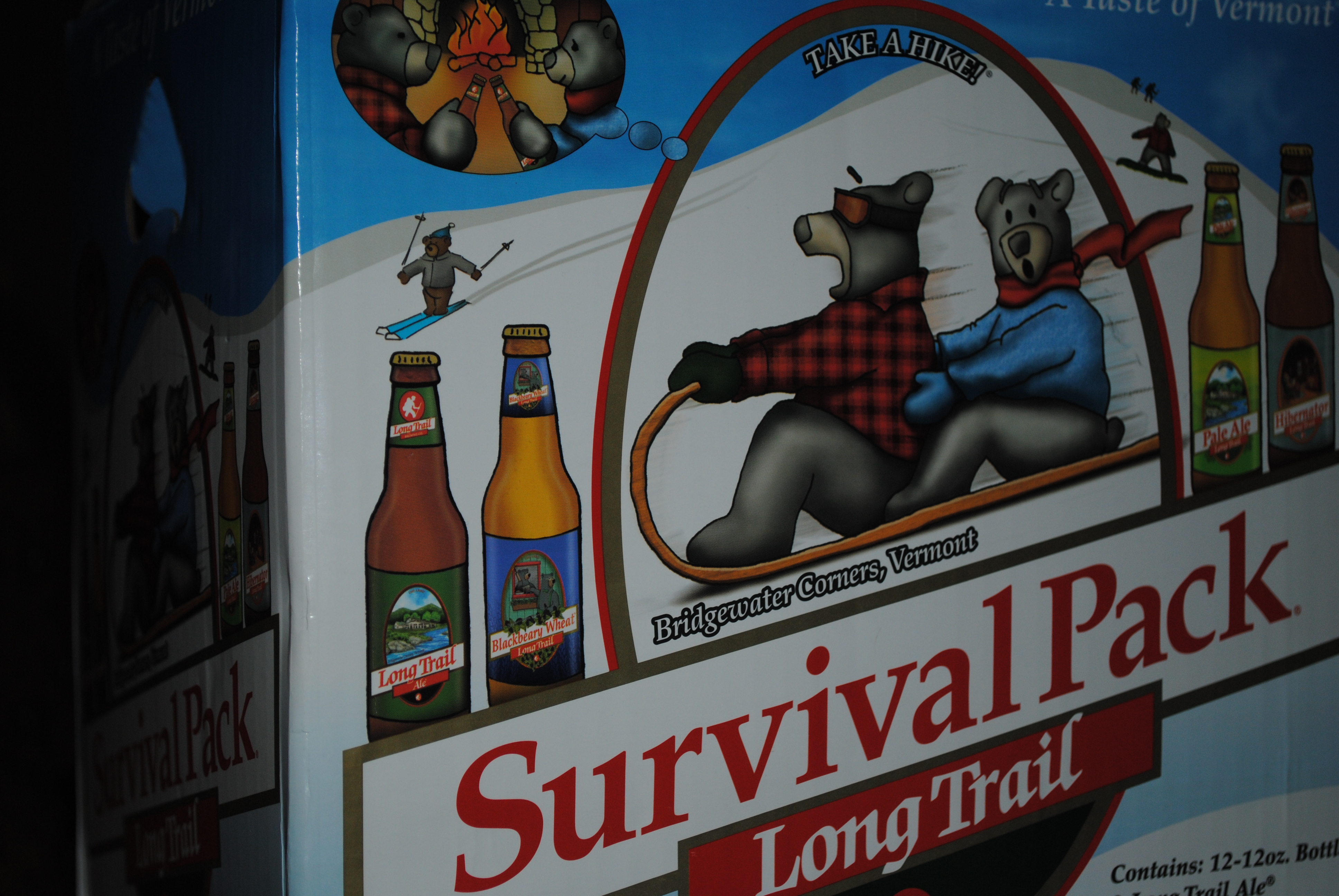
One of my favorite things to do in the mountains in the winter, is to return from a day of slogging (skiing, climbing, hiking, whatever!) and sit by a fire and enjoy a beer.  Here are six brews worth sampling one or celebrating with a couple: 

  • Dogfish Head’s “Raison D’Etre” — a dark amber, pleasant yet bitter finish with a hint of cocoa. 
  • The Shed Brewery’s “The Bull Does Love” — A hoppy beer, like any I.P.A., has a medium body and was very drinkable. 
  • Long Trail Brewery’s “Hibernator” — A stout-like brew, with a medium body easy to drink. 
  • Trapp Family Lodge’s “Dunkel” — Like the name implies, it is a dark beer with a medium body and has a light finish.  Because all of the Trapp Lagers are not filtered, they are complex and taste differently throughout the enjoyment of sipping. 
  • Trapp Family Lodge’s “Wintergeist” — Served in a wine glass, this dark beer is a seasonal beer that is unfiltered and has wonderfully malty flavors including a not-unpleasant taste of rasberry.  It also has a higher than average alcohol content, hence the wine glass! 

These beers are available in limited quantities in various parts of New England and parts of the Mid-Atlantic.

Well, thanks again for visiting.  If you enjoyed this post, please consider becoming a fan of the Suburban Mountaineer on Facebook or following me through Twitter (@SuburbanMtnr).

What’s too Little Snow to Snowshoe?

I got out on the snow this week (which was fantastic!) and thought with the two-to-three inches of snow on the ground that it was not worth strapping on the snowshoes.  Walking was the only effort required, right!?  Well, I was wrong.

Walking in the lighter snow on the yard and the trails seemed like my boots were all that was necessary.  Moving through it was easy enough, but it was a bit wet and lumpy so it had the texture of clumpy sand at the beach under my feet.  My heel sunk and toes dug in deeper to push off.  It was not exactly an ordinary walk in the park.

Until now, I thought snowshoes were strictly for deeper snow (say six-plus inches, depending on your height and weight).  Snowshoes are meant to give the winter hiker the ability to float higher in the snow.  They prevent post holing in the snow and exerting more energy from high stepping it through the deep white stuff.

Now I think that even a bit of moderate depths, hiked over a longer distance as I have in the last couple of days, it is easier (requiring less effort) to do so in my slabs.  It might look a bit silly, but it is actually pretty efficient.  I sunk less and pushing off was less straining in the calve and ankle.

Anyway, those are just some thoughts for the snowshoers.  Have a Happy New Year and remember you can follow the Suburban Mountaineer on Facebook and Twitter.

In Stowe, the Ice Axe is Optional

It is not always easy trying to satisfy my family’s desire for luxury and my personal needs for a wintry mountain experience during the holidays.  I can’t seem to talk the family into visiting Talkeetna, El Chalten or even Keene Valley any time of year.  They expect a warm bed, decent shopping, fine restaraunts and the option of room service.

However, even though I’d like an all-out alpine climb, I still look forward to fine dining these days now that I have been living an easy, professional life in Peaklessburg (probably for too long).  Thankfully, there are places to get the feel of both — at least we can with a little compromise of our expectations.

There are two types of mountain towns as I see it: wilderness towns, usually centered around parkland, and mountain resort towns.  Mountain resort towns usually offer skiing in winter and golfing, fly fishing and so forth during the rest of the year.  While wilderness towns, like Talkeetna, are preferable, some resort towns are on the edge of some great wilderness.  Whistler, British Colombia and Girdwood, Alaska are great mountain resort towns on the edge of major parkland.  But for the eastern part of North America, Stowe, Vermont, a mountain resort town, can serve the bill probably better than the rest, even the famous Whiteface Mountain near Lake Placid.  Lake Placid has been overrun by conventions and sporting events and makes the town often too crowded to enjoy in peace.

Stowe has a high degree of sophistication and resides in a valley of pine, maple and birch.  Once a quiet farming town at the base of Vermont’s highest peak, Mount Mansfield (4,393 ft./1,339m.), it has grown into a mature ski resort with a pleasant New England town.  You can ski, golf, fly fish and best of all, hike and get a taste of alpine in during the winter.  It’s great day up on Mansfield or Mount Hunger and then enjoy the town’s coffeehouse, Black Cap (formerly the Stowe Coffee House), which now roasts its own beans or then visit the Lounge at Trapp Family Lodge for some hearty cuisine and a Trapp Lager.

There are other destinations as well, such as the Ben & Jerry’s ice cream factory, which also offers 20-minute introductions to snowshoeing and conservation efforts, taught by a guide from the Umiak snowshoe and kayak outfitter, on Ben & Jerry’s private land.  It is especially good for people who have never been on snow before; come for the ice cream but learn to appreciate nature.

Last year the town has been enhanced with a true backcountry outfitter to compliment the numerous ski shops: CC Outdoor Store just South of town on famous Route 100.  While the staff of the ski shops did not know what gaitors were, CC Outdoor’s staff know as well as what gear you need to tackle Camels Hump (4,083 ft./1,245 m.) and its bald summit on a blustery day in January.

Again, with a little compromise, a decent, winter mountain experience can be had here while your family enjoys the town.

Thank you again for visiting.  If you enjoyed this post please consider following the Suburban Mountaineer on Facebook or on Twitter (@SuburbanMtnr).