A Reminder of Fay Fuller and Mount Rainier

The unstoppable Fay Fuller.

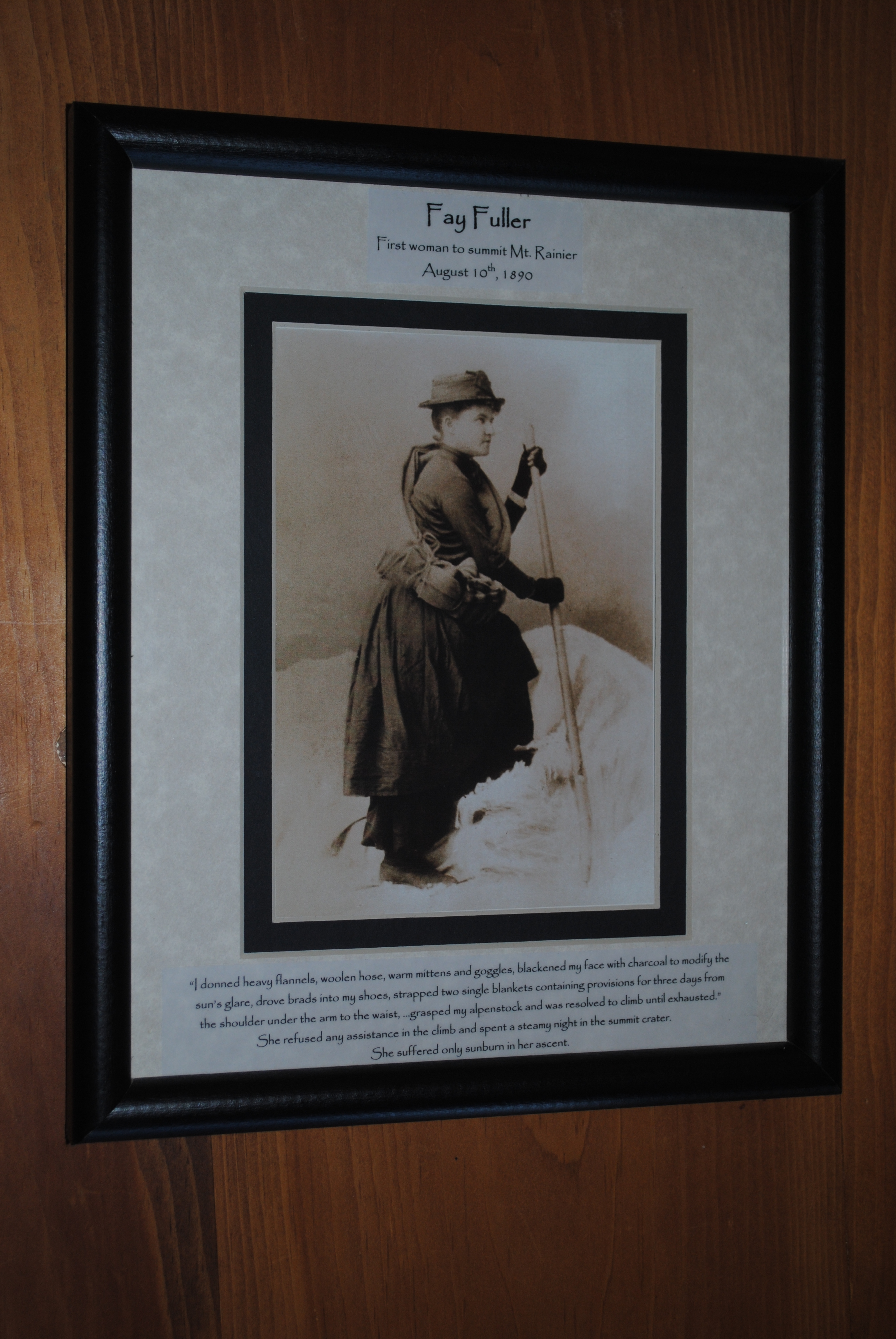
I came across this picture at a lodge I recently passed through.  I always appreciate it when a ski town or some other mountain village acknowledges mountaineering either for its heritage or the spirit of adventure and exploration.  It celebrates Fay Fuller.  The captions say it all…

On top it reads, “Fay Fuller / First woman to summit Mt. Rainier / August 10th, 1890.”  She did so at the age of 20. 

Below the photo it quotes her: “I donned heavy flannels, woolen hose, warm mittens and goggles, blackened my face with charcoal to modify the sun’s glare, drove brads into my shoes, strapped two single blankets containing provisions for three days from the shoulder under the arm to the waist, …grasped my alpenstock and was resolved to climb until exhausted.” 

After the quote it goes on to comment: “She refused any assistance in the climb and spent a steamy night in the summit crater.  She suffered only sunburn in her ascent.”

Fuller was a first in several other ways as well.  She was Tacoma, Washington’s first female journalist, where she wrote extensively about climbing in the region.  She also helped established the Mazamas that helped create Mount Rainier National Park. 

Fuller past away in 1958.  Her legacy has lasted well beyond. 

Thanks again for visiting.  If you enjoyed this post, please considering following the Suburban Mountaineer on Facebook or through Twitter (@SuburbanMtnr).

The Risks We Take and the Joys of Home on Christmas

I just finished re-reading the New York Times best seller by Jon Kraukauer, Into Thin Air.  Each time I’ve read it, it’s left me with a horrible aftertaste about climbing.  It’s a shame because I really love the mountains. 

No matter how I sugar coat it by talking about character building or the experience among nature’s wonders, mountaineering is still a frivilous activity.  As Kraukauer pointed out, mountaineering is best enjoyed by those ignorant of the knowledge of climbing.  Some great pioneers have made historic FAs without knowing their right crampon from their left.  But it was usually their determintation that got them to the top first, rather than their experience or skill.  In any case, they clearly assumed the risk. 

We assume the risk of frost bite, falling, altitude sickness, exhaustion, attacks from wildlife and who knows what else each time we go out.  Of course, that is, as Krakauer put it, what makes mountaineering unique among all activities.  The risk of death stands out.  People have died playing basketball or football, but it does not hang around the activity like in our sport. 

Getting home from our adventure in the mountains is always sweet, regardless of whether the goal was attained or not.  After sleeping in tents, hanging on cliffs, waiting out bad weather or having to relieve oneself in odd places (and positions) the joy of being home is even sweeter than for people that rarely leave suburbia.  We treasure the carpet under our bare feet and the ability to poor a glass of water from a faucet. 

With the holidays upon us, the risks can be put into perspective again.  Now we get to enjoy the best of it.  Relish the accomplishments of the year’s hikes and climbs and enjoy some egg nog with your favorite accompanying fluid (Bailey’s anyone?) and family and friends. 

Now, that I am done with Into Thin Air I think I will turn my reading attention to lighter book, like Jeff Alt’s A Walk for Sunshine.  Then I’ll move on to Felice Benuzzi’s No Picnic on Mount Kenya, I think. 

Well, Merry Christmas.  I hope you all get the stuff from EMS or REI that you’re dreaming of!  I’ll write again next week…

Thanks again for visiting.  If you enjoyed this post, please consider becoming a fan of the Suburban Mountaineer on Facebook or following me through Twitter (@SuburbanMtnr).

Trail Restoration and its Contradition

The American Alpine Club (AAC) is currently supporting a trail restoration project in Los Glaciares National Park in Argentina.  For we hikers and climbers, this type of effort should be up there in our priorities for giving financially right after general efforts to preserve wilderness, like the work by the Alaska Wilderness League or Friends of Clayoquot Sound, for instance.  However, the idea of the need for such work is contrary to our sense of simplicity and enjoyment of the outdoors.

Trail restoration is odd when juxtaposed to our notion of valuing wilderness.  In an extreme position, wild places ought to be untouched, sacred from society or civilization and man in general, except for perhaps spiritual sojourns.  But more reasonably, we want to enjoy our wild spaces and geographical and biologically unique places on Earth.  So we permit modest intrusions, like foot paths, bridges and the occasional ladder.  It allows us access natural wonders without trampling them to oblivion.  God forbid that the land and biological things change too quickly because we visited, rather than by natural forces like tectonics, wind and water.

In the same way that a society requires rules and rights for the people to be free, our wild places need paths and limited infrastructure in order for we trekkers and mountaineers to roam wild.

Think about your favorite wild place and consider the infrastructure as part of your assurance that that place will be there for you in the future, even as the trails encourage more to come.

Well, thanks again for visiting.  If you enjoyed this post, please consider joining the new community and becoming a fan of the Suburban Mountaineer on Facebook.

Why the European Guide Certification is Still the Benchmark

You may have heard that the American Mountain Guide Association (AMGA) and the International Federation of Mountain Guides Associations (IFMGA) held their first joint meeting and did so in Boulder, Colorado in November.  The AMGA is a member of the IFMGA, which is also known as the UIAGM in French and IVBV in German, but the concept and demands of the IFMGA certification is a high standard and is also alluring to North American alpinists.

IFMGA was established in 1965 by guides from Italy, France, Switzerland and Austria.  At the time that was the “international” community of mountain guides; they worked to provide each other open access to the Alps over their own borders.  Today, European states are considerably more open to each other, and “international” may seem like a stretch.  Today, IFMGA guides are truly international, including a rare, exceptional few dozen in North America, including Canadian alpinist Barry Blanchard.

IFMGA guides must demonstrate proficiency in three key disciplines of mountain travel: Rock, Alpine and Ski.  The European inclusion of skiing for standards and expectations of their best mountain guides has always interested me, as a climber that grew up in the Northeast United States.  The culture in my part of the country allowed me to separate climbing skills from skiing (so I only learned to ski recently).  However, in Europe skiing and climbing, when it came to the guiding culture, high-level skiing skills were expected of the best hired hands in the business.

From all reports, the joint meeting was like any other business convention, which entails board meetings, committee proposals and discussions and some exhibits.  According to the American Alpine Institute Climbing Blog, the most contentious issue was that while AMGA guides have broad access in the Alps, the European guides do not receive the same open access in the United States.  This is interesting because, as I said, several Americans have sought out the IFMGA certification.

The certification if being a IFMGA Mountain Guide is badge of honor, and perhaps because of its European roots, has a mystique among North Americans.  The handful of American guides that have it often use it in their advertising for business (and rightfully so).  It is admittedly more difficult than AMGA standards.  IFMGA guide applicants must have several years of climbing experience, be sponsored by a IFMGA guide, and pass a rigorous multi-day exam in the backcountry while under the scrutiny of the certifiers.  The certification gives the guide membership in the IFMGA and makes them an IFMGA licensed guide able to climb throughout Europe.

Regardless of the differences, the IFMGA designation may be more valuable to guides in North America and elsewhere than even in Europe.  The Europeans set the bar high and all else respected that and have met the standard only in rare occasions.

Thank you for visiting again.  Please join the community of followers of the Suburban Mountaineer on Facebook and get additional information and resources.

Broad Peak and the Sought-After First Winter Ascent in the Karakoram

Broad Peak in the Karakoram on a day the Poles are unlikely to see (By Svy123 2006)

The so-called 8,000ers (peaks above 8,000 meters) have all been climbed, but not all of them have been topped-out in winter.  This is most notable in the Karakoram Range, where five of the world’s highest peaks stand and none of them have had an alpinist arrive on the summit between early December and the beginning of March. 

Right now, a Polish expedition lead by Artur Hajzer is already in the Baltoro region staging its bid for Broad Peak (26,401 ft./ 8,047 m.).  For the 8,000-meter peaks that have been climbed in winter, those seven winter-first ascents were all accomplished by Polish expeditions. 

But Broad Peak, like other Karakoram 8,000ers, has been tried before in winter.  In 2006 and 2007, Italian super alpinist Simone Moro led attempts on Broad Peak in the coldest months, including an unsuccessful 2006 climb, which was almost a solo attempt.  What he said in advance of that trip shows his determination: “I will stay there until end of February; and I didn’t find any photographer or cameraman to come with me. So I will have to do all by myself.”  Ultimately, he climbed with Shaheen Baig.  In 2007, he returned in winter only to be turned back again. 

  
While a Polish expedition attempted Nanga Parbat (26,657 ft./8,125 m.) in the Karakoram winter, also in 2007, most attempts in Pakistan have been aimed at Broad Peak.  This is interesting because it must appear achievable to the climbers over the other four 8,000ers in the region, including Nanga Parbat, K2, and Gasherbrum I and II.  If the winter conditions in the Karakoram are holding the climbers back from the tops of these mountains, then the lowest mountain or one with the most direct lines may be the simplest, which could be Gasherbrum II. 

However, we all choose our targets in climbing and even hiking because of our passion for the trail, route or the romance of the peak.  We tend to obsess over our objective.  The reason for the recent attempts on Broad Peak could be based on Moro’s singular excitement over that goal, and the Hajzer expedition on the Godwin Austin Glacier now may have chosen Broad Peak because of the rich, recent information from Moro’s two seasons of attempts.  I am very curious about why Broad Peak has been so popular and am asking some knowledgeable people – I will let you know what insight they share, if any.

While a Polish expedition attempted Nanga Parbat (26,657 ft./8,125 m.) in the Karakoram winter, also in 2007, most attempts in Pakistan have been aimed at Broad Peak.  This is interesting because it must appear achievable to the climbers over the other four 8,000ers in the region, including Nanga Parbat, K2, and Gasherbrum I and II.  If the winter conditions in the Karakoram are holding the climbers back from the tops of these mountains, then the lowest mountain or one with the most direct lines may be the simplest, which could be Gasherbrum II. 

The so-called 8,000ers (peaks above 8,000 meters) have all been climbed, but not all of them have been topped-out in winter.  This is most notable in the Karakoram Range, where five of the world’s highest peaks stand and none of them have had an alpinist arrive on the summit between early December and the beginning of March. However, we all choose our targets in climbing and even hiking because of our passion for the trail, route or the romance of the peak.  We tend to obsess over our objective.  The reason for the recent attempts on Broad Peak could be based on Moro’s singular excitement over that goal, and the Hajzer expedition on the Godwin Austin Glacier now may have chosen Broad Peak because of the rich, recent information from Moro’s two seasons of attempts.  I am very curious about why Broad Peak has been so popular and am asking some knowledgeable people – I will let you know what insight they share, if any.

Well, thanks again for visiting.  If you enjoyed this post, please consider joining the growing community and becoming a fan of the Suburban Mountaineer on Facebook.
Christmas Gifts for the Non-Hiker and Climber

When you are obsessed with the mountains as I am, it can be difficult to remember that not everyone else is.  This gets particularly tricky during gift giving time.

For instance, did you know there are activities other than hiking and climbing that your friends and loved ones are interested in?  I did some research and found the REI, Eastern Mountain Sports, Hudson Trail Outfitters, Erehwon and other outdoor supply companies are prepared for this revelation by providing equipment for kayaking, cycling and even car camping.  Who knew?

What we have to do to show that we care through our gift giving is to think of how all those products in the outfitter can benefit the receiver in his or her non-outdoors lifestyle.  (Keep in mind that this is not the appropriate time to hold a grudge because they refuse to go on another “death march” – their words, certainly not mine – with you.)  For instance take the backpacker’s cook set.  The pots are collapsible or at least they fit neatly together – suitable for your friend that lives in a tiny apartment.

When you show up at the Christmas party or on Christmas Eve, you can also be sure to have the perfect gifts for everyone.  Remember that lady-friend that insisted Teva’s were “unsightly tire rubber” – again, their words?  Well, now they can be fashionable when they come to camp with you in the new super-impractical high-heeled version of the useful sandals.

Lastly, we should also think about the holidays as a door way to enriching everyone’s year with our love for the mountains.  Most outfitters provide regular classes and even outings to regional trails and peaks.  Go ahead and sign everyone up!  Be sure not to overlook the cycling and the kayaking activities, because there is more than hiking and mountaineering… apparently.

Well, thanks again for visiting.  If you enjoyed this post, please consider joining the growing community and becoming a fan of the Suburban Mountaineer on Facebook.  I’ll see you there!