Mount Katahdin

It has been a long, good journey, which is why I have not posted a new article in over a week.  I just completed a 2,000-plus-mile road trip in our new Subaru Outback, covering some of the Maritime Provinces and all of the New England states.  On the drive up north from Peaklessburg, I took in Mount Katahdin for the first time.

Before I go on, I must confess that I once underestimated this mountain.  Katahdin is Maine’s highest peak in Baxter State Park (an hour-and-a-half drive from Bangor, Maine) with an elevation of 5,267 feet / 1,605 meters and is the final destination of thru hikers of the 2,175-mile Appalachian Trail (AT). Unfortunately, based on the photos I’d seen years ago, stories from Adirondack hikers I met, and the fact that Katahdin rises as mainly the sole mountain massif from what I once considered a dull, featureless forest made the peak completely uninteresting to me.  I was wrong to make such judgments.

In terms of the AT, Katahdin’s mountain features overtake all other peaks on the Appalachian Trail south of Presidential Range.  For instance, Clingmans Dome, a tree covered peak in the Smoky Mountains, is gently rounded; in fact, an auto route was constructed to its summit, like that on massive Mount Washington.  Katahdin by contrast, is like a miniature version of Mount Logan in the Yukon Territory.  Okay, that might be a big stretch.  Katahdin is not covered in glaciers and snow year-round.  However, both stand alone on plains and rise and stretch at length rather than a beautiful conical peak.  On Katahdin, the peak ascends through a combination of moderately sloped arms alongside deep cirques created by former glaciers.  In addition, the forests of northern Maine are beautiful too, and I would think crossing such country without a maintained trail would be a challenge in its own right.

While the AT route takes thru hikers up the Hunt Trail straight to the summit, the most spectacular path on the mountain is the Knife Edge Trail, which links Katahdin’s South Peak (5241 feet / 1,597 meters) and Pamola Peak (4,902 feet / 1,494 meters).  A local told me that the trail was so narrow on either side at times that it had to be straddled with one leg on each side.  Truth be told, it is not that narrow.  However, when the south flank of the mountain is on one side and the South Basin (with a drop of approximately 2,000 feet over half-a-mile) on the northern side is separated by a mere several feet (two or three at parts), the route is extremely dangerous and should be attempted only in relatively calm winds and dry weather.  There are alternatives to getting around this trail by heading north from South Summit instead and taking the Saddle Trail.

Now back in Peaklessburg I can say that Katahdin is well worth the visit – not for settling for lower standards or because it is the terminus of the AT or because I have been in the city too long.  Katahdin stands as one of the northeast’s formidable mountains in its own right.  If you have climbed its summit I would love to hear your story, so please leave a comment or email me.

If you enjoyed this article, please consider subscribing to my RSS Feed.

Before Vibram: Hobnail-Boot Ascents

The Great George Mallory.

When we cannot hike climb (mainly because of work and family), many of us enjoy reading stories of other explorers’ experiences.  Most of these stories tend to be about near-death or death experiences.  While climbing is inherently dangerous, it is actually about living. 

It seems the experiences of life and death in the mountains fascinates all of us.  We enjoy it with Gore Tex and fleece, and even that sometimes fails to keep us dry and warm at times.  Once upon a time, a legendary climber, who wore hobnail boots and climbed in various layers of wool (for warmth) and silk (for wind resistance) and his partner approached the top of Mount Everest and was never seen again. 

His body was not found until this past decade by American climber Conrad Anker.  He wrote an enjoyable short, enjoyable book with David Roberts and now National Geographic is releasing a documentary on Anker, who has parallels in his life to the life of George Leigh Mallory’s, and making an attempt on Everest with the equipment of the 1920s.  You can watch the of the trailor of the movie, The Wildest Dream, here.  It opens on August 6th. 

I have said before that the coverage of Everest gets a little silly and this is an example.  The mountain appears to get more media coverage in North America, at least, than any other peak aside from Mount Rainier.  I do not mean to diminish the climb or the effort; I have not climbed it and I do not intend to.  However, mountaineering is more than just ascending the highest peaks and being the first to reach the top (though sometimes I wish it was that simple).   That being said, this documentary will share with us, and possibly a new generation unfamilier with the suffering and sacrifice of early climbing, the magnitude of the challenge mankind faced, particularly in the Himalayas. 

If you enjoyed this piece, you can continue following the Suburban Mountaineer through Facebook.

Love Your Shell: Care for It

EMS Shell jacket

Shells' water repellancy and breathability diminish with time and wear; do something about it.

Two things: Your so-called three-season rain jacket probably is not made of polyurethane, so the “proof” qualities will wear away without care.  Also, if you find the breathability of the jacket suffocating now, don’t replace it; there is a better way.  Same goes for winter shells. 

While proper water-proof shells are basically durable plastic bags, like the Helly Hansen Voss jacket and pants, they are really only good at keeping the wind and rain out if you are reasonably sedentary.  We bird watchers or the Queen’s guard should appreciate these shells a great deal.  These “rubber” shells are non-breathable and require little-to-no care. 

Breathable jackets that use Gore Tex, HyVent DT, Conduit and other brands of treatment require maintenance to maintain optimum performance.  For those of us stuck in Peaklessburg, our shells are probably worn year-round but rarely get to see “action” on the trails or up a route.  Still, wearing it every day is every day wear.  Your sweat clogs the pores on the inside of the jacket, preventing it from breathing, and both the sun and the rain skim off the protective water resistant coating.  Both are reparable. 

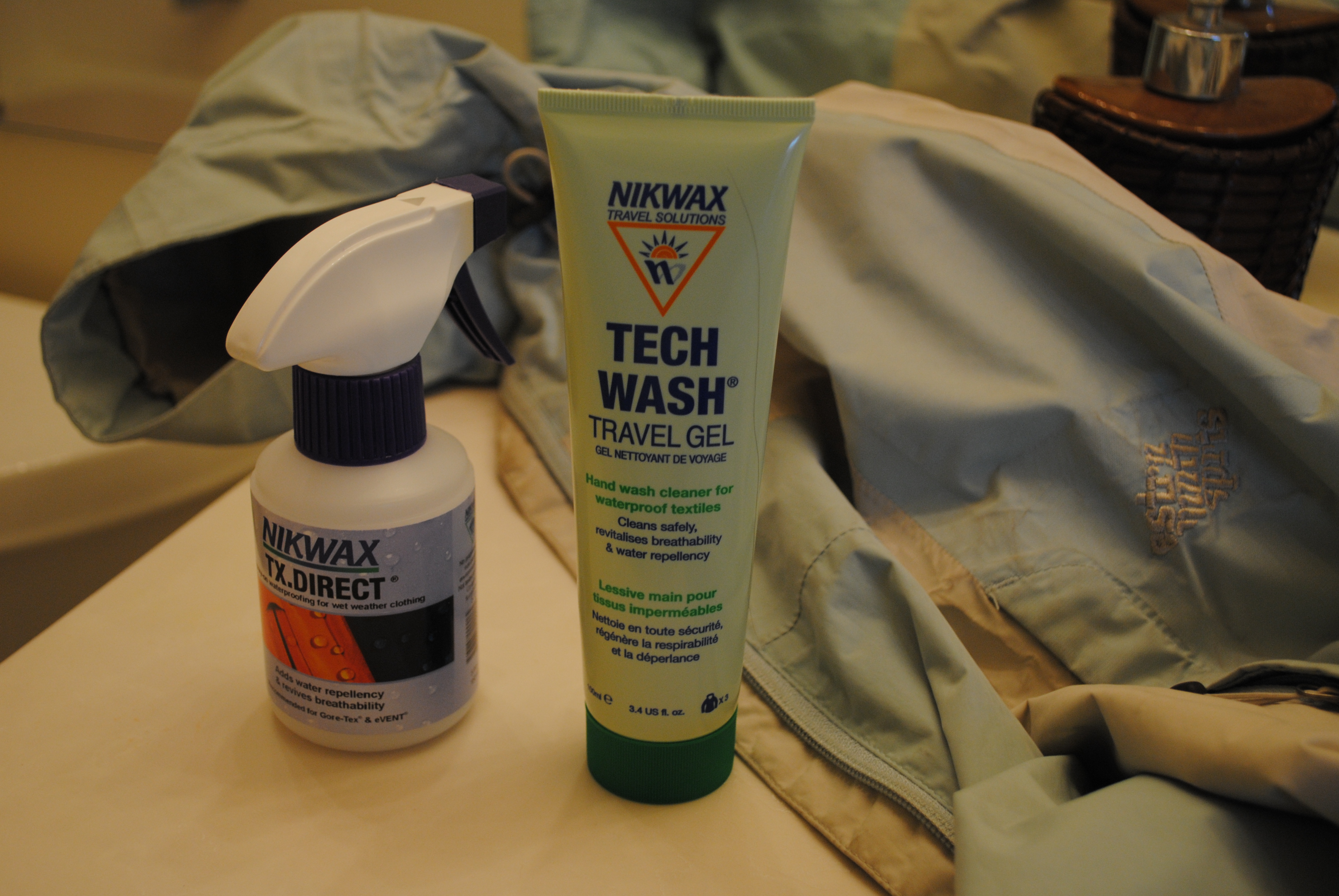
Nikwax treatmentTo restore breathability, the shell needs a wash, especially on the inside.  I like to hand wash my jackets and snow pants, so I get a bucket and fill it most of the way with water (leave room for the garment) and two caps full of Nikwax Techwash Gel.  Gently massage the fabric.  Sometimes the garment’s label might be in conflict with the recommended water temperature for the Techwash Gel, which is warm.  If the shell says wash in cold water I put just a little hot water in first with the cap full of Gel just to activate the soap, and then fill the rest with cooler water. 

Once the shell dries most of the way and still a little damp, I lay the garment flat and systematically spray every section of the shell with Nikwax TX Direct.  The shell needs some water moisture on it to properly receive the spray treatment.  If it over dries prior to spraying, run it through the shower for a moment.  Be sure to put an unused trash bag under the shell before spraying: the spray can leave tiled floors quite slippery.  Follow the instructions on the bottle, which calls you to wipe off any excess spray and water from the garment after a few moments.  Then repeat on the other side before allowing it to hang dry.   

Some of us could have had a fashionable leather bomber jacket for what we paid for our shells.  We ought to care for them so they give us a great deal of protection over a long time, from the snow, rain, and ice.  Maybe even some protection from city smog. 

If you liked this post on The Suburban Mountaineer, consider subscribing to my feed.

Dragons, Dracula and the Future of Climbing

The Open Championship was held this past weekend.  I know what you’re asking, what does this have to do with backpacking and climbing on our vacations?  Clearly the heat in Peaklessberg has gone to Andrew’s head.  Well, something the color analyst said about the up and coming generation of golfers struck me about our own sports.

He said that television and the Internet have transformed players’ knowledge and their ability to prepare for those golf courses.  They can see golf courses they have never played, like St. Andrews or TPC at Sawgrass, and know where the hazards lie or the way the ball will roll over a particular part of the green.  Golfers today come to these courses more knowledgeable than golfers before.  For example, when players from the United States and Canada in the 1960s went to play St. Andrews in Scotland for the first time, the only guidance they had was a rudimentary rendering of the layout of the course.  So when Jack Nicklaus (golf’s version of Reinhold Messner) first arrived at the Old Course, he could not predict or know what precisely the ball would do at various aspects of the course.

One hundred years ago, backpacking and mountaineering was also guided by rudimentary guidance about the territories we explore.  But since the 1950s and 60s, these sports have evolved upward as well.  Maps, trail guides, and route reviews online have exposed what was once a mystery of topography.  While man, as a species, has not yet been to every point on earth, there is little secret about what is there… generally speaking.

The big, obvious mountains have all been conquered and some of the lesser peaks too.  One day, it will be recorded in Alpine Journals that all the peaks have been climbed.  There ought to be a celebration at that point.  It would be a significant junction, where the touching the points ended and the familiarizing ourselves with the intimate aspects of the mountains and climbing might begin.  Only, this familiarization has already begun in many of the great ranges, such as the attempts on the infamous Magic Line up K2 or the new route up Mount Foraker in Alaska, aptly named Dracula, which was just scaled this June.

The age where there is a blank on the map is over.  Finding dragons in the unknown is a preposterous idea.  We cannot stop this trend from happening, where the map is being filled-in and the peaks are being bagged.  But the thrill of making an ascent yourself – your own first – or creating your own route will never be surpassed.

Ten Priorities for an Outdoor Vacation

  1. Go somewhere the Blackerry and cell phone gets no signal.
  2. Get up early at least once and watch the mist rise off the lake.
  3. Stay up late to watch the stars, and then sleep in.
  4. Hike, climb or paddle hard and finish the day with an ice cold beer.
  5. Find a great vantage point, lay out the map and match each point within view to its name.
  6. Cook something over an open fire.
  7. Use a pocket knife for something other than opening a beer bottle. 
  8. Play cards with friends on a rainy day.
  9. Upon reaching your destination you see a peak not too far off, look it up on your map and say “what the heck,” and go exploring.
  10. In-country, cook a meal you thought you would only find in a restaurant. 

Cramped in the City: Condos and Apartments

Bus stop on snowshoes

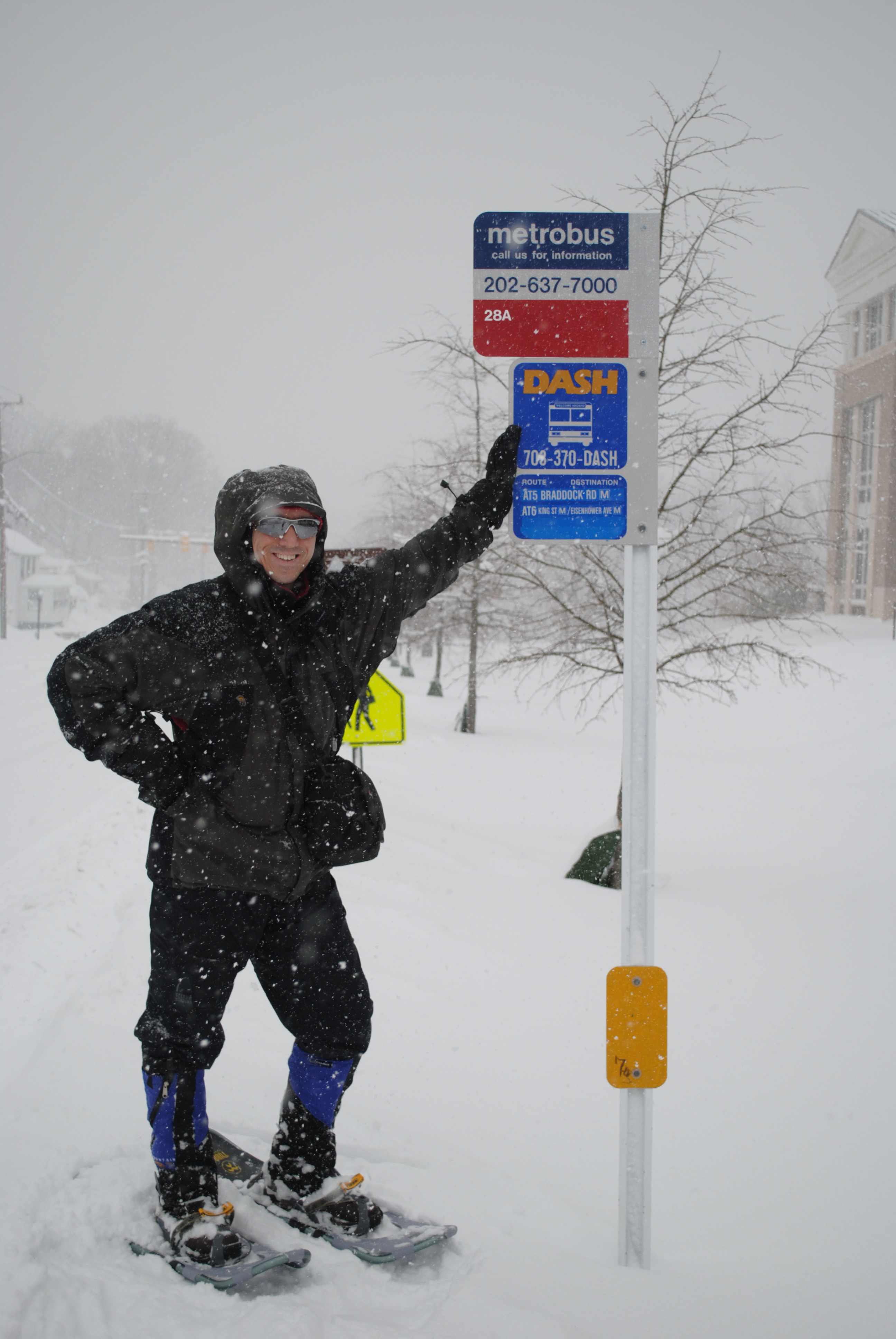
Life in Peaklessburg where apartment living, bus stops and humidity is the norm; snowshoeing -- rare the exception.

Ordinarily, most of us returning from a day of snowshoeing simply put the rackets in the garage or mud room to dry.  However, for those of us living in a condo or an apartment, we have to be more creative with tending to all of our gear.  In addition, we must grin and bear the consequences.  For instance, our significant others may give us a look of “What’s this?” when they come across a tent set-up randomly in the living room.  What are we supposed to do?  It has to air out somewhere! 

In humid Peaklessburg, we do not usually run into issues with ice and snow.  But this past winter we did.  It was the snowiest season for the region on record.  It snowed more here than in Buffalo!  That meant snowshoeing routes were accessible right outside my door for several weeks. 

Which brings us to a unique conundrum: Where do we lay out gear to dry and clean filthy equipment?  Back to my original example, where do you set the ice-and-snow-flecked Tubbs?  We do not have a garage.  We do not have a mud room.  Some of us in condos and apartments may have a porch that we could use but during this snowy season (others call a snow storm) we could not even open the door (because of the snow).  In the end, the bath tub worked.  The snow pants were hung like a towel over the shower curtain rod. 

For paddlers, the problem may have been the greatest of all, until recently.  Where do we store your canoes and kayaks?  Unless we were willing to have our boats serve double duty by laying Plexiglas over them and serving chips, there were next-to-no solutions for storage within the unit.  However, one company solved the problem by finding a way of putting a quality, recreational kayak in a corner of our closets; Advanced Elements has developed a hybrid foldable kayak that is also inflatable that has received tremendous reviews.  After paddling, simply dry with a towel, deflate and fold it back into its bag about the size of medium piece of luggage. 

Living in a condo or apartment full-time, unlike those of us that have condos at the ski resorts for a week here and there, highlights limitations of the living space juxtaposed on our preferred lifestyle.  Our boats, ice axes, frame packs and tents deserve a garage or shed and occasionally a plot of grass that is ours to spread out and allow the open air and sun to do its work.  But since we are making the compromise of living in the city or suburbia to advance our careers, our hobby of the outdoors sports has to be flexible… like the kayak.