Reviewing Books and Burning Bridges

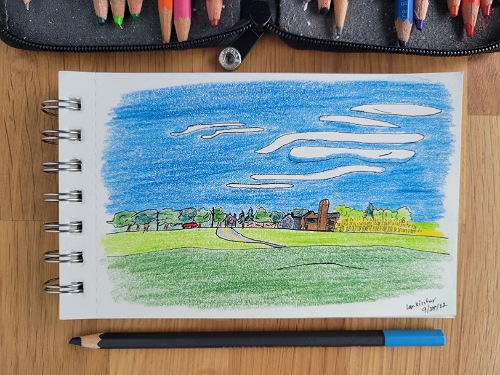
It’s pronounced Lankisstur (All rights reserved)

The first book I reviewed was an unsolicited book from the author about an Appalachian Trail through hike. I didn’t give a rating here on TSM but I did say whether I would recommend it. I didn’t recommend that book. I also gave it two stars on Amazon (which at the time was a mere bookseller with a growing online department store,) and I got a terse email from the author about that.

He complained that my review seemed like a four-star review or at least three and that I just didn’t love his book. I explained my case and held my ground. Later, I changed the stars to three. I’m not entirely sure why I did that. I haven’t revised a rating, unless there was an error, since.

I have been reviewing climbing and adventure books and even articles since 2010. I served as a pre-reader for the Banff Mountain Literature Competition for many years. But after some evaluation, I think my reviews need some improvements for you, the readers that want to read these books but don’t write reviews. Let me explain…

I believe that every book should do something new. A new topic is valuable. Two writers can write about the same event so long as the perspectives are unique; there is nothing worse than redundancy about reporting and retelling. The exception here are updates and revisions on books. For instance, there are a lot of books on the disappearance of Mallory and Irvine. The coffeetable book rich in photographs and pictures of artifacts added something. A freshly written history for a new, younger audience might add something for that generation, but I doubt that I would think the book is significant or unique. This is what I have always been looking for as a starting point for my quest.

You may not know this: I am on a long-term reading adventure to identify the climbing classics. (Well, the English language ones anyway.) It means I will continue to read a lot of climbing and mountaineering books for many years to come. The genre is bigger and deeper than most non-climbers, and climbers for that matter, might imagine, despite being rather niche. I keep a list of books to read (and acquire) that I call my Short Long List and it has been modified and updated only a little in the last couple of years.

But there is a problem. The Short Long List has books mostly ten years old and older. The short lists of the English language mountain literature competitions, Boardman Tasker, Kendall Mountain Festival, and the Banff Mountain Literature Competition, include about a dozen books annually. I like to read a few of them too, in addition to my search for the classics. This makes my progress slower than it already was.

For example, I am currently reading a new book, Native Air, a novel by Jonathan Howland (2022). After that, I am reading Meghan Ward’s Lights to Guide Me Home (2022). Then I am returning to my Short Long List and finishing Paul Pritchard’s Deep Play (1997). After that, I am picking up Bernadette McDonald’s biography of Elizabeth Hawley, by the original title, Call Me in Kathmandu (2005). I also mix in reading for work and my other hobbies, like baseball, golf, and history, so things naturally move slowly.

To give you my take on why the book is significant, especially these newly published books, doesn’t seem entirely as relevant. I think you should know if it is significant but you probably also want to know if it’s worth buying and reading. So I am starting to change the way I do my book reviews.

As a principle, readers of reviews need to trust the reviewer. This means I must be honest, and that I shouldn’t sidestep criticism or things that I didn’t like (I haven’t meant to, but in the past I usually did.) I would acknowledge those things, but I would usually only focus on the significance of the story or the record of the event. I will still pay attention to the significance but there is more that you need to have disclosed and I will work harder to do that. (In fact, I once lost an opportunity to have one of my book reviews in Alpinist Magazine because of that old approach.)
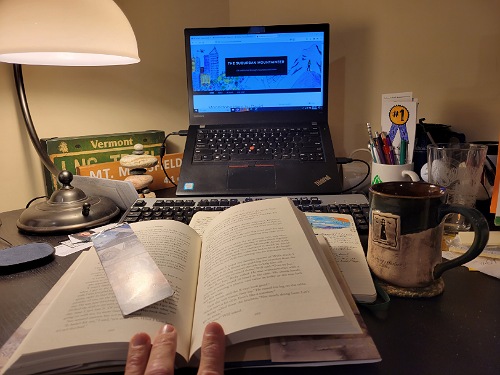
Early morning blogging session (All rights reserved)

So that brings me to clear and transparent ratings. While I might recommend that you read the book, where does it stand in terms of rating or score? In the past I only posted a score-out-of-five rating on book seller websites or on Goodreads.com (or just Goodreads.) But I’ve learned that readers find it helpful about what to expect. Theoretically, I could praise and recommend two books but give one a four and one a five.

I am still in the process of determining my rating system. Stars are popular but not relevant on TSM. I use the tag line: Life undimmed through mountains and books. Arising out of the mundane things of work-commute-repeat is the ultimate goal here. Would matches or match lights or flames make sense?

I will also start posting my reviews on Goodreads as well, going forward. Although you found TSM many others haven’t and some of the reviews on the books I have read don’t comment on the matters I think are important. So it’s time to share in that market.

In my reviews, there is only one I am sad about and think that a rating could have helped. I liked the book and reference it relatively frequently since it covers the main story of one of favorite climbers. I criticized it for being written for too general of an audience and I recommended alternatives. It was fair. But later, that author offered to send me her latest book but I never received it. Did she read the review after offering me a copy? Did I burn that bridge inadvertently? Well, that’s the game. I just went ahead and bought the book.

Well, thanks for dropping by. If you enjoyed this post, please consider joining my email list, which is the best way to get updates. (I am on Facebook, but make sure your preferences will see my posts.) Thanks again and be well!
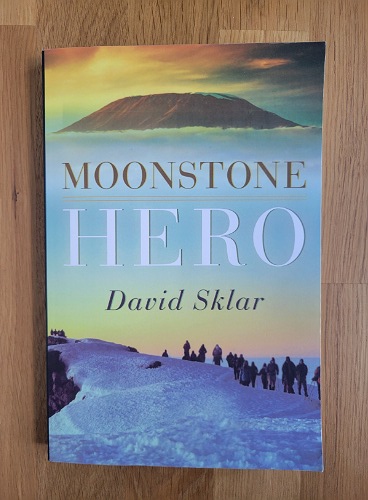
Moonstone Hero by David Sklar Reviewed

Moonstone Hero by David Sklar (2022)

This book is going to be hard to forget. A publicist reached out over email asking if I would review a novel based on a doctor’s lived experiences on Kilimanjaro and having to make decisions about how far his character would go to save another life. I insightful books and thought this could take me some interesting places as a reader and a climber. It left me a little uncomfortable.

The book is Moonstone Hero, a novel written by David Sklar, and is being released on or around October 25, 2022. The back of the paperback, focuses on the first half of the book, where the lead character Andrew must choose between going with the rest of his party to the mountain’s summit or descending in the dark to save a stranger, when no one else will. However, this is only a snippet of what I read in the novel’s 243 pages. The climb (or descent, really,) is just the start of what turned into a romantic story; Andrew pursues Eve, the girlfriend of Barry, who Andrew attempts to rescue. The back of the book did not give this theme the proper weight.

The story starts in Tanzania in 1974 and follows Andrew’s life starting on the verge of summiting Kilimanjaro, when Barry comes down with a serious case of pulmonary edema. It is dark when Barry’s condition worsens; Barry needs to get down just when the group of climbers and their guide were leaving the camp to make the final push. (Apparently it was unsafe to descend in the dark by not to ascend to the summit.) Andrew, is a medical student, and puts Barry’s condition first. The lead guide, Salaam, insists Andrew and Barry wait until morning when its light and they return from the top, but finally relents to Andrew and his opinion, as a medical student, and allows Andrew to descend with Barry immediately. Andrew is joined by the leader’s younger cousin, Koba. The others press toward the top.

I enjoyed Sklar’s character Koba, but I worry that I may be appreciating some Western stereotypes of African males unnecessarily without knowing the perspectives. Sklar shared his fears, their origin from his mother and songs they sang in school, his work ethic and how that approach to his job was, in part, to keep him save from the white man. He had a back story that seemed, as a reader, to be authentically African. Koba pretended not to understand Andrew or Barry on the descent, because he knew that if he spoke it would encourage more questions, and he was being cautious with these white men, and didn’t want to be hypnotized by them. It’s likely that Andrew wouldn’t have completed this leg of the journey without him, and Koba learned to admire Andrew. Koba’s honorable character helped set Andrew as the stories honorable hero.

From this point, the climbing portion of the story is a descent, and the rest of the story all goes down hill. Andrew saves Barry’s life and while Barry recovers in the hospital, he takes Eve on an out of place beach vacation. I was sincerely curious about where Sklar would go once Barry reached the hospital, but by this conversation I lost interest, but I plodded on to the end to see what surprises the book had.

I think the story has greater potential with some rewriting. The third person omniscient perspective left too few, if any, conceal-and-reveal moments. It limited Andrew and Eve to being one-dimensional. In good stories, you feel like the character or understand their worries, fears, and what excites them, and these things you can see the mistakes they make and how they overcome their flaws to become heroes. For Andrew, he just seemed like a nice guy doing the right thing but not getting what he wanted out of life. There were mentions about how he was longing for or obsessed with Eve, but I never felt or understood why, only that the perspective indicated that it was destiny, without saying explicitly so.

I was also perplexed by various little things that could have been omitted and that didn’t move the story along. Why did I need to know Eve was wearing eyeliner on the day of the ascent to the summit? (For that matter, why was she wearing eyeliner on the day of the ascent to the summit?) There was a lot of detailed discussion about travel details that were too instructional, such as how one would visit someone by flying in and whether they took a bus or train. And when things did move the story along, details were too often revealed in long answers of dialogue, which is how we learned that Eve, even on the mountain, was ready for the beach, because she said, in thinking aloud about whether to go, that she did in fact pack a bathing suit in her bag.

Moonstone Hero is about Andrew finally getting together with Eve. It only marginally covers climbing Kilimanjaro. And the conflict, drama, and ethical issues that were promised about choosing to do the right thing over going to the summit and peer pressure, never gets much deeper than what was said on the back of the book.

The story needed some more challenges and the book description needs to be honest. I also think that the fate of Barry was an opportunity to inject more conflict that might have challenged Andrew more and maybe even the circumstances around he and Eve. Andrew could still be a hero, deal with some greater adversity, and he and Eve could still go off into the sunset.

(Don’t buy this one for the AAC Library, Ms. Sauter, it isn’t relevant.)

Rating: 2/5

Well, thanks for dropping by. If you enjoyed this post, please consider joining my email list and/or following me on Facebook. Thanks again and be well!

Not Without Peril by Nicholas Howe Reviewed

Not Without Peril by Nicholas Howe (2009, 2nd ed.)

Nicholas Howe grew up and around the Presidential Range of New Hampshire with the tallest peak, the Mount Washington, within view of his family’s first home. He hiked extensively, served as a trail and hut steward, and participated in some rescue efforts. In his book, Not Without Peril: 150 Years of Misadventure on the Presidential Range of New Hampshire (2009, 2nd ed.,) Howe explains how the mountain trails have changed yet the mountain itself and the people who climbed it have not.

Starting with a grand sentence to lead his book, Howe beckons us to read on: “Mountains were invented in the 19th Century.” We learn about exploration in England’s land in North America and the carriage road up the summit of Mount Washington. We read about Frederick Strickland, an Englishman scientist, who has a tragic mishap in 1849. We follow enthusiastic mountain climbers, and evaluate their situations in 1855, 1886, 1900, 1912, the 1920s, the 1930s, the 1950s, 1986, and the deadly 1994 season.

Often the demises of hikers lost were due simply because they were unprepared. They were without appropriate clothes, nutrition, and navigation. Many died mere meters away from shelter they could not locate due to snow, wind, rain, fog, or the dark. I feel like several disaster stories (including Simon Joseph’s and Joe Caggiano’s) start out “three friends from Boston decided to go climb in the Presidential Range…”

Howe introduced me to Jesse Whitehead. She was the daughter of Alfred North Whitehead, a British-born Harvard philosopher, and she was a scholar of ancient Arabic languages that maintained a prominent place in Boston’s society. Well, she was also a hiker, skier, and a serious climber “long before anyone thought such a calling would include women,” as Howe explained her pioneering ways. Whitehead, with three men, made the first ascent of the Pinnacle in Mount Washington’s Huntington Ravine. Later, she climbed in the Alps, including the an attempt on the Matterhorn. But it was another attempt in Mount Washington’s other major eastern ravine, Tuckerman’s Ravine, that Whitehead makes Howe’s book. She and her partner, a less experienced gentleman, fell from a ghastly height. Howe traces the accident and the rescue (not a recovery) that includes Bradford Washburn, which almost seemed like a cameo in the story.

Howe’s treatment of these stories combine the enthusiasm we share for mountain adventure and is simultaneously clinical enough before leaving the reader sad. After the accident, Howe starts to evaluate the situation for lessons and explains the search and rescue process and tells stories from their perspective with as much ferver as going into the range. Each chapter I read I went with the traveler Howe profiled, full well knowing it wouldn’t end well, and they examined the maps and mistskes by flipping pages back and forth. I’m grateful to Howe and the subjects, like Joseph amd Caggiano, for their anecdotes as I prepare better my next hike.

Howe also taught me about the early visitors approach to the Presidential Range and Mount Washington in particular. They believed the mountain would largely be ascended by horseback, which was why the carriage road and the halfway house was built. The observatory on the summit was not the only purpose. In fact, other early routes attempted to rise up via gradual grades much longer than our uphill trails we rely on today.

I was drawn to reading Howe’s book because of David Roberts’ books about his own adventures with the Harvard Mountaineering Club and retelling of stories of fellow-Harvard alumni Bradford Washburn. Those tales taught me about the significance of climbing Mount Washington, in spite of its relatively low elevation of 1,918 m/6,288 ft. I learned that it was not only the highest peak in the Northeastern United States, but it was also a cold, windy place that was the best “local” training for Alaska and beyond.

I climbed it in 2002 in a round-about way via the Ammonoosuc Trail from the West. I was an experienced hiker from dozens of trips up the Adirondack 46rs, but I didn’t have more than a simple map for directions. I was surprised by many things, from the large lodge known as the Lakes of the Clouds Hut, that I was able to easily make it to the summit of Mount Monroe by a short detour, and that the bald rock was not in fact relatively smooth like the Adirondack peaks but rather enormous boulders evenly spread out; stumbling could easily mean a twisted ankle. I knew the summit had a large weather station and a cog rail train and auto road brought tourists, but it was weird summit experience after walking alone (with joy and meditation) for hours. It’s only taken on a more significant role in my imagination.

Howe’s book is worth reading if you frequent the Presidential Range or if you hike and scramble over peaks often. The anecdotes and historical tidbits, along with practical takeaways for the trail, are valuable and downright charming.

Rating: 4/5

Well, thanks for dropping by. If you enjoyed this post, please consider joining my email list, which is the best way to get updates. (I am on Facebook, but make sure your preferences will see my posts.) Thanks again and be well!

The Mountains and Plains of Walt Disney World Resort

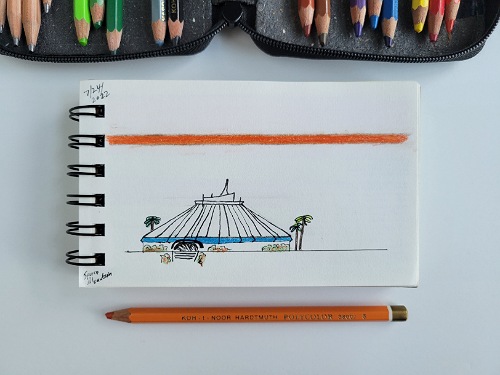
Space Mountain, Disney Range (All rights reserved)

Earth’s natural mountains were formed and shaped around two billion B.C. from powerful geologic forces and erosion. The most visited mountain was constructed in Florida on sandy soil by homo sapiens between 1972 and 1975 A.D. for tourists and vacationers and actually had no resemblance to Earth’s surface or its mountains.

It was called Space Mountain, the first indoor roller coaster, and was the first of several man-made mountains to enhance the plains of Central Florida thanks to Walt Disney establishing his Walt Disney World Resort outside of Orlando. You may have heard of it. You may be among the more than 250 million people that have rode it since it opened.

I hadn’t planned on bringing Natalie, Wunderkind, or Schnickelfritz there. We had a list of reasons (or objections) rooted in our values. We were capitalists like Walt but we preferred using our travel money and time related to hiking, bicycling, making s’mores, and our own wood-fired pizzas. Then the kids’ grandpa had a burning need to take them on a milestone American trip.

He offered his grandchildren one of two choices: A trip to Mount Rushmore or Disney World. Everyone should see both, in his opinion. To his daughter, Natalie, she, like me, couldn’t figure out why Mount Rushmore was being offered at all. To me, we were being offered either a man-carved mountain or a set of constructed mountains.

Natalie and I had once discussed whether we were going to ever bring the kids to Disney World. Now that this trip was being offered on a silver platter, the choice between this or taking all four of us South Dakota, it was more a worry that grandad would be disappointed and complain to us about the accommodations. A hot dog for lunch wouldn’t be a problem, but at least in Disney World he could find decent oysters on the dinner menu. Disney World had become a foregone conclusion. Once the pandemic restrictions lifted sufficiently to enjoy the destination freely, we’d be there.

I didn’t want to go, for all the reasons Natalie and I discussed before. I floated the idea of staying home and working for half the week, but Natalie said we were all expected to be there, so I was committed for the week. I wasn’t sure what I was going to do there; I didn’t like fast, jerking rides. Not for motion sickness, but I tense up, and then immediately afterward feel ashamed, with a bruised ego, for not shouting “Wee” at the top of my lungs with my arms outstretched. So I knew I would be relagated to Sherpa dad, carrying water bottles, stuffed animals, souvenirs, light sabers, and a tube of sunblock. I would be constantly in search of iced water, shade, food, and the next great ride with the shortest line.

I tried to find something about the trip that would interest me. Star Wars: Galaxy’s Edge in Hollywood Studios was the obvious one, but that was just one objective for a whole week. The other was the food, especially at the sit-down restaurants, so we made reservations, but it didn’t seem truly enticing. Golf was an option; but I decided the courses didn’t seem to justify the greens fee and it was going to feel like the peak of summer during a heatwave at home when I don’t play, so that was out. I really thought the resort complex would have a neat climbing gym or fitness center with a bouldering wall. Perhaps I would be hanging off a hold in the shape of Mickey Mouse’s iconic head. But it doesn’t. Orlando has gyms, but all were impossible to reach with the Disney bus and monorail system.

We sought advice from friends and family, though only a minority of which had real experience with Disney World. Two made a strong case for us to stay at the Wilderness Lodge hotel. It’s modeled after the grand Old Faithful Inn in Yellowstone National Park. Well, if we weren’t going to Yellowstone, let’s bring Yellowstone to us.

When we arrived, the background theme music began. It was a steady stream in whatever public setting you visited. We checked in the great lobby with balconies and balconies of log cabin railings. There were taxidermy bison heads and beaded Native American art, which seemed true to Yellowstone, and then there were enormous totems, which have no relationship to Yellowstone. And, of course, there was a man-made geyser outside near the pool. The design was a hodge podge of white Western heritage, an eclectic collection of Native American artifacts, and inauthenticity.

Our room was the final straw: It was too small for the four of us and couldn’t fit the rollaway bed we requested. They could have told us that six months ago, but instead we looked for alternatives. In the end we moved to The Contemporary next to Magic Kingdom. It’s so fanciful and tried to be futuristic in the 1970s that it was what it was and in that was more authentic and functional than the Wilderness Lodge. I preferred it.

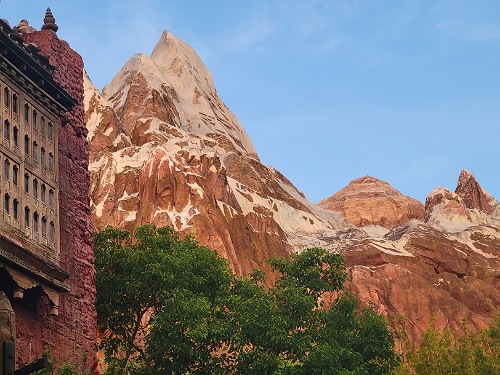
Forbidden Mountain, Disney Range (All rights reserved)

The background theme music resumed, albeit with a new theme, at every park we visited. My mind started to dull. The parks, from Magic Kingdom to Hollywood Studios, were like watching television; I didn’t have to challenge myself. Well, other than the quest for iced water, shade, and the next great ride. I downloaded a Robert MacFarlane audiobook to listen to in snippets while I waited for the family. Except even with the sound turned up, the theme music and chatter from everyone wearing Mickey ears drowned out anything read outloud.

Animal Kingdom was the one park that engaged the mind not just the senses. The safari was the fastest-paced by-vehicle zoo tour I ever experienced, it was the most interesting activity. I wasn’t merely in awe of nature, I learned about baobab trees and how important hippopotamuses are to Africa’s ecosystem.

Animal Kingdom also hosts an area called the Annapurna Sanctuary, and includes a river rapids ride and a roller coaster with a theme of a Himalayan myth. Expedition Everest is a coaster ride answering the question of whether the Yeti is real. (Of course, you can just ask Don Whillians.) I have never been to the Himalaya or the Karakoram so I don’t have a real world experience to judge it by, but I felt like I stepped into the scenes of a Patagonia catalog.

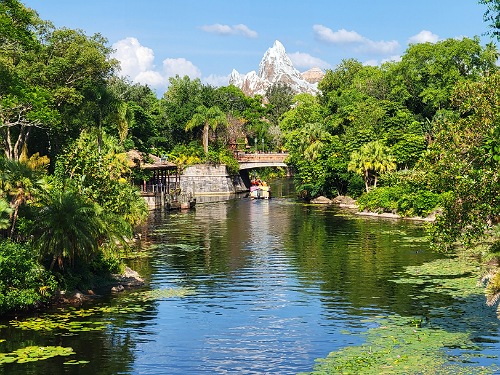
Disney World’s Expedition Everest in Animal Kingdom’s Annapurna Sancuary (All rights reserved)

Expedition Everest is a roller coaster that is both indoors and out and it rolls around Forbidden Mountain (the larger peak in the photo,) and a man-made Everest is visible in the distance. I enjoyed sitting and wondering here and admiring the detail as much as taking in the geeky nuances of Star Wars Galaxy’s Edge at Hollywood Studios. That said, the background theme music was incessant at the Annapurna Sanctuary. But at Galaxy’s Edge, it was all sound effects of space vehicles landing and taking off, as if you’re at a spaceport.

When I returned to work, my colleagues asked me how my vacation was. It wasn’t a vacation, it was a trip, I replied. On a vacation, I pursue something I enjoy and ususally return to work feeling renewed. I was tired and I looked forward to coming back to the office. Disney was a novelty. My wife and kids definitely enjoyed it a great deal. The grandparents made a lot of memories with the grandkids.

Well, there was one moment that surprised me and touched me and reminded me of my childhood. Again, we were in Animal Kingdom, and the pontoon with the live drummers making the theme music sailed past. Earlier in the day we saw Mickey and Minnie wearing khaki explorers clothes. Mickey, notably, was not wearing a pith hat, as old drawings of him did. He wore a bucket-style cap instead; which distanced himself from colonial symbolism. At this special moment, there was a broad shouldered duck in a leather jacket and leather hat and goggles. It was Launchpad McQuack from Duck Tales. Launchpad was the pilot that only landed by crashing but took his boss, Scrooge McDuck, on some amazing adventures. No one seems to remember him. My kids didn’t know who he was and were completely unfamiliar with the television series. But I made eye contact with Launchpad and he waved more vigorously. Perhaps he was grateful to connect with a knowing fan too. I felt like Disney reached out to me that once.

At the end of the day, the destination was good. I was glad my kids experienced things their grandparents cared about. It prompted some good conversations about some American pop culture. But the place didn’t replace my desire, or my wife’s and kids’ desire, for the outdoors, whether it’s our trip to New England’s mountains or even Assateague National Seahore. Disney was an authentic amusement park, but it didn’t replace our interest in authentic nature and adventure.

Well, thanks for dropping by. If you enjoyed this post, please consider joining my email list, which is the best way to get updates. (I am on Facebook, but make sure your preferences will see my posts.) Thanks again and be well!
Four New Climbing Books — Narratives — for 2022

Mountain Singe (All rights reserved)

How many new climbing books are coming out this year? Maybe more than 20, but these four books caught my attention. Why? Because they are not advice on climbing a higher grade or improving your skills, like assessing avalanche risk; I mean, you could search the Internet for that.

These are narratives, book narratives. Climber Paul Pritchard explains why this is significant in his 1997 memoir Deep Play: “A magazine that readers dip into, not knowing what kind of excitement they are looking for, and so only happening across a piece of your life, is not a place for such intimate subjects. In a book, on the other hand, readers must go out and find, already knowing that they want to learn about you or read what you have to say.”

Here are my brief notes, and I hope you find at least one worth picking up:

NONFICTION NARRATIVES

Science on the Roof of the World by Lachlan Fleetwood (May 2022) — Lachlan shares untold stories, well untold until now, that give perspective on the nexus of empires and mountains and even sheds light on one of the reaons “dependence on indigenous networks” was erased in order to make knowing the world possible. If that doesn’t compel you to read, well…

Born to Climb: From Rock Climbing Pioneer to Olympic Athlete Culture by Zofia Reych (June 2022) — Reych of Fontenbleua is an anthropologist by training that works in climbing media. They also established the Women’s Bouldering Festival and as of this month, released her first book tracing the rise of climbing to the Tokyo Olympics.

FICTION

Peak: A Novel by Eric Sparling (January 2022) — Sparling tells the story of Phil Truss, diagnosed with a terminal brain tumor, turns to not just a modest goal of climbing Rainier but the Mountaineers’ Mountain: K2. Except, after hiring the best guide, he faces a grand demon that has tried to transcend his cage before. The story is gruesome and witty. I reviewed it here.

Native Air by Jonathan Howland (April 2022) — Howland’s first book (and novel) tells the story of Joe Holland from when he was young and climbing free with his partner Pete Hunter, and the story of returning to climbing after Pete’s death. What intrigues me, based on an interview by Chris Kalous, Howland starts the story in the 1980s and leapfrogs to modern gym climbing.

Well, thanks for dropping by. If you enjoyed this post, please consider joining my email list, which is the best way to get updates. (I am on Facebook, but make sure your preferences will allow you to see my posts.) Thanks again and be well!
Peak, a Witty Horror Novel, by Eric Sparling

Peak: A Novel by Eric Sparling (2022)

It was intelligent, exciting, gross, at times nauseating and frightening, and I nearly quit reading it. But I am glad I toughed it out because the conclusion was climbing-history informed and damn witty.

Eric Sparling, a writer from Nova Scotia, wrote Peak published by Podium in 2022, didn’t set out to write a horror book about the supernatural. He liked monster movies like The Thing. And he had gathered a lot of convincing knowledge of high-altitude mountaineering that I was convinced and a climber-writer I referred the book to, who also read it, said it was good, “until it went batshit crazy.”

(Side note: I don’t like violent movies and I have never been inclined toward horror stories in books or movies because I think the real world has enough violence and frightening things; so I always try to pull back that veil of fear and find the beauty because of or in spite of the horrible things. I’ve watched a handful of movies, always with friends, and think fondly of The Others, The Ring, but when I tried reading Mexican Gothica by Silvia Moreno-Garcia, I couldn’t finish. So for Peak, I got the audio book and listened to it driving between meetings for a week. I need a little more old-fashioned grit, I suppose.)

Sparling tells us the story of Phil Truss, a divorced newly-rich aspiring climber who learned that a brain tumor may kill him within a year. His desires to climb mountains grows and decides he wants to die a mountaineer and what better mountain to climb than the Mountaineer’s Mountain, no not Rainier or even Robson, but K2. He hires Ukrainian superstar alpinist Ivan to be his guide (for the most of his remaining wealth,) and they’re off to the Karakoram.

The first three-fifths of the book Sparling does a reasonably convincing job of describing what the climb would be like from Phil’s newbie-amateur perspective. Phil may be paying the bill, but Ivan is the boss, trying to keep him alive, and more importantly, alive until he succeeds at reaching the top. But along the way, Phil experiences some unusual visions and hears voices. Of course, he has a brain tumor, which could cause that. Ivan even explains his experiences with feeling someone’s tangible presence helping him on a climb, but he was clearly and objectively alone. This was high-altitude climbing and many things can cloud our perspective, Ivan explains.

Phil realizes he can’t ignore the visions and voices he sees of the demon trapped around K2, which he names Varney. Varney chose to reveal himself to Phil because he was the first person ever to K2 wanting life but seeking death. As we read on, as an intriguing detail, we learn that even Aleister Crowley, the Wickedest Man in the World, didn’t have the advantage Phil had in connecting with Varney.

After Sparling’s witting storytelling, my favorite aspect was how Phil dealt with the blog’s, social media outrage, and disgust from other climbers on K2 that he didn’t belong on the mountain. There were opinion pieces lambasting him for being a privileged, rich man buying his way to the top. He weighed that heavily. Was he a fraud? If he lived longer than expected, he would never be a peer to the climbers that climbed and worked for years and decades to top out on K2. He was getting a crash course and practically pulled up the mountain by Ivan, Dawa, and to some extent supernatural forces. In the end, Phil comes to peace within himself about it, but it’s quickly dashed by Varney’s plot being unveiled and what horrifying things Phil must do to transcend into the supernatural.

Other than my reservations about violence and the horrible descriptions of putrid smells (I have to give him high points for “raw vegetables reduced to liquid fermented in a coffin,”) there were two aspects that fell flat for me: First, Dawa, a professional climber on Ivan’s expedition team, was referred to as just “the Sherpa” on several occasions. Perhaps that was intended as a title of respect, but I wasn’t sure it was appropriate today. Lastly, Phil had an amateur perspective that all climbers facing a climbing challenge “storm the gates of hell” to ascend to the top of any peak, especially a dangerous one like K2. That attitude was something I thought too before I started climbing beyond bouldering and reading so many, many more first-hand non-fiction accounts. No climber is so brave and perhaps it was more tied to the book’s theme, but it wasn’t rooted in reality and I think a climber, even one unique like Phil, would understand the calculated risk management that there was no storming anything.

For mountaineering literature, I think it is hard to write something authentic without it being nonfiction. But there are exceptions. Comedy like The Ascent of Rum Doodle comes to mind. And now, for me, so does Peak. I recommend it for climbers and anyone that reads this blog willing to read a supernatural story because the twist at the end is smart and admirable, but you’ll have to go enjoy the whole adventure to find out what I mean.

(By the way, there are two non-fiction books on the market titled Peak. The other is a young-adult novel about a boy named Peak that goes to climb Everest. I read it and recommend it more favorably. Of course, I’m rated G in an R world.)

Well, thanks again for dropping by. If you enjoyed this post, please consider following me on Facebook or Twitter. And if you value this blog, please consider giving me a tip to support the blog by buying me a cup of coffee to keep it (and me) going. Thanks again and be well!