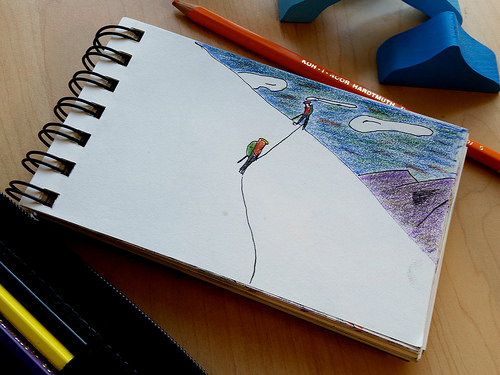
Alpine start. (All rights reserved)
My mother was born in America but her first language was Polish. She still speaks with a hint of an accent if you know to listen for it. I took for granted any appreciation for my Polish heritage for most of my life. When I was young, I was teased for being a “Polack,” which, I was crudely informed through jokes, were stupid people. So I conveniently hid that part of me for a while and emphasized my Hungarian, English and German heritage from my father’s side whenever national background mattered.
Now that I am older and thankfully more mature, I’m fond of my collective heritage. I’ve always enjoyed my Polish traditions at Christmas Eve and at Easter — two of the holiest days of the year for Catholic Poles. Still, I never thought that I would have any real reason to have pride in being Polish. Poland, to the best of my knowledge at one time, was merely another country ransacked by the Soviets and the only amazing people from there were Pope John Paul II and Lech Walesa. Later I learned of alpinists Wanda Rutkiewicz and Jerzy Kukuczka, though I only thought of them as alpinists, not as Polish alpinists… until recently.
My perception of Poland changed in the context of mountaineering. I read Freedom Climbers by Bernadette McDonald (2011) at long last. Between responsibilities with family, work, and helping my wife launch her start up (which opened on Monday), my reading habits have relied on taking small sips rather than large gulps, as author Stephen King would put it. Albeit for me, very small sips.
McDonald’s book has won several awards, including the 2011 Banff Mountain Book Festival Competition and the 2012 American Alpine Club Literary Award, among others. At the outset of reading it, I didn’t think there was anything that special in the first few chapters. I already knew much about Wanda Rutkiewicz, Jerzy Kukuczka and Artur Hajzer as well as a little about Krzystof Wielicki. They were all great Polish alpinists, and Hajzer is still attempting winter ascents of the 8,000 meter peaks that haven’t been summitted those days. But by the middle, and certainly by the final two chapters, I realized that McDonald didn’t tell me why I needed to learn about them all together as a group, she showed me. I had to go on her journey — chapter by chapter — to get fully get it.
Freedom Climbers is the story of some — but not all — of the significant alpinists that made Poland the Himalayan powerhouse of the 1980s and 90s. She demonstrates through examples, told through short biographies, and explaining the historical context of the economic and social forces shaping their environment, to show why what they accomplished was so important in the climbing realm and even of greater significance in the idea of human freedom.
I’m tempted to repeat McDonald’s punchline and restate some of her conclusions about why they were so prolific in the Himalayas, but they lose their force of truth without the examples and stories that precede them. Instead, here is a sampling of what made them so impressive: They were poorer than any other nationality of climbers, ca$e in greater numbers and yet spent the most time in the Himalayas. Their gear was inferior and often homemade and yet they created new routes in the most awful conditions, including winter. Despite lack of government permissions and other support, they were innovative in gaining mobility and visited the mountains other than their beloved High Tatras.
The book also brought to light a climber that previously escaped my attention, or at least qualities that I didn’t know he had: Voytek Kurtyka. For me the story begins with a mountain seriously ambitious alpinists consider beautiful: Gasherbrum IV. It’s a 7,000-meter peak, but may have qualities that are tougher than any of the 8,000ers, including K2. Kurtyka was part of the two-man team that first ascended the high, vertical Shining Wall.
While I could recount his other notable climbing accomplishments, like his ascent of Nameless Tower in the Karakorum, what fascinates me most about him is the combination of his accomplishments and his philosophy toward the mountains and climbing. In many ways, he’s helped me — through the writing of Bernadette McDonald, of course — understand climbing at the level David Roberts has delved into the questions of why do we choose to suffer so to climb, through cold, avalanche risk, damaged or ruined relationships for the experience of a climb.
Kurtyka developed a philosophy that borrowed from and closely resembles the Buddhist Middle Path and the Samarai Path of the Sword. He wrote about it and called it the Path of the Mountain. He drew his energy from nature, but only the mountains would satisfy his desire for connection; only in the mountain environment would he face fear, anxiety, exhaustion, hunger and thirst and peer into another level of his soul and finding a special peaceful place.
This approach brought Kurtyka to face high challenges that were private. Climbing the 8,000ers in a day when his former climbing partner Kukuczka was racing Reinhold Messner to top out on all 14 was the antithesis of Kurtyka’s climbing style and spiritual goals. He climbed for 30 years and constantly pushed the limits, not unlike Steve House today. What may have kept him alive and successful, McDonald argues, was that unlike Kukuczka, he never allowed his ability to detect and weigh risk be pushed aside; she cites numerous “strategic and hasty” retreats that seemed irrational at the time but proved to be “mystical” and insightful.
I’m grateful McDonald told this story. It’s a wonderful narrative, full of mini-biographies and gives a better understanding of the struggles under the Soviets and what greatness actually entails.
Thanks for dropping by again. If you enjoyed this post, I’m sure you’ll enjoy following the Suburban Mountaineer on Facebook and/or Twitter, because if you’re like me, you believe climbing matters, even though we work nine to five.
 The Suburban Mountaineer