Most action happens during the fall, which is the case for major league baseball and, more importantly, mountain literature. With the literature, both the Boardman Tasker and the Banff Mountain Film & Book Festival are letting the world know that they have curated the year’s new mountain publishings into their short lists.
And then there are the grand prize winners. Boardman Tasker will be announced at the Kendall Mountain Festival on November 20, this year. Banff’s Book Competition was presented on November 5.
Banff has a five stage process that starts in late spring and runs into November: Nominations, evaluation by pre-readers and jurors, a long list in solid nominees in each category, a short list of category winners, and a grand prize awardee chosen from the category winners and celebrated at the festival. And you can follow the stages starting with the publishing of the long list on the Banff Centre website. It’s a reliable source for good book recommendations.
I was pleased David Smart was on the Banff short list for his recently-released new biography of Antonia Pozzi, Among the Pale Spires: The Life and Verse of Antonia Pozzi, Alpine Poet (2026). Smart is the Editorial Director of Gripped Magazine, and he’s written several other enjoyable books, including award winning biographies. (I think his books are more interesting than Bernadette McDonald’s biographies, but its not really a competition, since their different subjects.) I also highly recommend his memoir of his youth, which you can read about here.
(Here’s a quick side note about Gripped: It’s available in paper form and wonderful for being a classic climber’s magazine. It has exclusive photos, interviews involving the biggest stories, essays, gear candy reviews, and destination advice. Like someone else said, it belongs on a crate in an old climbing gym but I like it best in my bag for work in between appointments. I recommend subscribing to a climbing print magazine because it supports the community, written word, and, well, print.)
Well, all of these book lists and awards are action if you’re into this stuff. I am, of course, and despite not prioritizing this T.S.M. blog regularly like I used to, I can’t escape the joy I get from it. I even got a surprise in the mail that fanned a flame.
I arrived home from work just before Natalie and the kids. They bounded through the door and I didn’t get the traditional, “Hi, Daddy!” Rather, Natalie asked, “What did you order now?
She was holding a cardboard box the size of a shoe box from Patagonia. I didn’t know what it was; I hadn’t ordered anything.
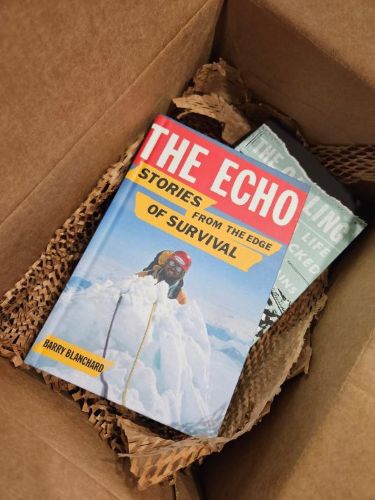
It turned out Patagonia Books sent me Barry Blanchard’s first book in paperback and his new book in hard cover. There was no note, but this is how we’ve done it before. They wanted me to review it.
Barry rocks and I reviewed his first book, Part I. (the blue book under The Echo in this post’s photo), which you can read here.
I have been reading The Echo: Stories from the Edge of Survival {2026) mostly in sips rather than gulps. Even when I tried to finish it before Halloween “more important things” (sigh) got in my way.
But so far, it’s a great memoir of a good guy and a mountaineer that has lead a wonderfully successful life. There are parts that made me grimace, like when he was climbing Chomolungma solo and he was concerned about his health. The way he described his condition was crude, mildly funny, but it was still gross. And, it was Barry, all the way.
The book is written like a journal with dates and even time so you can follow along and face the choices, uncertainty, and joy minute-by-minute. This took me a while to embrace. It felt choppy for the first three chapters until I got in tune with Barry’s story telling and rhythm. I was telling Natalie that it felt cheaply put together, but I don’t think so any more. The entries have continuity and are closely tied together for the book. It wasn’t arranged in haste as I felt.
Barry references reading in camp often. And he read many climbing books in his down time. They inspired him. It struck me that reading isn’t just for escapism, it’s for participants. Plus, it seems, while many climbers today don’t read, climbers do read.
My favorite portion in the first third was his retelling of his solo of Kusum Kanguru. He opens with a passage by Felice Benuzzi in No Picnic on Mount Kenya (1947):
Our ignorance proved an insuperable handicap from the point of view of material achievement; but from the spiritual point of view, which is of far greater importance to the true mountaineer, it was a gift from God. Every step led to new discoveries, and we were continually in a state of amazed admiration and gratitude. It was as thought we were living in the beginning of time, before men had begun to give names to things.
I will finish sooner than later. I am aiming to have it done before Thanksgiving (the American one.) Barry’s longueurs more than anything are keeping me going. The downtime in camp, dealing with out demons, anxieties, and settling on what matters is the spiritual part that Benuzzi and Barry know are of far greater importance. They’re in all the good and especially the great climbing books, because it’s human, not artificial. And celebrating these works and books in the fall makes it the best time of year.

