Lots of News from Alaska

For those of you closely following the discussion over determining the greatest climbers of all time (and there are a lot of you, it turns out), I’ll be posting an updated list of nominees momentarily, then on Monday morning I will post the list of the five greatest climbers of all time.

Today, however, we’re taking a break to take a look at some news from Alaska, including news on Clint Helander’s remarkable season.

I love this time of year. In between the Himalayan and Karakorum seasons, the best news starts coming in from the Alaska Range, St. Elias, and other peaks surrounding the Yukon River Valley and more:

  • Mt. Laurens — Graham Zimmerman and Mark Allend made the first ascent of the NE Buttress on Mt. Laurens (10,042ft.), which they rated V A1 AI4 M7, 4,650 ft. It’s along the rarely trampled Southwest Fork of the Lacuna  Glacier.
  • Citadel — The East Face of the Citadel in the Kichatna Range allowed Ben Erdmann, Jess Roskelley and Kristoffer Szilas to make the first ascent of the Hypa Zypa Couloir (ED: AI5+, M6+, 5.10R, A3, 1100m). They suffered some minor frost bite to their fingers and managed to complete their ascent and descent in 70 hours.
  • Broken Tooth — This one is my kind of climbing tale: Alaska native Jay Rowe, completed a 20-year quest, which included 11 attempts, to complete a line up the Broken Tooth along the Coffee Glacier. Rowe finally summited with partner  Peter Haeussler. Even after 20 years, Rowe doesn’t consider himself done; according to Alpinist: Rowe intends “to climb routes on each of the major peaks that make up the Mooses Tooth massif. In total, Rowe has climbed five of those summits…” This should be worth following.

Still, the biggest accomplishment comes from someone soon to join the ranks of big Alaskan climbers, like Joe Puryear, Jack Tackle and Bradford Washburn. We’ve talked about him a few times before.

Lee Anderson recently posted this on the TSM Facebook page and I wanted to make sure everyone saw it:

Clint Helander has just completed what can almost be termed a mythic series of tests and accomplishments in the first part of this climbing season in Alaska. [They] include: (1) First ascent of Apocalypse [Peak] with Jason Stuckey, (2) skied out of the Eldridge Glacier to the road with Travis Zuber, Jeff Barnes and Evan, (3) third ascent of Mount Huntington’s Phantom Wall with Kurt Hicks, (4) Moonflower to the summit of Mount Hunter and [(5)] over the West Ridge, Denali with Ryan Johnson.

The use of the word mythic is appopos. It reminds me of the climbing seasons of Colin Haley, the way he stormed through multiple significant challenges.

As evidenced by Clint’s own FB posts, he’s ceaselessly energetic and positive. While he has had his set of failures in the mountains, his attitude has certainly propelled him over each speed bump along the way.

Well done, Clint!

As always, I appreciate you stopping by for a read once again. If you enjoyed this post, please consider following the Suburban Mountaineer on Facebook and Twitter.

Climbing matters, even though we work nine to five.

Your Nominees for the Greatest Climbers of All Time

This is part IV of this series on determining who are the greatest climbers of all time. You can catch up on reading at the beginning by clicking here: Greatest Climbers.

Yesterday, on Facebook, I shared a rubric to help determine who are the best climbers of all time. I’m working to narrow the list to the greatest climbers — meaning only five and no more than 10. But first, I wanted to share with you the full list of the 43 climbers that you have suggested might be among the greatest. They’re listed in alphabetical order.

  1. Amedeo, Luigi
  2. Anker, Conrad
  3. Beckey, Fred
  4. Bielecki, Adam
  5. Bonatti, Walter
  6. Boardman, Peter
  7. Boukreev, Anatoli
  8. Brown, Joe
  9. Buhl, Hermann
  10. Caldwell, Tommy
  11. Cassin, Riccardo
  12. Desio, Ardito
  13. Diemberger, Kurt
  14. Haston, Dougal
  15. House, Steve
  16. Humar, Tomaž
  17. Kaltenbrunner, Gerlinde
  18. Kor, Layton
  19. Kukuczka, Jerzy
  20. Kurtyka, Voytek
  21. Loretan, Erhard
  22. Lowe, Alex
  23. Messner, Reinhold
  24. Paradis, Marie
  25. Park Young-Seok
  26. Pasaban, Edurne
  27. Peck, Annie Smith
  28. Prezelj, Marko
  29. Rebuffat, Gaston
  30. Rutkiewicz, Wanda
  31. Scott, Doug
  32. Sharma, Chris
  33. Shipton, Eric
  34. Steck, Ueli
  35. Tasker, Joe
  36. Terray, Lionel
  37. Tillman, Bill
  38. Urubko, Denis
  39. Viesturs, Ed
  40. Whillians, Don
  41. Wielicki, Krzysztof
  42. Wiessner, Fritz
  43. Workman, Fanny Bullock

I’m a little concerned, as Katie Ives indicated, that we might be underrepresented in some respects. The only climber from China, Korea, Japan, Nepal, India, Pakistan and that region of Asia I have named thus far is the late Park Young-Seok. He was the first person to climb all 14 of the world’s 8,000-meter peaks, the Seven Summits and reach both poles (the so-called Grand Slam of Mountaineering.)

Also, I will be making a naming the greatest female climbers of all time in a separate list. Women climbers have faced unique, and in many ways harder, challenges in the sport over the past century and they deserve to be featured in a way that honors and celebrates their accomplishments.  I may solicit and add more names for consideration, and a rubric must be a drawn up. Let me know if you have any thoughts on this.

I appreciate you stopping by for a read once again. If you enjoyed this post, please consider following the Suburban Mountaineer on Facebook and Twitter.

Climbing matters, even though we work nine to five.

Click here to view the next post in this series.

Who Are the Greatest Climbers of All Time III

So we’ve been discussing how to determine who are the best climbers of all time. We’ve gotten good guidance from Katie Ives of Alpinist and mountaineering historian Bob Schelfhout Aubertijn. I encouraged you make your own list of you thought was deserving — some of you shared your picks on The Suburban Mountaineer’s facebook page — thanks; they were helpful in ensuring the final list considered a complete list of nominees.

At the end of this post, I share the list I wrote over two-months ago before I started this quest. Now, after reading this criteria for determining the best, my original set of names seems laughable in some respects. I saved chuckles for you on that note for last. First, let’s look at the rubric:

BARE MINIMUM FOR CONSIDERATION
1. Objectives —
The peaks and routes sought must be of a grand scale and pushed the limits of what was believed to be possible at the time.

2. Climbs’ Duration —– The American Alpine Journal requires that the entries be about climbs longer than a day and that rule ought to apply here too. It will be the minimum threshold on this point. Climbers will get additional favor if in addition to scaling the peaks in their back yard, also ventured into foreign territory where customs and complicated logistics are part of the broader route to the top.

3. Routes’ Difficulty — The difficulty must include the challenges of an alpine climb and at the highest grades of the period the climber climbed. Some handicapping (sorry to use a golf term, folks, but it works well here) is done here; for example, using oxygen tanks at altitude in the 1930s is quite different than using them in the 1990s.

4. Lead Historic First Ascents or Established Significant New Routes — This means even memorable repeats are out and so are strong climbers that collect climbs or did things for their nation. So sorry to Ed Viesturs (a hero regardless) and Erhard Loretan (a strong high altitude climber), your quests were thrilling to follow, but you don’t pass the bar.

SEPARATING THE GREATESTS FROM THE GREATS AND HONORABLE MENTIONS

5. Creativity — This may have been the key factor, though clearly not the only one. The standard here is about conventions. Did the climber work within the conventions of the day to excel? Or did the climber innovate to disregard the normal path. Examples can range from the invention of specialized gear to the establishment of a new route over previously thought unclimbable terrain.

6. Climbing Style — This could be the most subjective factor. It might also be the one factor where the values of “great” climbers 100 years ago are quite different from what is valued today. For this test, the climbers must embrace and exhibit the use of small teams and taking little gear. This does not require the climbers to have adopted a fast and light ethic, but rather an independent alpine approach with only a few companions, little support and minimal fixed ropes.

7. Purity of Approach — While approach is related to the climber’s style, it is also about what the climber seeks and his/her respect for the mountain and any traditions related to the culture around the peak. A climber seeking a mystical or spiritual experience will be rated higher than someone looking to be in the record books.

8. Influence on Climbing — It’s theoretically possible that a climber that fulfills all of these criteria might not be influential. To be influential, the climber must have notoriety. Climbing in a vacuum by not sharing your first ascents, style and other accomplishments is wonderful and pure but doesn’t give to the climbing community. If anything, climbing in secret gives doubt about first ascents and attempts for future climbers. Notoriety is an element of being among the greatest because they’re example leads a way for others to follow. Notoriety isn’t necessarily synonymous with influence and I recognize that as well, but it is an important factor in determining who among us is the greatest.

I’d appreciate any thoughts or reactions on this list of factors for consideration. Shoot me an email, leave a comment or hit me up on Facebook or Twitter.

Okay, so here it is. This is my original list as promised. Before you laugh too hard, remember that it was before I got your input and developed a rubric. This list was merely a starting point. If you chuckle, please don’t keep it to yourself. Let us know what you thought.

The list is also 17 names and not 20 as originally advertised; after I jotted down the unranked list I went back only to share it for a couple of special purposes. It remains unranked now as I first wrote it because to order them now would be based on what I know and believe now, not what I thought then.

Reinhold Messner
Jerzy Kukuczka
Denis Urubko
Fritz Wiessner
Fred Beckey
Voytek Kurtyka
Barry Blanchard
Mark Twight
Steve House
Vince Anderson
Marko Prezelj
Lionel Terray
Anatoli Boukreev

POSSIBLE HONORABLE MENTIONS:
Colin Haley
Hayden Kennedy (up and coming)
Ueli Steck
Simone Moro

Here are some quick notes reflecting on my early scribblings:

Some of the names, like Twight, House and Haley are rather contemporary. I wasn’t sure they could stand a test against some of the old school mountaineers, and yet I suspected that they’re modern attitude toward the sport might match up to some historical accomplishments.

I left off Ed Viesturs. He was once a hero to me and he is still a role model. While he means something to many Americans, his mountaineering accomplishments were not progressive or influential. He was conservative and enjoyed his quest to reach the top of all the 8,000-meter peaks. I like him for that but he can’t be among the greatest in the scope of the history of climbing.

Voytek Kurtyka has recently become my favorite alpinist. He climbed on his terms, skirted death many times from a Zen-like outlook, and made some significant first ascents in the Karakorum. Yet, even when I wrote this, I wasn’t sure he’d make it to the final list. I’ll let you know…

I appreciate you stopping by for a read once more. If you enjoyed this post, please consider following The Suburban Mountaineer on Twitter and Facebook.

Climbing matters, even though we work nine to five.

Click here to read the next post in this series.

Who Are the Greatest Climbers of All Time II

26034742254_d78378a64c

Good morning, K2. (All rights reserved)

I’ve been surprised by the amount of feedback that I’ve received from my question of who are the best climbers of all time. The comments have come from personal friends, regular readers and those of you that follow TSM on Facebook and Twitter.

I also reached out to several people asking for their list, but two of them gave me something more valuable than their opinion: I got guidance.

However, there was a down side. In giving guidance, the sense that I was assuming a daunting project only swelled after I received their thoughts.

Katie Ives and Bob Schelfhout-Aubertijn were my sources for help. Katie is the Editor-in-Chief of Alpinist and a former juror — no, not at the Piolet d’Or, thankfully — rather the Banff Mountain Book Competition. Her work and her team at Alpinist scrutinizes the accomplishments in climbing based on their place in history, style and philosophy.

In an email, Katie shared the questions that ought to considered in order to produce a credible list:

It’s hard to make lists of top ten greatest climbers–do you take into account the quality of routes vs. the quantity? Difficulty vs. style vs. remoteness? Do you look at climbers from all nations? Do you look at their routes in and of themselves or at the historical impact? Do you consider the philosophy that drove them? Or, as Alex Lowe would say, do you consider the climber having the most fun? There are obvious names of legendary mountaineers who have appeared many times in print. But what about the great climbers who haven’t made it into history books?

Okay, so there’s nothing to it.

My friend Bob is a mountaineering historian that specializes in K2 but has a broad breadth of mountaineering knowledge and natural skills suited for such research, including an excellent memory for details. Bob took some time to reply and when he did I received a memo, four pages long, single spaced and plenty of names. Before he got to his list of names, he shared his rationale for weighing true mountain climbing and alpine climbing more heavily over other styles of climbing.

For anyone that has worked on their own list (and I encourage you to write one up before my next post), you better read what Bob had to say too:

First off, and this applies to both categories, what are the criteria?  What makes a good climber or mountaineer an outstanding one?  With regards to rock climbers I would suggest it’s all about the grades they manage to successfully master, the style they apply, and the philosophy they bring into the game.  I am full of respect and stand in awe of their stunning achievements, but what appeals more to me is the versatility and the wide[r] scope that can be found in mountaineering.  In that discipline one needs more than just agility, athleticism, pure strength, or bold courage.  IMHO mountaineering is more of a craft then what we encounter in [rock]-climbing [or bouldering, let’s include that one as well here].  My preference to mountaineering has got to do with that bigger scope where it is important that a participant is gaining a degree of experience in all fields of the game; rock, ice, mixed alpine, maybe even the greater ranges like the Himalaya.  On top of that, it’s more of an overall adventure, as you need knowledge about weather, and more diverse dangers awaiting you, about the effects of altitude, about cultures, languages and people.

Feel free to fill me in when you think I’m missing certain aspects, but the steady progress from a novice, to becoming an experienced one, to an exceptionally outstanding mountaineer, lies in the quality of the skills the managed to build, the length of their career, and the big leaps forward they manage to make in alpinism.  That last item is more a thing that has to do with philosophy, I think; the way they form a new view on how things can be done differently.  In my humble opinion that may very well be the most important aspect, the one defining characteristic that separates the [“merely”] good ones from the extraordinary climbers and mountaineers.

So, please forgive for making this distinction, but else I wouldn’t be in the position to answer your question as you may have expected.  As much as I respect and have big admiration for the big names in the history of [rock]-climbing, to me it’s not the same type of appreciation as I experience for great names in mountaineering.  Don’t get me wrong; the likes of Paul Preuss, John Gill, Royal Robbins, John Bachar, Jim Bridwell, Wolfgang Güllich, Kurt Albert, Alex Honnold and the brothers Iker and Eneko Pou would probably tick most or all of the boxes listed above, but with their qualities and agility, their vision and fantastic skills I consider them to be “superbly athletic rock artists”.  As such they operate in only a narrowed playing field and don’t make use of many skills and qualifications that are needed for big mountains, mixed terrain, unknown territories or geographic “blanks on the map”, nor do they need to.  Their “unknowns” are the next couple of meters of rock that they have to scale, the “unknowns” of new techniques, new methods to improve their physical and mental strength and maybe the scariest of all; courage.  Well, at least I suggested a couple of names there :-)

Mountaineering to me is [so much] more than “climbing”, so I hope the preceding didn’t come across like talking out of the back of my neck.  [No need to answer; that was a rhetorical question I just reflected on to see where I was going…].  The main reason why I did this was because I didn’t want to send you a tsunami of names; I had hoped to limit my list to three or at five persons at max, or else we’d be better off writing a new encyclopaedia about the “who’s who” of mountaineering history.

Bob’s point about the hierarchy of approaches to climbing and the objectives has to be taken into consideration, and I think that will bother some of you. I’ve got my prejudices, and you’ll probably see them in my next post on this question, where I’ll lay out a rubric for determining the best climbers of all time. After I do that, I’ll share my original list, which might be amusing to those of you playing at home.

Feel free to leave your thoughts in a comment. And if you enjoyed this post, please consider following The Suburban Mountaineer on Twitter and Facebook.

Click on this link to read Part III of this series on The Suburban Mountaineer.

Climbing matters, even though we work nine to five.

To read the next post in this series, click here.

Who Are the Best Climbers of All Time?

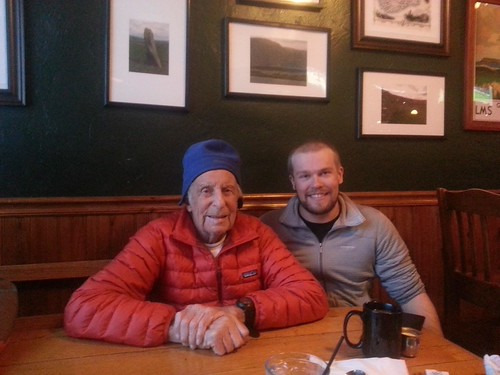
The Great Fred Beckey (left) and Ryan S. (Dusin Byrne 2013)

My friend Ryan posted a photo on Facebook of himself with an old man wearing a Patagonia down jacket and a simple fleece cap. I was impressed, “liked” it and the next day when a colleague who climbs dropped by my office I shared it with her on my smartphone. No reason that she should recognize Ryan or the 90-year old man, but I thought at least the older person’s name, Fred Beckey, would set off some conversation.

It didn’t.

She tried to play it off coolly, and nearly got away with it but I guessed her silence indicated something else. So I went on to tell her about him and his many first alpine ascents in North America. We proceeded to talk about who’s who in climbing on and off for the next few days.

Our conversation over those climbers was the celebration in climbing I missed this year because of the Piolet d’Or. The 2013 Piolet d’Or was a disappointment to nearly everyone that follows the award. All seven teams nominated were awarded. Instead of bringing focus for comparison and the inevitable disagreement, the biggest criticism this year was over the jury’s indecision. They didn’t even make an arbitrary decision, which, to some degree, is necessary for the Piolet d’Or to be credible, even if the recipient declines the golden ice axe and denounces the annual ceremony as contrary to the spirit of climbing. For everyone else that simply loves climbing and admires the climbers, identifying the best brings focus by identifying role models, heroes and heroines and their style and philosophy.

By considering Fred Beckey’s climbing accomplishments, for instance, my friend and I felt closer to him and a little closer to each other because we both valued what he has done. Whether or not he is our favorite climber ever, he was certainly a hero.

So I have started on a little journey. It’s somewhat of a quest. I want to identify who are the best climbers of all time.

I’ve been pondering this question for over a month now. I developed my own list of 20 names, which I’ll share later. I reached out to several friends with knowledge of climbing greater than mine in various areas of the sport, from rock to alpinism and from around the world, and asked them who are the top five climbers of all time? I asked without sharing my list; I didn’t want anyone to be steered.

They’ve all given me answers and some I didn’t expect. What’s clear was the question was stimulating. It made me feel a little more alive, especially when someone recommended someone that I did not put on my list; what did they see that I didn’t? I had to ask whether my list was wrong. Was I looking at this from too strong of a North American prism? Were they? Do you?

I’ll fill you in on the conversation from the past month in the next few posts. Definitely check into some more on this topic on Twitter and Facebook. For now, have a good weekend and I’ll catch-up with you later…

Click on this link to read Part III of this series on The Suburban Mountaineer.

Climbing matters, even though we work nine to five.

To read the next post in this series, click here.

Everest Distractions, Mooses Tooth and K2 at First Sight

The first image of K2 as taken by Jules Jacot-Guillermod in 1902 and recently purchased in auction by Bob Schelfhout-Aubertijn in 2011.

The first photographic image of K2 as taken by Jules Jacot-Guillermod in 1902 (Bob Schelfhout-Aubertijn / Top of the World Books)

So you’ve heard about the fiasco that pulled Wool Stick (ahem, that’s Ueli Steck, actually), Simone Moro and Jon Griffith off of Everest this past weekend. There was a dispute that turned physical around a protocol that was unique to siege-style climbing, which was in conflict with the freedom of climbing unsupported in alpine style. There was even some early speculation that there than me have theorized that the self-centered Western climbers (in general, who are usually guided clients) haven’t treated the Sherpa and other native assistants with the respect they deserve and that the Sherpa and other assistants are now lashing out, but doesn’t seem to be panning out to be the case.

Still, Chad Kellog through Facebook called the event a “show stopper.” Melissa Arnot — who played a leading role in settling the conflict — was disturbed by the events and had to regroup in order to continue guiding. Garrett Madison, a guide that played a role managing the Sherpas for a commercial expedition, has been attempting to explain both sides of the conflict. But Simone Moro claims Madison’s story was “completely false.”

It’s sad that whatever goes on around Everest is more akin these days to the adventures from the History Channel television show Ice Road Truckers than pure climbing. In pure climbing, it’s about the style and the achievement, but the journey alone might be the achievement. In the TV show, the goal is to go from point A to point B on treacherous terrain to deliver machine parts to a remote Canadian diamond mine, return and collect your reward. The promo calls it “the dash for the cash.” When you’re dashing for reward, what’s the journey worth?

I wish all of the mountains were a place where it’s just the climber and the wild. However, on Everest, its less wild (in the natural sense) because it’s the domain of the commercial guiding companies, and you have to play by their rules, whether you’re on their “expedition” or not. At least that’s how Moro, Steck and Griffith felt, I’m sure.

Mooses Tooth

It’s also a shame that the banter about Steck, Moro, Griffith and the Sherpas on Everest have dominated climbing news; this story from the Alaska Range has been more significant in terms of actual climbing: The Mooses Tooth, which rises like broad daggers on the east side of the Ruth Glacier, saw a lot of activity including the first free ascent by Scott Adamson and Pete Tapley. They also pitched a bivy that Alpinist accurately called “Dr. Suesse-esque”.

Be sure to click those links on the Mooses Tooth climb; they’re well worth your time.

Unpacking

On a gentler note, Natalie and I are unpacked and settling into our new place. It’s nice to see my gear in one pile in the basement. It’s been in an attic-like space, mostly out of site, for too long. My mountaineering library is on shelves and has also been reunited with the rest of my modest collection; its a disjointed grouping and is actually overflowing the bookcase.

Next to the bookcase is my desk set against a blank wall. I’ve been thinking about acquiring some special climbing-inspired art for years. While now may not be the right time financially while paying private school tuition, but I do like to browse and the blank space has been tempting me…

Climbing Art on K2

I would like to own my own mixed-media piece by Renan Ozturk or even a sharp, well-composed photograph by Alexander Buisse, but another piece holds a certain fascination, especially after writing that series on K2’s first photograph.

Do you remember when I talked about my acquaintance with Greg Glade? He was one of the references cited in Alpinist 37 about the first photo of K2 along with Jules Jacot-Guillarmod (the photographer) and Bob Schelfhout Aubertijn (the climbing historian and collector). Greg is the merchant.

Greg’s shop, Top of the World Books, is a unique bookstore located not far from Vermont’s Green Mountains in North America. It specializes in arctic and mountaineering books, both new and collectibles (drool), plus artifacts, historical reproductions, DVDs, and even art in the form of prints and posters.

Bob, the current owner of the Jacot-Guillarmod image of K2, has made a general print and a limited edition high-resolution print available for purchase through Greg’s shop, Top of the World Books.

This image, originally captured on delicate glass plates, was taken in haste. As you can see in the picture at the top of this post, there is some remnant equipment in the foreground on the path up the Baltoro Glacier. This was the first time the 1902 expedition probably saw the mountain. They stopped and gasped. Nothing in Europe compared. At that moment, the climbers, including Aleister Crowley, either were inspired or fearful — maybe a little of each — because they had come fully intending to, at minimum, climb higher than anyone else had ever climbed.

When you know that, you can see it in high res print of the first image of K2. Maybe it says something else to you.

It might not hang on the blank wall where I live now, but maybe at my next home. Maybe you’ll appreciate it even more than me; go check it out.

Thanks for dropping by again. If you enjoyed this post, please consider following the Suburban Mountaineer on Facebook or Twitter. Climbing matters, even though we work nine to five.