Mountaineer’s Remains Given up by Glacier

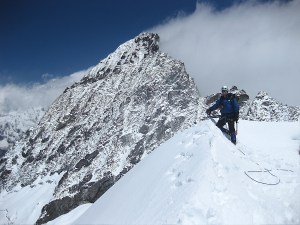
In the Tyrol region of the Alps – the same region where Reinhold Messner is from – the remains of a climber that went missing from the town of Matrei in 1957 was found.

The report from the Associated Press gives limited detail, but the remains were likely discharged from the glacier it was found near. Only bones and a hiking boot were found.

Such discoveries are made occasionally at the edge of glacier. Glaciers move at their own slow rate, advancing somewhere around six to twenty inches per day. Some people like to refer to them as frozen rivers, though that description is imprecise, it illustrates that it is not static. Airplanes that have crashed on mountains have vanished completely, presumably being covered in fresh snow, or buried in avalanches and slowly joining the glacier. Parts of the plane and its contents may show up decades later.

Presumably, this missing climber from Matrei either fell to his death or stumbled into a crevasse. This is the dark, tragic and lonely part of our sport.

Rest in peace, climber.

Thanks again for dropping by. If you enjoyed this post, please considering following the Suburban Mountaineer on Facebook or Twitter.

Source: “Remains of Mountain Climber Found After 54 Years,” Associated Press, August 12, 2011.

The Guides of Mount Rainier

To date, 1981 was the worst year on Mount Rainier in terms of climbing deaths. That year, eleven climbers died in an ice fall along the Ingraham Glacier. Lesser incidents happen frequently and people get hurt from the various occupational hazards of mountaineering every year on the mountain. Often when trouble happens, someone whips out their cell phone and dials 911 and then maybe the Global Rescue Hotline.

The climbers in danger often get through to a dispatch involving the Washington police or to the National Park Service. However, it isn’t the park rangers or the police that often arrive first, but rather the professional mountain guides from Alpine Ascents International (AAI), International Mountain Guides (IMG), or Rainier Mountaineering, Inc. (RMI), the three guide “concessions” permitted to lead groups on Mount Rainier by the National Park Service. They’re presence is nearly perpetual throughout the busy climbing season from May through September.

The Rainier guides’ often serve as first responders to their own groups and other climbers ascending and descending the slopes independently. They can respond with first aid, technical equipment for a crevasse rescue, leadership and an enhanced line of communication with other help providers. Notably, guides must be physically fit to endure a slog to the summit but then have the stamina, whenever necessary, to go the extra mile for when something horrible occurs.

Their knowledge of the mountain and its conditions are invaluable in these circumstances, but perhaps the most crucial element is their “bedside manner.” Most guides are hired not because of their climbing resumes (they often become star climbers after serving as a Rainier guide) but because they have both the knowledge and fitness required but also the ability to teach the skills of climbing and have patience doing so. They will show you how to get your harness on, tie into a rope party, and slow themselves down to go at their client’s pace.

The Rainier guides have a lot of admirable qualities, whether you experience an accident or are being shepherded up the mountain, just based on their job description and how they have been utilized. Regardless of the proverbial safety net around the mountain, we should all be stronger, more knowledgeable and have more patience too. Those things keep us all safer.

Thanks again for dropping by. If you enjoyed this post, please considering following the Suburban Mountaineer on Facebook or Twitter.

Sources: 1) 2009 Accidents in North American Mountaineering, American Alpine Club, 2009; 2) Mount Rainier National Park website; 3) Filley, Bette, The Big Fact Book About Mount Rainier: Fascinating Facts, Records, Lists, Topics, Characters and Stories, Dunamis House, 1996; 4) Viesturs, Ed, with David Roberts, No Shortcuts to the Top: Climbing the Worlds 14 Highest Peaks, Broadway Books, 2006.

Rainier’s Cramped Camp Muir

If you’re trying to reach Mount Rainier’s summit (14,410 ft./4,392 m.), most climbers pass through Camp Muir on its southern face. It makes sense. At 10,080 ft. (3,072 m.), it is the most accessible fixed camp to any trailheads to get you in position for the summit day, assuming you are trying to get up and down in two to three days.

It is named for John Muir (of course) because it is located at the same location that he, Philemon Beecher Van Trump and five others camped in during the ascent of August 1888. The site was suitably protected from some of the winds that strike the mountain by the nearby rock features. Since then, the area has been a common halfway point when ascending from the Paradise Valley.

The first hut was built there in 1916. It was the size of a large bathroom or a small bedroom and its stone walls were three feet thick. In 1921, a bigger hut was established and the 1916 structure was made into the Park Company’s guide house on the mountain and later into a cooking house used by the guide concessions. Today, the National Park Service says there is enough space to sleep 110 people there. But when they say “space,” they don’t mean within the walls of the buildings. While the camp is first come first served, permits from the National Park Service regulate the capacity of the Camp Muir area. Don’t be surprised if you need to pitch your tent nearby.

Climbing guide author Mike Gauthier recommends navigating by compass on the ascent; fog, white out or other conditions of low visibility can make the terrain very difficult to read. He also says a map from the park rangers with compass bearings to Camp Muir is also very helpful. Once you arrive, you can take a rest and take in the view, like at the Mount Rainier National Park’s new Camp Muir Webcam.

The route to the summit from Camp Muir takes several different paths, while the path to camp from Paradise is one herding trail. So in many ways, the route fans out from there, and the 110 capacity is often met in the popular summer months and around the weekends.

It has to be said: This is not a route to gain a wilderness experience. It is popular, crowded and often uncomfortable. People pack into the fixed shelters and sleep very close. Everyone still shares the established toilets. As Bette Filley put it in her book, The Big Fact Book About Mount Rainier, “Some have described Camp Muir as half way to Heaven, while others claim it’s half way to Hell.”

The key is to keep in mind you’re climbing to the summit and not Camp Muir. It’s just a check point along the journey.

Thanks again for dropping by. If you enjoyed this post, please considering following the Suburban Mountaineer on Facebook or Twitter.

Sources: 1) Gauthier, Mike, Mount Rainier: A Climbing Guide, The Mountaineers Books, 1999; 2) Filley, Bette, The Big Fact Book About Mount Rainier: Fascinating Facts, Records, Lists, Topics, Characters and Stories, Dunamis House, 1996; and 3) National Park Service website.

Rarely Visited Sikkim: 2010 Expedition

Paul Swienton on the summit of Lama Lamani with Jopuno in the background (Swienton personal collection, rights reserved 2010)

Day dreaming of alpine mountains that are rarely seen and trampled by Westerners can be difficult these days. The Khumbu Valley may seem like it is being overdone. Going to Patagonia is hardly remote any more. The solution might be the Sikkim region of India, which is wrapped in Nepal, China, Tibet and Bhutan.

I recently learned of the region and its potential from alpinist Paul Swienton of Maryland at the Blue Ridge Section meeting of the American Alpine Club (AAC). Swienton was a member of a 2010 expedition of Scottish mountaineers lead by Geoff Cohen, who lead other Highlanders Bob Hamilton, Richard Isherwood, Steve Kennedy and David Ritchie. Together they intended to make only the second ascent of a new route on Jopuno (5,936 m.) in West Sikkim.

Sikkim was explored in the early days by Alexander Kellas — the first authority on high altitude mountaineering — in 1907 and 1921, but was virtually inaccessible for nearly 50 years while China, India and (to some extent) Nepal squabbled over the rights to Sikkim. During that period, few ventured in to climb or hike. The disputes were resolved in 2004 and Roger Payne and his wife Julie-Ann Clyma stormed in to establish themselves as the Western authorities on the climbing there. Payne’s article on Sikkim in the 2008 American Alpine Journal inspired the 2010 expedition.

Swienton reports on the 2010 climb in the upcoming 2011 American Alpine Journal. If you are an AAC member you can read it now before the book is in print in the members-only part of the website. I won’t repeat what he reports on there, but rather provide some interesting and informative pieces that the expedition learned in 2010.

While the expedition’s main objective was Jopuno, the team also climbed the west face to Lama Lamani’s “North Top” (5,650 m.) for a second ascent by a new route and Peak 5,500 m. (between Jopuno and Lama Lamani) for a first ascent.

The expedition attempted Jopuno last and worked to establish a feasible new route for its second ascent. However, due to dangers on the other proposed routes, the group decided to climb the original route up the West Ridge. In addition, one of the climbers was not sending at full strength due to altitude sickness. Around 5,450 m., the team roped up again on another icy section to attain rock, though covered in snow. Further up, the “black rock” section (a stretch of 300 m.) was slow going and it became clear that the day was spent. Fortunately, this climb was more about exploration, camaraderie and alpine climbing.

Conveniently, these were all day climbs from the expedition’s high camps (approximately 4,900 m. for Lama Lamani and Peak 5,500 m. and 5,100 m. for Jopuno.) This allowed the expedition to function to keep gear higher up and maintain a full-working base camp with a kitchen (and plenty of Scotch whiskey) below.

The 2010 expedition members received much helpful guidance from Payne. He recommended the staff of Sikkim Holidays located in Sikkim to serve as the travel agent. The staff, including Barap Namgyal Bhutia, were extremely helpful in making transportation arrangements from Kolkata and Delhi (depending where the expedition members flew in to) all the way to Gangtok and Yoksam, as well as working with the Indian government on the expedition’s behalf.

One piece of advice from this expedition to the next says when hiring guides and porters in-country, be sure you know ahead of time who is expecting to be fed and what their role will be during the journey. There was a little surprise when the porters did not come “self-sufficient” and were expecting to fix ropes on the slopes to boot. So much for the alpine-style climbs! Fortunately, the expedition’s positive attitude won the day and the trip went smoothly.

Over all, the journey gives one hope in virgin peaks in, untamed exotic locations. In fact, consider this last point: there is no rescue service in Sikkim. So many other areas have infrastructure to be ready for the unthinkable. Here, it’s still wild.

Thanks for dropping by again. If you enjoyed the value of this post and many others, please consider following the Suburban Mountaineer on Facebook or Twitter.

Sources: 1) Paul Swienton of Maryland, USA; 2) Jopuno Expedition 2010 Memorandum/Report by the expedition party; and 3) Payne, Roger, “Emerging From the Mists: The Sublime Alpine Peaks of Sikkim, India,” 2008 American Alpine Journal pp. 112-127).

Bhutan is Forbidden but Sikkim is Open

When it comes to the Himalayas, you probably think solely about Nepal and Pakistan. Well, India and China have some big peaks too, and so does the country of Bhutan. In fact, the mountains to the east of Nepal are rather interesting as I was recently reminded.

The highest unclimbed mountain may never be topped out and may remain the highest unclimbed mountain indefinitely. It seems the only way anyone will climb Gankhar Puensum (7,570 m.) on the China-Bhutan border is to cheat; it’s a sacred peak to the Bhutanese, like all Bhutanese mountains, and climbing it is forbidden by law.

Interestingly, China has helped enforce that edict once. However, that may have more to do with spiting the Japanese who were seeking approval to climb the mountain. It’s just a guess since things are not always friendly between them.

The region between Nepal and Bhutan, east of the third highest mountain in the world, Kangchenjunga, is Sikkim. For all practical purposes it was shutdown to mountaineering and travel in general because it was disputed by Nepal, China and India. In 2004 China released its claim and things settled down. While there are sacred peaks in Sikkim, there are several that are designated as “alpine peaks,” which are available to be climbed with a permit.

At my last American Alpine Club section meeting (Blue Ridge Section), I was introduced to a member of the 2010 Expedition to Sikkim. Their primary aim was Jopuno (5,936 m.) for a second ascent by a new route. Anyway, I’ll tell you more about Sikkim, the expedition and the opportunities later… There is a lot to tell.

Thanks for dropping by again. If you enjoyed the value of this post and many others, please consider following the Suburban Mountaineer on Facebook or Twitter.

Rainier’s Elevation Controversy

During my research time on Mount Rainier I regularly came across an inconsistency. Some of the references to Mount Rainier list it as 14,410 ft. and others add on a foot to make it 14,411 ft. above sea level. So which is it?

The National Parks Service lists it “officially” as 14,410 ft. and so does National Geographic’s Trails Illustrated Map (No. 217) of the park. But a new measure, done in 1989 by the Land Surveyors Association of Washington, placed its elevation a foot higher.

While some respect the new measurement, most others – including the National Parks Service – are slow to update their maps and records. Maybe they never will. Measuring elevation is more of an art to get at science. Today, surveyors use high tech equipment like lasers and satellite GPS. However, the key information inputted to provide the output of elevation is still based on several judgment calls. These judgments include what might (or might not be) accepted as the average sea level as a starting place and then using that data and applying it to a location many miles away from the sea. It’s remarkable that we can get as accurate as we can.

So which is right? Well, if you are not certain you can always take the approach of Alpine Ascents International, one of the guide concessions in the park; as of July 5, 2011, their website reports both (one in the header and the other in the body) on their Mount Rainier Program page.

But does it really matter? Not in such a minute denomination. When Bradford Washburn and National Geographic revised Mount Everest’s height it was more dramatic – adding on six feet. After all, it doesn’t change the fact that Mount Rainier dominates Puget Sound’s skyline.

Thanks again for dropping by. If you enjoyed this post, please considering following the Suburban Mountaineer on Facebook or Twitter.

Sources: 1) Hill, Craig, “The True Measure of a Mountain,” The News Tribune, Feb. 16, 2009; 2) Mount Rainier National Park website; 3) Alpine Ascents International website; and 4) Filley, Bette, The Big Fact Book About Mount Rainier: Fascinating Facts, Records, Lists, Topics, Characters and Stories, Dunamis House, 1996.