Nepal’s Unclimbed Peaks

Happy Wednesday.  We are all a little closer to a long weekend to hit the trails or kick back. 

I recently heard that the Nepal counts approximately 120 unclimbed peaks in its region of the Himalayas.  However, some climbers say the number is much higher and could include 300 other summits. 

The reason for this discrepancy could be the way Nepal officials and the mountaineers are identifying and counting peaks.  For instance, peaks with names in North America are given names because the high point rises a certain distance over its surrounding landmass and stands a minimum length away from other points.  Nepal may do something similar on its official maps where it records peaks. 

If mountaineers are claiming that additional peaks are not being counted by Nepal, it is probably because they recognize numerous mountains or peaks not properly identified by Nepal.  The only other explanation is that there are far fewer peaks actually climbed than Nepal has knowledge of, which, if true, should be suspicious to climbers.  Perhaps the Alpine Journals and American Alpine Journals and such records might prove better research if that were the case. 

Notably, another Himalayan peak may be summited this October in Nepal.  Chekigo Peak (20,528 ft./6,257 m.) will be the goal of a friendship expedition of Bangladesh and Nepali mountaineers.  I will update you with any additional news on this when I hear about it. 

Thanks for visiting again.  If you enjoy these posts, please consider being a fan on Facebook.

Bigger Send than Everest: Olympus Mons

Before I ever got into climbing in middle school in the 1990s, I knew the answer to a great trivia question: What is the name of a mountain bigger than Mount Everest?  The answer is Olympus Mons.  It is a sheild volcano with a broad, elevated caldera on the planet Mars.  It is approximately three times the ascent (measured from base to summit) of Everest, standing 27 km./17 mi. above Mars’ mean surface level.

What would be the challenge of sending such a peak?  Other than getting to Mars, the climber would be facing a myriad of different challenges.  For one, from base to summit, the mountain climber would be in a space pressure suit, dependent on that environment.  If the suit was suitable for the climb, it might make the ascent as easy as climbing a small peak in the thick air of sea level.  Would several days and camps be necessary?  Probably not.  One reason this mountain is so high is because Mars’ gravity is much less than earth’s.  Gravity keeps many of earth’s mountains more compressed and thereby closer to sea level.

Weather, however, would be a problem.  Mars commonly has numerous dust storms that may make climbing difficult.  It might be possible for the climber to bring a bivy shelter (not exactly a tent) to use as added protection from the winds and debris of a storm.  The bivy would probably be anchored into the side of the peak.

Here is an article that was published late last week on other peaks in the Solar System if you’re looking for more possibilities.

Well, I’ll cover a peak that we can actually go to in my next few posts.  And if you enjoyed this post, please consider following The Suburban Mountaineer on Twitter and Facebook.

Backpacker: Triple Divide Peak

Backpacker online (not the print edition, or else I would have caught it already) covered a great scramble in Glacier National Park in Montana.  The mountain also has a unique geological characteristic. 

Triple Divide Peak (8,020 ft./2,444 m.) in the Lewis Range may not be the most beautiful mountain, but it’s bare and looks like a great escape.  Its snowmelt and rain water feed rivers that deposit drainage into the Gulf of Mexico, Hudson Bay and the Pacific.  Because Hudson Bay feeds the Artctic Ocean and the Atlantic, some like to claim the mountain feeds three oceans. 

Strict geographers disagree, but it would not stop me from climbing and thinking about how it drains into three distant bodies of water. 

Thanks for visiting again, and remember that you can always follow these posts on Facebook.

In the Anchorage Bowl and Up Ptarmigan Peak

Ptarmigan Peak by Szalay 2004

Looking east toward Ptarmigan Peak's pyramid, just off the Powerline Trail (All Rights Reserved 2004).

Good morning.  I went through some photos from my trip to Alaska I took several years ago and thought one hike was worth sharing; while most hikes are in Denali National Park and Preserve or on the Kenai Peninsula, visitors often overlook the convenience of peaks in the Anchorage Bowl. 

Anchorage is surrounded on three sides by water and ringed by the Chugach Mountains on the eastern side.  If you are visiting Alaska for the first time and possibly only time, I recommend you hit up the traditional sites, like Wonder Lake for Denali, Talkeetna for beer, and Resurrection Bay for dramatic scenery.  But if you have a day or so in Anchorage, as I did when I was waiting for the friend I was visiting to get out of work, a hike or climb up Ptarmigan Peak (4,880 ft./1,487 m) might be called for. 

The mountains outside of Anchorage are often overlooked, and for good reason.  The peaks are small compared to the others deeper in the Chugach Range, or in the Wrangell-St. Elias region.  When there is plentiful supply of big, beautiful mountains to be had, the hills surrounding Anchorage can easily be dismissed.  

As many visitors to Anchorage do, we visited Flattop (3,510 ft./1,070m.) in South Anchorage at the Glen Alps entrance of Chugach State Park the evening I arrived.  Flattop is known as the most climbed peak in Alaska.  Perhaps because of its popularity, it reminded me a tourist trap (of course, I think Niagara Falls would be so much nicer if the casino and railings were removed).  But the view was nice.  But it was near the trailhead I first saw Ptarmigan Peak. 

The peak is named for Alaska’s state bird and it has beautiful lines.  Later in the week, after visiting some more exciting landmarks of the 49th State, I returned to the Glen Alps trailhead and hiked down the Powerline Trail approximately three miles before turning right and heading up the spongy slope to Ptarmigan Pass. 

I was hoping to scramble up the steep north face.  After moving delicately and foolishly over the scree field I soon realized why this field was here; the slope was full of rotten rock.  Much of it came apart as I gripped the wall.  Since I was climbing alone, I opted for a more conservative approach to the top.  While I did not know if then, back in 1997 a group of students from the University of Alaska were practicing here and two died and 11 were seriously injured from a fall, according the 1998 edition of Accidents in North American Mountaineering

The western ridge from Ptarmigan Pass provides a mostly narrow path to the summit.  Portions are only three feet wide and the views to the tarn below can be thrillingly dizzying.  The last one-hundred feet or so require some scrambling and is not for the faint of heart.  A rope and a partner may be recommended for most travelers. 

Return the same way, hop back on the highway and head for Snow Goose and order a beer from the Sleeping Lady Brewery.  If the weather is right, you might catch a glimpse of Denali from their back deck. 

Well, if you enjoyed this post, you may follow the Suburban Mountaineer on Facebook.

Vittorio Sella’s Photography Reviewed

I hope everyone had a good Oktoberfest weekend by enjoying some brew and perhaps a brat, like I did.  If not, hopefully you were out on the trail. 

This weekend I came across a review by Mark Feeney of the Boston Globe of the work of the great mountain photographer Vittorio Sella, who’s work is on display at the Panopticon Gallery in Boston.  Sella followed the Duke of Abruzzi, Luigi Amedeo, around for several expeditions.  These trips included the legendary journey by the Duke that named the most direct route up K2, the Abruzzi Ridge. 

Here is a sample of Sella’s work at this link.  The sample does not do him full justice.  Sella’s finished work in Europe brought the strange lands of the Himalayas and elsewhere to life the way National Geographic had in a time when the work beyond our borders was alien, not just exotic. 

Sella, as well as Amedeo, are responsible for advancing mountain exploration and inspiring climbers and mountain photographers like Bradford Washburn and their successors.  While some of us may wish the mountains were as mysterious today as they were then, it is thanks to their work that we can plunge into the great ranges with knowledge of the risks and dangers of the terrain and weather. 

So here is an Oktoberfest toast: To Vittorio — Proost! 

If you enjoy these posts, you can follow them on Facebook.

Analogue Altimeters Promote Better Mountain Skills

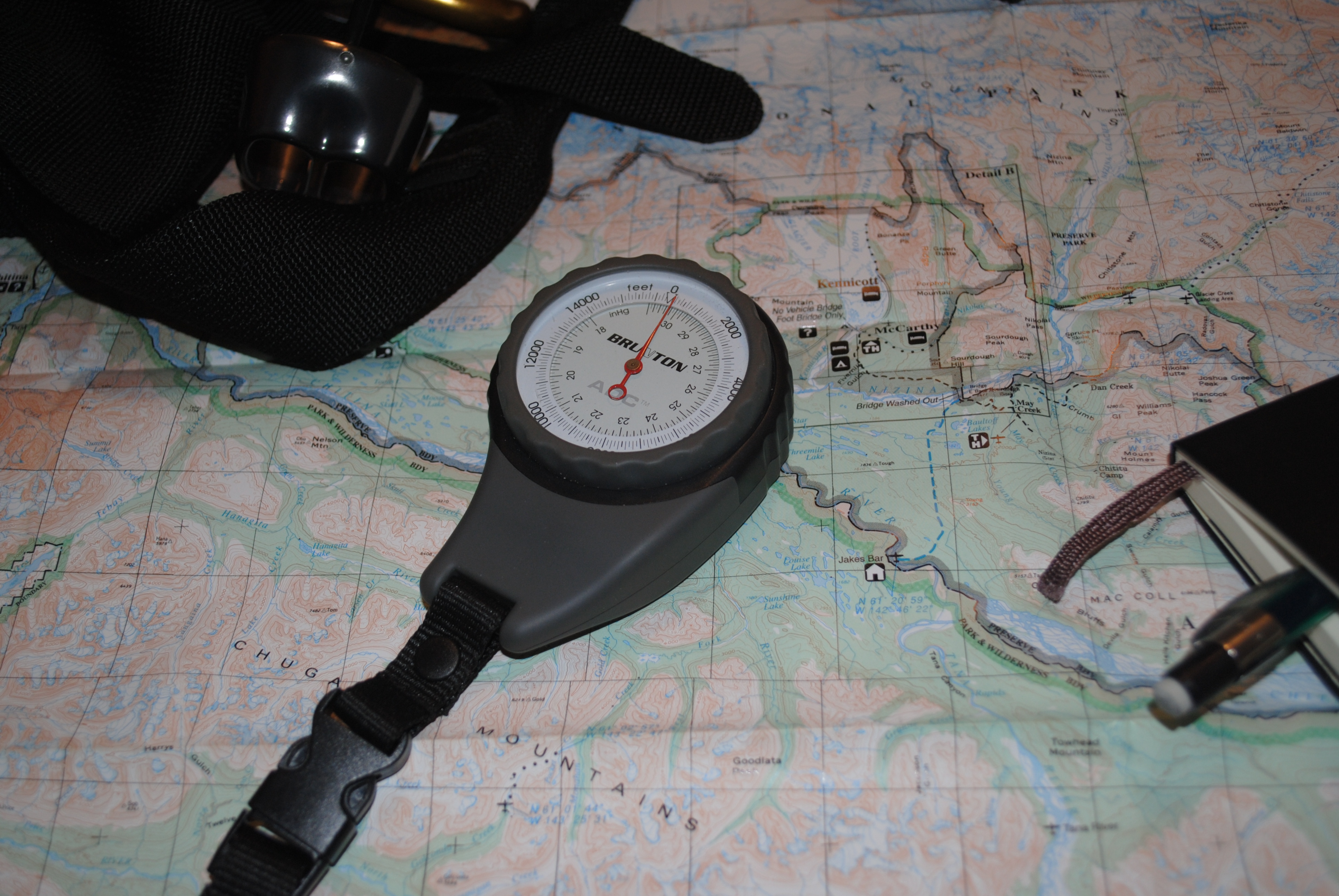
ADC Ridge analogue/aneroid altimeter (Szalay 2010).

There are a number of devices on the market that can determine your elevation, or to use a cooler mountaineering term: altitude.  While pilots may use any type of altimeter, such as radar altimeters, alpinists only use aneroid altimeters.  Aneroid altimeters measure the barometric pressure, or the air’s weight, to correspond to the altitude.

Digital altimeters, like the watches from Suunto or Casio or a GPS device with elevation output, and analogue altimeters, like my ADC Ridge shown in the picture above all have pros and cons.  Digital altimeters are also aneroid devices, which use a barometric scale that corresponds to altitude, but the output of data is presented digitally instead of on a pressure gauge.  The biggest advantage of a digital device is that it distinguishes barometric pressure changes from weather system from real elevation changes; analogue altimeters require the user to make the adjustments manually.  The downside is that digital devices are electronic and dependent on batteries though both are equally susceptible to moisture.

The analogue altimeter requires a bit of work to operate.  To properly determine your elevation with an analogue instrument you must adjust the dial to place the known elevation at the appropriate altitude.  However, the device requires the user to confirm higher elevations on its gauge at known points, to counter for non-climbing changes to the detected barometric pressure.   This requires the user to be using their navigation skills.  In this way, the altimeter compliments a hiker’s or climber’s information about his or her location, but it doesn’t replace map and compass skills.

In fact, if used properly, the analogue altimeter can help the hiker or climber be more aware of his or her terrain.  The compass determines bearings, the map can identify topography, and an altimeter can help confirm both.  By comparison, a digital altimeter provides the same output, but an analogue instrument encourages the user to actively think about the clues of the landscape.

Thanks again for stopping by. If you enjoyed this post, please consider following The Suburban Mountaineer on Twitter and Facebook.