Love Your Shell: Care for It

EMS Shell jacket

Shells' water repellancy and breathability diminish with time and wear; do something about it.

Two things: Your so-called three-season rain jacket probably is not made of polyurethane, so the “proof” qualities will wear away without care.  Also, if you find the breathability of the jacket suffocating now, don’t replace it; there is a better way.  Same goes for winter shells. 

While proper water-proof shells are basically durable plastic bags, like the Helly Hansen Voss jacket and pants, they are really only good at keeping the wind and rain out if you are reasonably sedentary.  We bird watchers or the Queen’s guard should appreciate these shells a great deal.  These “rubber” shells are non-breathable and require little-to-no care. 

Breathable jackets that use Gore Tex, HyVent DT, Conduit and other brands of treatment require maintenance to maintain optimum performance.  For those of us stuck in Peaklessburg, our shells are probably worn year-round but rarely get to see “action” on the trails or up a route.  Still, wearing it every day is every day wear.  Your sweat clogs the pores on the inside of the jacket, preventing it from breathing, and both the sun and the rain skim off the protective water resistant coating.  Both are reparable. 
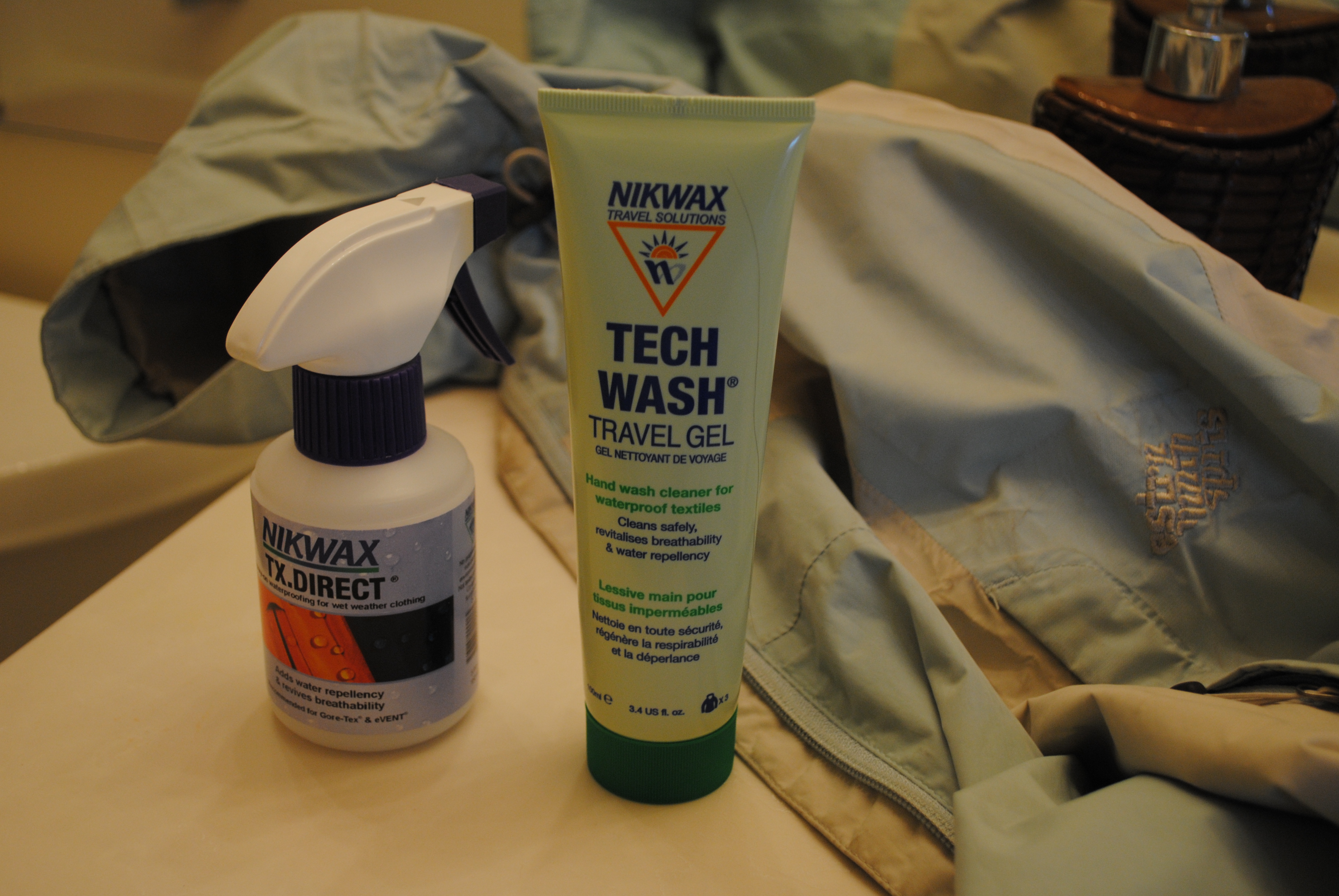
Nikwax treatmentTo restore breathability, the shell needs a wash, especially on the inside.  I like to hand wash my jackets and snow pants, so I get a bucket and fill it most of the way with water (leave room for the garment) and two caps full of Nikwax Techwash Gel.  Gently massage the fabric.  Sometimes the garment’s label might be in conflict with the recommended water temperature for the Techwash Gel, which is warm.  If the shell says wash in cold water I put just a little hot water in first with the cap full of Gel just to activate the soap, and then fill the rest with cooler water. 

Once the shell dries most of the way and still a little damp, I lay the garment flat and systematically spray every section of the shell with Nikwax TX Direct.  The shell needs some water moisture on it to properly receive the spray treatment.  If it over dries prior to spraying, run it through the shower for a moment.  Be sure to put an unused trash bag under the shell before spraying: the spray can leave tiled floors quite slippery.  Follow the instructions on the bottle, which calls you to wipe off any excess spray and water from the garment after a few moments.  Then repeat on the other side before allowing it to hang dry.   

Some of us could have had a fashionable leather bomber jacket for what we paid for our shells.  We ought to care for them so they give us a great deal of protection over a long time, from the snow, rain, and ice.  Maybe even some protection from city smog. 

If you liked this post on The Suburban Mountaineer, consider subscribing to my feed.

Dragons, Dracula and the Future of Climbing

The Open Championship was held this past weekend.  I know what you’re asking, what does this have to do with backpacking and climbing on our vacations?  Clearly the heat in Peaklessberg has gone to Andrew’s head.  Well, something the color analyst said about the up and coming generation of golfers struck me about our own sports.

He said that television and the Internet have transformed players’ knowledge and their ability to prepare for those golf courses.  They can see golf courses they have never played, like St. Andrews or TPC at Sawgrass, and know where the hazards lie or the way the ball will roll over a particular part of the green.  Golfers today come to these courses more knowledgeable than golfers before.  For example, when players from the United States and Canada in the 1960s went to play St. Andrews in Scotland for the first time, the only guidance they had was a rudimentary rendering of the layout of the course.  So when Jack Nicklaus (golf’s version of Reinhold Messner) first arrived at the Old Course, he could not predict or know what precisely the ball would do at various aspects of the course.

One hundred years ago, backpacking and mountaineering was also guided by rudimentary guidance about the territories we explore.  But since the 1950s and 60s, these sports have evolved upward as well.  Maps, trail guides, and route reviews online have exposed what was once a mystery of topography.  While man, as a species, has not yet been to every point on earth, there is little secret about what is there… generally speaking.

The big, obvious mountains have all been conquered and some of the lesser peaks too.  One day, it will be recorded in Alpine Journals that all the peaks have been climbed.  There ought to be a celebration at that point.  It would be a significant junction, where the touching the points ended and the familiarizing ourselves with the intimate aspects of the mountains and climbing might begin.  Only, this familiarization has already begun in many of the great ranges, such as the attempts on the infamous Magic Line up K2 or the new route up Mount Foraker in Alaska, aptly named Dracula, which was just scaled this June.

The age where there is a blank on the map is over.  Finding dragons in the unknown is a preposterous idea.  We cannot stop this trend from happening, where the map is being filled-in and the peaks are being bagged.  But the thrill of making an ascent yourself – your own first – or creating your own route will never be surpassed.

Ten Priorities for an Outdoor Vacation

  1. Go somewhere the Blackerry and cell phone gets no signal.
  2. Get up early at least once and watch the mist rise off the lake.
  3. Stay up late to watch the stars, and then sleep in.
  4. Hike, climb or paddle hard and finish the day with an ice cold beer.
  5. Find a great vantage point, lay out the map and match each point within view to its name.
  6. Cook something over an open fire.
  7. Use a pocket knife for something other than opening a beer bottle. 
  8. Play cards with friends on a rainy day.
  9. Upon reaching your destination you see a peak not too far off, look it up on your map and say “what the heck,” and go exploring.
  10. In-country, cook a meal you thought you would only find in a restaurant. 

Long Underwear, Please – So What if it’s August!

While the weather here in Peaklessburg is going to be sunny, 90 degrees (with and a ruthless dew point of 65), some were recently reminded that winter-esque activities can be found year round if we are willing to travel across the globe.  For instance, today’s coverage of the World Cup in South Africa shows fans shivering in the stands at the brink of winter and a person who recently bought an ice axe on Ebay from me a month ago indicated he plans to use it to climb in the Andes.

However, one of the complications of preparing for an alpine adventure in Peaklessburg – during any time of year – is that the brick and mortar outfitters do not carry the specialized gear necessary and the staff’s knowledge is left entirely to hearsay advice on those topics.  The local REI, for example, does not even carry one basic ice axe or a pair of crampons.  What if a customer was going to climb in the Yukon Territory, where there are few-to-no places to gear-up upon arrival?  Of course there is the ability to shop on the Internet, but you cannot return climbing gear for any reason because of liability issues, even if the length, fit or weight is not satisfactory.  Perhaps outfitters in the south should at least have samples of alpine gear at the outfitter from which to judge comfort issues of weight and length and base making online purchases or special orders through the outfitter.

I have run into this issue with outfitters here regarding full grain leather boots and long underwear as well.  Sure, full grain leather boots are hot and uncomfortable in Peaklessburg where I bought them from a salesman that thought I was 1) throwing away money, and 2) should be buying a heavily ventilated mid-top sneaker he was pushing on me.  He clearly had never hiked in the Adirondacks where the Asolos I bought excel in crossing streams, traverse trails soaked by runoff and keep my feet comfortable despite the inevitable deep mud.  The less expensive mid-top would have left me wet and less supported under my loaded pack.  I also had difficulty obtaining long underwear for trip to Alaska, just because I was traveling in August.

Outfitters may be located in a certain region, and their staff may be most knowledgeable with the local climate and conditions, however we live in the jet age.  We travel, at least sometimes, to exotic locations.  As backpackers and mountaineers, the allure of what else is out there is very exciting.  It is too bad the stores in flat, featureless metropolitan areas are still limited in their expectation for what their customers may want to do.

Don’t Leave Your Binoculars Behind… Ever

Originally submitted at REI

New styling and high optical specifications characterize Nikon’s latest Action Series binoculars, designed for quality minded, outdoor enthusiasts.


Nikon Action 8X40 Binoculars

By SuburbanMountaineer from Alexandria, VA on 6/7/2010
 

I received these binoculars as a present right before a trip to the Coast Range in British Colombia. I used them to take in the slopes during our hike and choose routes — the wide field view is great for that. I then went whale watching in Boston last year and left them behind (along with a great deal else) to travel light. I did not miss my jacket, but these binoculars would have been invaluable.

They are nicely compact and I enjoy the wide angle view which works very well for landscapes and finding birds. They are not as powerful as some others I have used (once used pair from Bushnell) but it’s power was almost too much for landscapes and the bird only 200 yards away. The sole downside to this pair is that the lens caps may be lost easily. I recommend putting them in your pocket as soon as the binoculars are removed from the case.

Now, after the whale watching experience, whenever we visit friends out of town, or just run to Annapolis, I have them in a backpack in the car ready for birding or whatever tall ship may be coming through. Don’t leave home without them.

(legalese)

In Case of Emergency Light Fire, Almost

Despite all of the benefits a campfire brings, they are increasingly rare in the backcountry.  Fire can provide us with light and warmth, can cook our meal, ward off predators and give us comfort during a lonely night as if it were a companion.

It is too bad that they are rarely ever permitted these days, though for good reason: According to the U.S. Forest Service the leading human cause of wildfires are from campfires not properly controlled or extinguished.  Government land management agencies have largely adopted policies that prohibit campfires outside of existing fire rings and in some places, removed the rings altogether, except in established car camping areas along park entrances and roadsides.  In some ways, the prohibition on flames has made any occasion we get to make and enjoy a fire even more enjoyable.

Once we started camping in the backcountry, we all began loathing car camping and fire rings with grates over them for a ready-made grill.  Now in an era where Whisper Lite and Jetboil stoves are our source for flame in the wilderness, such fire pits are such a rarity they are a joy to be had.  Some of us may even have gas powered fireplaces we turn on with a switch in our homes, but there is a romance over making kindling and stoking a flame to health.

So when can we fire it up in the backcountry?  Check the land management agency’s rules before going out.  If fires are strictly prohibited or just because of a significant danger of forest fire, don’t even think about it.  That is, unless it is an emergency.  At least that is what every guidebook and experience backpacker will tell you.  Use a space blanket to conserve warmth if you did not just lose it with your pack foolishly crossing a river at high water.  Of course, I am assuming we all carry one – we all should.

My late Uncle Tom — the original Suburban Mountaineer — and I once made a fire in an “emergency.”  We were in the Adirondacks and our camp was visited after dark twice by a black bear.  Despite the prohibition in effect at the time, we gathered rocks into a ring and lit a match.  Never regretted it.  Then again, we were never penalized and no forest fires erupted either.  We just let the fire die out on its own overnight.  Of course, it helped that it poured all the next day.  In retrospect, it was a bad idea to allow the fire to smolder.

If I were injured and stranded, even in Yellowstone, where flame has generally been forbidden (by regulatory flexibility rather than fixed policy), I would probably light a log.  That’s what the survival books tell us to do.  But be careful.  Be sure to contain it and put it out properly before leaving camp.  I couldn’t bear one of us being responsible for ruining someone’s favorite stomping ground, including that unnerving bear’s.