AAI: Gourmet Backcountry Food for Backpacking

Some of you may recall that I enjoy good food.  This probably stems from living and working in one of the nation’s fastest growing citites.  Well, Jeff Ries of the American Alpine Institute has some great advice on gourmet backpacking foods on the Institute’s blog.  He gets it.  Here is his post…

Before leaving the trailhead, I like to have everyone enjoy the option of a treat from a nice bakery and offer everyone a scone or something similar. On the hike in on the first day I offer grapes and bing cherries at the first rest stop. They are a bit heavy to carry further but the water and sugar content are both well appreciated.

A good first lunch is some fruit and pastries, rather than a larger meal that could slow strenuous activity. I prefer eating a little around 11am and a little more around 2pm, so I offer snacks like fruit, gorp and energy bars. Gourmet crackers with flavored cream cheese, like Laughing Cow products work well.

It doesn’t take as much effort to carry a little more weight to the first camp, I splurge a bit with beef stroganoff on the first evening. I grill some fillet mignon medium rare a couple days before the trip; it will cook the rest of the way just before it is served. Then I cut it up into 1 inch cubes and freeze it. It will keep other foods cold on the hike in. I cook a stroganoff noodle mix and then add fresh sour cream, a little white wine and then the fillet mignon. The rest of the wine is served with or before the meal. If it is cold and rainy, I also serve soup. If it is hot and the climb has been tough, it is a good time for Frito’s or baby carrots dipped in french onion dip (made with the rest of the sour cream). Variations I have used for the first evening include grilled salmon instead of fillet mignon and apple slices dipped in carmel dip as the appetizer.

For the next morning, eggs and hash browns work well, especially with some tomatoes. I always have some flavored oatmeal for people who don’t like to eat eggs. A little ham and/or cheese is nice to put in the eggs. I boil some water for tea, coffee or hot chocolate before the main course.

The second lunch is a good time for fresh fruit; apples or oranges. I also like to provide some quality dinner rolls or flavored bread (last trip the bakery had spinach feta) with some flavored cheese spread.

Dinner on the second night is a good time for ham as it keeps well for 2 days and a night (as long as temperatures are not too hot). I serve soup if it as cold and cold beer if it is hot. If I have a campfire, I wrap some potatoes in foil and put them in or by the fire while cooking fresh broccoli. If there is no campfire, I slice the potatoes and boil them. Chocolate covered blueberries make a great dessert.

The rest of the trip breakfasts offer a choice of precooked Mountain House scrambled eggs with bacon (sometimes with potatoes – the skillet selection), flavored oatmeal, granola and of course coffee/tea/hot chocolate.

Lunch on the third day includes flavored wheat thins with extra sharp cheese and salami. If there is any fresh fruit left over, we finish it up today.

The third night’s dinner is time for something that keeps well for a few days. I prefer precooked flavored chicken breasts in a foil pouch, available at some grocery stores. I serve them with instant flavored potatoes and baby carrots. Chocolate covered espresso beans are a hit with the coffee drinkers.

Beef steak nuggets, Bakers breakfast cookies and dried fruit (different types) make great lunches an later days of a trip. Bagels and cream cheese also keeps well. Soup is always nice when it is cold and stopping for a long lunch, I sometimes build a campfire to warm bodies and dry clothing.

For dinner on the fourth and subsequent nights, I offer a variety of Mountain House brand freeze dried dinners. I want the backpackers to try different entrees so I bring several 2 serving choices. If anyone is still hungry after emptying the foil pouch in which it cooks, I add an envelope of instant potatoes and the appropriate amount of boiling water to make sure everyone has had enough. This keeps dish cleaning to a minimum as there are no dishes to clean these nights.

–Jeff Ries, AAI Backpacking Guide

Thanks again for visiting and remember, you can follow The Suburban Mountaineer on Facebook and Twitter (@SuburbanMtnr).

Hike Long and Stay Safe

Happy holiday, everyone, whether you’re celebrating Thanksgiving or Columbus Day! 

A local news station put out the total number of hiking deaths for climbing Colorado’s 14ers.  It came to 10 for this season.  As a percentage it is likely a small fraction, but the danger remains nonetheless. 

The article (see the link above) quotes an outfitter observing that many hikers and climbers probably do not feel they can get lost today. 

I agree.  Disorientation is rare today.  With our cell phones, maps and the majority of our population living in urban centers, we take what open space and natural hazards mean. 

The bottom line is, even for a day hike, plan ahead, pack the Ten Essentials, let someone know where you are going and when you are expected back, and if bad weather rolls in, take shelter or go home.  Stay safe.

If you enjoy these posts you can follow them on Facebook or subscribe to my RSS feed.

Backpacker: Triple Divide Peak

Backpacker online (not the print edition, or else I would have caught it already) covered a great scramble in Glacier National Park in Montana.  The mountain also has a unique geological characteristic. 

Triple Divide Peak (8,020 ft./2,444 m.) in the Lewis Range may not be the most beautiful mountain, but it’s bare and looks like a great escape.  Its snowmelt and rain water feed rivers that deposit drainage into the Gulf of Mexico, Hudson Bay and the Pacific.  Because Hudson Bay feeds the Artctic Ocean and the Atlantic, some like to claim the mountain feeds three oceans. 

Strict geographers disagree, but it would not stop me from climbing and thinking about how it drains into three distant bodies of water. 

Thanks for visiting again, and remember that you can always follow these posts on Facebook.

In the Anchorage Bowl and Up Ptarmigan Peak

Ptarmigan Peak by Szalay 2004

Looking east toward Ptarmigan Peak's pyramid, just off the Powerline Trail (All Rights Reserved 2004).

Good morning.  I went through some photos from my trip to Alaska I took several years ago and thought one hike was worth sharing; while most hikes are in Denali National Park and Preserve or on the Kenai Peninsula, visitors often overlook the convenience of peaks in the Anchorage Bowl. 

Anchorage is surrounded on three sides by water and ringed by the Chugach Mountains on the eastern side.  If you are visiting Alaska for the first time and possibly only time, I recommend you hit up the traditional sites, like Wonder Lake for Denali, Talkeetna for beer, and Resurrection Bay for dramatic scenery.  But if you have a day or so in Anchorage, as I did when I was waiting for the friend I was visiting to get out of work, a hike or climb up Ptarmigan Peak (4,880 ft./1,487 m) might be called for. 

The mountains outside of Anchorage are often overlooked, and for good reason.  The peaks are small compared to the others deeper in the Chugach Range, or in the Wrangell-St. Elias region.  When there is plentiful supply of big, beautiful mountains to be had, the hills surrounding Anchorage can easily be dismissed.  

As many visitors to Anchorage do, we visited Flattop (3,510 ft./1,070m.) in South Anchorage at the Glen Alps entrance of Chugach State Park the evening I arrived.  Flattop is known as the most climbed peak in Alaska.  Perhaps because of its popularity, it reminded me a tourist trap (of course, I think Niagara Falls would be so much nicer if the casino and railings were removed).  But the view was nice.  But it was near the trailhead I first saw Ptarmigan Peak. 

The peak is named for Alaska’s state bird and it has beautiful lines.  Later in the week, after visiting some more exciting landmarks of the 49th State, I returned to the Glen Alps trailhead and hiked down the Powerline Trail approximately three miles before turning right and heading up the spongy slope to Ptarmigan Pass. 

I was hoping to scramble up the steep north face.  After moving delicately and foolishly over the scree field I soon realized why this field was here; the slope was full of rotten rock.  Much of it came apart as I gripped the wall.  Since I was climbing alone, I opted for a more conservative approach to the top.  While I did not know if then, back in 1997 a group of students from the University of Alaska were practicing here and two died and 11 were seriously injured from a fall, according the 1998 edition of Accidents in North American Mountaineering

The western ridge from Ptarmigan Pass provides a mostly narrow path to the summit.  Portions are only three feet wide and the views to the tarn below can be thrillingly dizzying.  The last one-hundred feet or so require some scrambling and is not for the faint of heart.  A rope and a partner may be recommended for most travelers. 

Return the same way, hop back on the highway and head for Snow Goose and order a beer from the Sleeping Lady Brewery.  If the weather is right, you might catch a glimpse of Denali from their back deck. 

Well, if you enjoyed this post, you may follow the Suburban Mountaineer on Facebook.

Analogue Altimeters Promote Better Mountain Skills

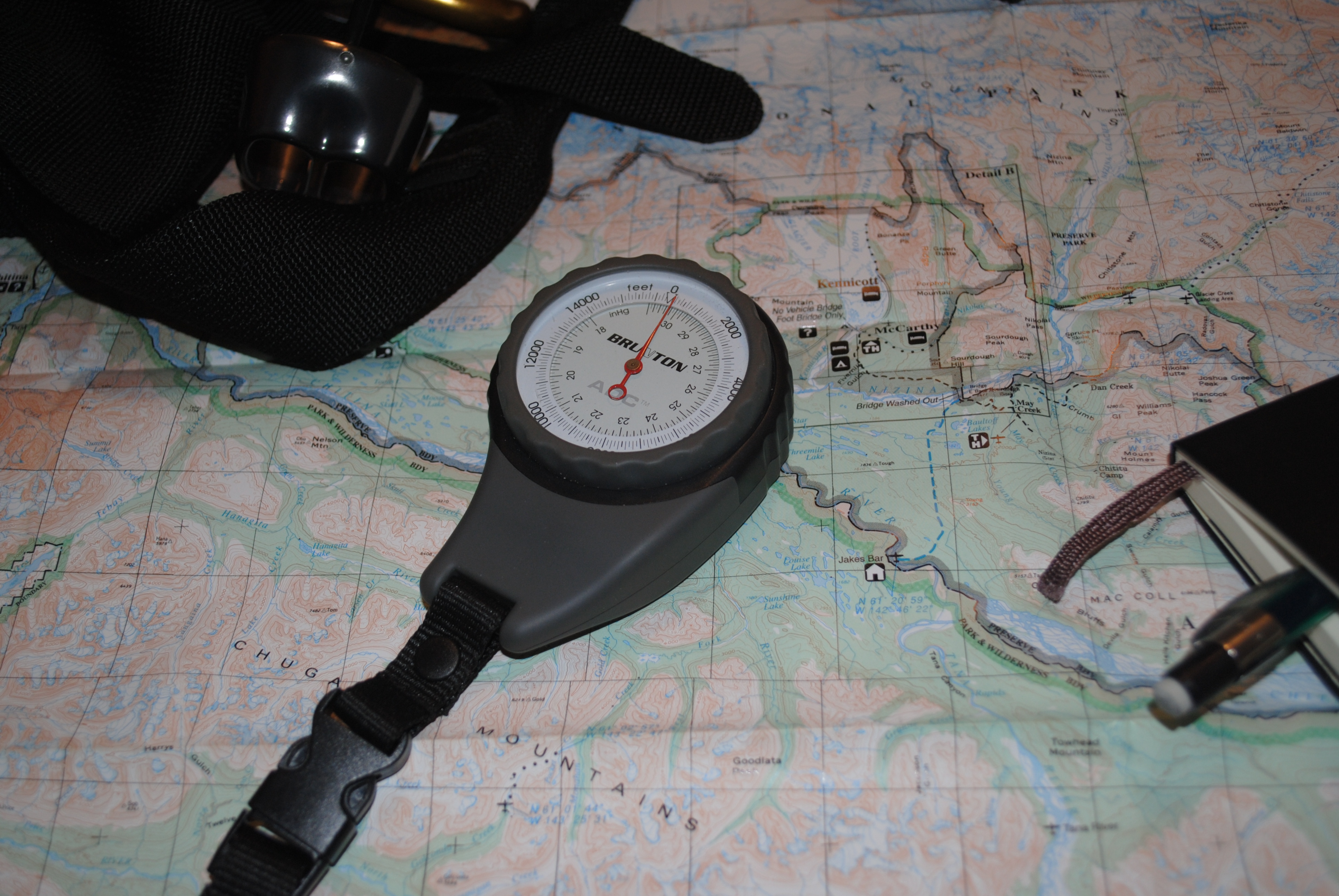
ADC Ridge analogue/aneroid altimeter (Szalay 2010).

There are a number of devices on the market that can determine your elevation, or to use a cooler mountaineering term: altitude.  While pilots may use any type of altimeter, such as radar altimeters, alpinists only use aneroid altimeters.  Aneroid altimeters measure the barometric pressure, or the air’s weight, to correspond to the altitude.

Digital altimeters, like the watches from Suunto or Casio or a GPS device with elevation output, and analogue altimeters, like my ADC Ridge shown in the picture above all have pros and cons.  Digital altimeters are also aneroid devices, which use a barometric scale that corresponds to altitude, but the output of data is presented digitally instead of on a pressure gauge.  The biggest advantage of a digital device is that it distinguishes barometric pressure changes from weather system from real elevation changes; analogue altimeters require the user to make the adjustments manually.  The downside is that digital devices are electronic and dependent on batteries though both are equally susceptible to moisture.

The analogue altimeter requires a bit of work to operate.  To properly determine your elevation with an analogue instrument you must adjust the dial to place the known elevation at the appropriate altitude.  However, the device requires the user to confirm higher elevations on its gauge at known points, to counter for non-climbing changes to the detected barometric pressure.   This requires the user to be using their navigation skills.  In this way, the altimeter compliments a hiker’s or climber’s information about his or her location, but it doesn’t replace map and compass skills.

In fact, if used properly, the analogue altimeter can help the hiker or climber be more aware of his or her terrain.  The compass determines bearings, the map can identify topography, and an altimeter can help confirm both.  By comparison, a digital altimeter provides the same output, but an analogue instrument encourages the user to actively think about the clues of the landscape.

Thanks again for stopping by. If you enjoyed this post, please consider following The Suburban Mountaineer on Twitter and Facebook.

Vermont’s Long Trail

The word Vermont was made from a loose version of French to mean green mountain.  The settlers adopted it in 1777 as a unique name for their land.  Arguably, the Green Mountain state would not have maintained its blend of rural life and passion for the environment without the establishment of the Long Trail.

The Long Trail was the brainchild of John P. Taylor, who back in 1908 came to Vermont to be an assistant principal at a local school.  He quickly noticed that while the area was rich in hills and woodland, there were no established trails for the community to enjoy and benefit from them.  In 1910, the Green Mountain Club was formed and his idea for a trail spanning the state through the Green Mountain range was adopted as the club’s own.

The trail is the oldest long distance trail in the United States and claims to have inspired the creation of the larger Appalachian Trail.  It was built between 1910 and 1930 and covers 272 mi./438 km. from East Mountain in Massachusetts to Quebec.  Approximately 100 mi./ 160 km. of which are shared with the AT until Sherburne Pass near Killington, VT, where a popular ski resort is located, as well as the Inn at Long Trail.

The Inn at Long Trail has been a traditional stop for through hikers of the AT and the Long Trail.  I’ve often wondered if the Irish pub at the Inn or the services they offer (beer and laundry services provided for a modest fee.)  Rooms are also available at a discount, when rooms are available, on a hike-in basis (literally) only.

The trail ascends several popular peaks with summits above timberline, including Camels Hump (4,083 ft./1,245 m.) near Waterbury, Mount Mansfield (4,393 ft./1,339m.), which is the highest point in the state and near Stowe, and Jay Peak (3,858 ft./1,176 m.), which is just south of the border with Quebec.  While every hike has potential dangers from trail conditions, weather and wildlife, I always appreciate the Long Trail for its simple elegance that follows a simple formula of putting one foot in front of another to take you to the next milestone or scenic outlook.

When I hike portions of the Long Trail or its adjacent trail network in the warmer months, I always carry the Ten Essentials plus my hiking staff and camera.  In the winter, I highly recommend the snowshoes of your choice (the bigger the better though, particularly in the middle of the snowy season).  Some summits during winter cannot be reached with snowshoes alone, particularly those above timberline.  Turn back if you are not trained and equipped with crampons and an ice axe.

Had the Long Trail not been established, ski resorts and mountain-side homes may have become even more common throughout the state.  The trail remains a landmark and a symbol of the conservation efforts to Vermonters and people like me far away in Peaklessburg.  I hope you get to try it or its adjoining trails out sometime.

Thanks again for visiting.  Remember, you can also follow these posts through Facebook or by subscribing to my RSS feed.  Happy hiking and climbing!