What I am Reading Now

Rock Climbing Virginia, West Virginia, and Maryland (Szalay 2014)

Have you ever flown over big snow capped mountains someplace? Do you remember being glued to that foggy airplane window?

I had the rare opportunity to enjoy a beer the other night with a friend after Wunderkind and Schnickelfritz went to bed. After we talked about our kids we talked about travel and adventure. His brother flies from Alabama to Alaska for work periodically. He said the first time he went, when it was clear enough to see outside the plane’s window, he saw a mountain goat on a cliff side. That goat, except for its own abilities, it would have otherwise been stranded. Remote and unreachable.

His brother feels that this is illustrative of what Alaska’s wilderness was: A frontier with places that no man could go.

As for other frontiers — those of the mind and page — let me share with you what is on my current reading list:

John Quillen’s self-published book, Tempting the Throne Room: Surviving Pakistan’s Deadliest Climbing Season 2013, (2013). John Quillen has crossed my radar tangentially last year after the terrorist attack at Nanga Parbat Basecamp. You might have already read some of the quotes or information he provided in the aftermath; Quillen was in the region and provided media some on-the-ground information and has since written this book about the summer of 2013 in the Karakorum.

I just started reading it thanks to a direct invitation from Quillen to review his book here on TSM (which I will do later this summer.) So far, it reads like a great deal like a traditional travelogue with a little inspiration from Annapurna. The format isn’t uncommon, but he manages to draw you in bringing you on his trip rather than telling you about his trip. The result is that you feel like you’ve landed in Pakistan. More to come…

Eric J. Hörst’s regional guide, Rock Climbing Virginia, West Virginia, and Maryland, 2nd Ed. (2013). I’ve lived in the Mid-Atlantic for a dozen years now and have only gone back to my home park, the Adirondack Mountains, a few times and Alaska only once in that span. So I decided to take an active interest in my “immediate” surroundings. After reading portions of this book with its rich illustrations by Stewart Green, I suddenly want to spend some time in Fayetteville, West Virginia and hang out with Pat Goodman at the New.

Also, possibly toward the end of summer or early fall, I’ll read through all of my copy of this book:

John Long and Peter Croft’s Trad Climber’s Bible, signed by John Long. I received this copy as a thank you for some work I did this past winter in promoting the late Michael Ybarra’s book about the McCarthy Era in Washington, Washington Gone Crazy. Long knew Michael and they even climbed together once. Michael’s sister was very generous in thanking me this way. I’ve read random snippets and feel as filled as reading from a gentle religious devotional: comforted and empowered. I wonder what will happen after I take it in in full.

Thanks again for stopping by. If you enjoyed this post, please consider following The Suburban Mountaineer on Twitter and Facebook.

Unsung Hero: A Review of Everest, The First Ascent

image

No one gave Griffith Pugh much thought. That was true among the climbers too, it seemed. And at first glance he was absent minded, eccentric, and stubborn.

Yet, his daughter, Harriet Pugh Tuckey, introduces her late father in a new light and while he might not have been beautiful, he can be appreciated to a greater degree. She has also made me rethink, to some extent, the reasons that the 1953 Everest expedition was successful. She does this through her award winning book, Everest, The First Ascent: How a Champion of Science Helped to Conquer the Mountain. Tuckey won the grand prize at the Banff Mountain Book Competition and the Boardman Tasker Award for Mountain Literature, both in 2013.

The Boardman tasker committee gave it this description: “Immensely readable biography of the 1953 expedition doctor and physiologist, the author’s ‘difficult, bad-tempered father’ who she lived with in an ‘uncommunicative co-existence’.” Yep. That’s the brunt of the story, however from a pure climbing history lens, it adds something new or at least brings some formerly obscure factors into focus.

The Golden Age of Himalayan climbing began in 1950 when the first of the 14 mountains over eight kilometers above sea level were climbed. After various failed attempts on the Himalayan giants, including eleven on Mount Everest, Annapurna in Nepal was climbed thanks to improvements in equipment and mostly bullheadness. Most climbs to the Himalayas at that time followed the tradition of ascents from the graceful Alps mixed with a military-style seige; grit and determination and advancing camps along the route to the top.

Before the Golden Age, it was a mystery why the oxygen tanks, brought to make climbing in the thin high altitude air easier, only earned complaints from the climbers about how useless they were. It was also a mystery whether man could adapt to the altitude, and if not what that meant.

Still, in the early 1950s, these mysteries were being settled by expedition leaders and their gut feelings on the matter. That approach seemed the only practical way; there was no one else with the skills or know-how to test the theories.

At the same time, sharing new ideas that ran against convention, like those from Pugh, had to go up against a virtual behemoth. The Everest Expedition was not a simple band of friends. It was institutional and political. The role of Everest Committee of the Alpine Club and the Royal Geographic Society was more akin to Washington, DC calling the shots in a ground war in Vietnam; the climbers with a real stake in the strategy rarely got to weigh in under the hierarchical structure. However, the Expedition Doctor (an official position on the Expedition), Michael Ward, understood this and believed that there were things the whole Expedition didn’t know that it didn’t know. He suspected an expert in physiology in cold might help break new ground.

Dr. Griffith Pugh was a lifelong tinkerer and a man of science in the exploratory sense. He knew more about humans operating in cold climates than almost anyone else because of his work for the Royal Army Medical Corps in Lebanon during World War II. He was also once an Olympic skier and did a bit of climbing himself. If someone can solve the mystery of how to put a man atop Everest (which had become as great a challenge as landing a man on the moon), perhaps Pugh could.

Tuckey summarizes one of the crux problems the expedition faced that Pugh solved:

“Pugh suggested that this common complaint [about the oxygen apparatus required so much energy to carry as to negate the supposed benefits] might be well founded. The oxygen sets used on Everest between the wars had been adapted from equipment developed for high-altitude flying. The supplementary oxygen was given to climbers at the same rate as to airmen — 2 to 2.5 liters a minute. However, unlike pilots sitting in their cockpits, climbers had to carry the oxygen sets on their backs while also expending energy climbing. If pilots needed 2 liters a minute, everything suggested that climbers would need much more.”

Overall, Tuckey doesn’t fundamentally change my concept of what Hillary and Norgay accomplished, but she does give detailed insight into the critical strides Pugh advanced among the Expedition. Sometimes his influence was subtle and sometimes not so subtle, like the climbers’ clothing and oxygen apparatus. As you’ll see in the book, he was often misunderstood, only now we know he shouldn’t be unnoticed.

I appreciate you stopping by for a read once again. If you enjoyed this post, please consider following the Suburban Mountaineer on Facebook and Twitter.

What I am Reading Now

image

Quick note on what reading material is going with me during my commute to work this holiday season…

Harriet Tuckey’s Everest: The First Ascent. It won the 2013 Banff Mountain Book Competition Grand Prize and the 2013 Boardman Tasker Award for Mountain Literature. I don’t like to dwell on Everest these days, but the history or the first atttempts are pure; they’re what most of us are really looking for in a climb, whatever that may be for you. In her book, Tuckey writes about her father and his unique contribution to making the first ascent of Everest possible. I’ll share my thoughts on it in the next couple of weeks.

I am also reading the December/January issue of Climbing (No. 321.) though not very quickly; Tuckey’s book has to be back to the American Alpine Club Library soon.

It also seems that I am “reading” REI, Patagonia, and LLBean catalogs at the rate of one each per week as we lead up to Christmas. They are mostly just a distraction to getting Everest done, except for the Patagonia catalog’s photography. These don’t go with me on my commute.

Happy Holidays.

Climbing matters even though we work nine to five.

Various Notes: Annapurna, Steve House Etc.

image

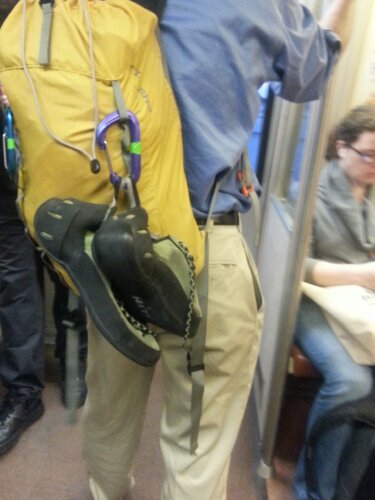
Every Wednesday evening, or another night during the week, I see this person carry his ultralite pack and his rock climbing shoes ride the Washington subway to meet his girlfriend at the climbing gym. He doesn’t climb outdoors much and he doesn’t know the route names of those he’s been on. But that’s not the point.

He and I haven’t spoken since the first time we met in a slightly belabored conversation, but I like seeing him on the train. Maybe climbing doesn’t end when you live far from real mountains; maybe it just takes on different forms.

Sometimes it’s just about following the news and living vicariously. The news from the last several weeks has been centered on one big alpine route: The south face of Annapurna. On October 9th, Ueli Steck summited Annapurna via an incomplete line first attempted by Jean-Christophe Lafaille and Pierre Beghin of France in 1992. He did so alone and at a lightening pace during a mere 28 hours.

Then, only days later on October 24th, French climbers Yannick Graziani and Stephane Benoist went up the same way (but that is unconfirmed), though no where near the same pace Steck traveled. They took eight days to climb.

I started thinking that the conditions (including the rock, snow, ice, weather, stability, etc.) on the south face must have been ideal to allow Steck to climb so swiftly and for a second team of two to ascend this wall. Ed Viesturs and David Roberts talk about the challenge and appeal of the wall in their book on Annapurna, The Will to Climb. If you have copy it’s worth going back and reading that chapter on the first ascent of the south face. (I’ve been carrying my copy in my bag on my commute these past few days.)

Now knowing that Graziani and Benoist struggled their way up, unlike Steck’s apparent saunter to the top. The pair experienced some cold nights with at least one spent without a shelter. Benoist suffered with significant frostbite and was evacuated once the they neared the base of the mountain.

What may seem like a stable route in ideal conditions can change quickly. It can also be subject to so many other factors, such as how a climber matches up to the challenge. Can they overcome the rock band? If their rope is too short, do you descend? If you run low on food, can you keep going?

It makes Steck’s ascent more impressive. But it also makes the climb by Graziani and Benoist stand for its own characteristics. They didn’t saunter, and their story will likely be a more compelling epic, especially in that they followed Steck’s lightning first ascent.

As a final note, the training guidebook that Steve House has been working on with Scott Johnston will be available to the general public in February 2014, and sooner if you can get to the Patagonia booth at the Outdoor Retailer Winter Market on January 24 in Salt Lake City. Its title is Training for the New Alpinism: A Manual for the Climber as Athlete. The forward is written by Mark Twight.

Well, Happy Halloween. I’m looking forward to leaving work a little early to take Wunderkind trick or treating for the first time. What costume do you think her father will wear?

I appreciate you stopping by for a read once again. If you enjoyed this post, please consider following the Suburban Mountaineer on Facebook and Twitter.

What I am Reading Now

Just a quick note on what I’m reading in rare spare moments between excitement at work and family fun…

Alpinist 44 (starting with the editors note, the poetry on Alison Hargreaves, followed by Gildea’s range profile on the Sentinels, and every other morsel after those.)

2013 American Alpine Journal (finished the features and obituaries, now I am looking at the Alaskan and  Canadian entries. Then I’ll hit up whatever region catches my interest before putting it on the bookcase until I need it for a reference.)

Cheers.

Climbing matters even though we work nine to five.

The Ideal Climbing Library

Natalie always dreamed of having a traditional library of hard bound books, and I realized that was something I really wanted too. I suppose the rationale is that when I am not surrounded by mountains I want to be surrounded by books.

Books and periodicals about climbing — especially early mountaineering adventures and modern alpine ascents — have been something that I have collected since I was 17. It wasn’t a disciplined pursuit. It happened quite accidentally and I didn’t recognize that I was a collector until Natalie and I noticed that my modest library was outgrowing its shelves.

But the volumes I own are a hodge podge of topics from various hiking and climbing guides from North America to stories of trekking across Tibet. There are also classics like Maurice Herzog’s Annapurna and most of David Roberts’ books. There are also a handful of American Alpine Journals, some because I wanted that year, and other because I donated money to the local AAC Section for a new projector and I was gifted several AAJs that I didn’t already own to say thanks.

Despite the collection, this is hardly the right combination of titles to support my writing on this blog, let alone support my ambitions for greater knowledge on certain subjects and regions. So I have been taking a less is more approach to thin out the shelves and to make me consider whether I need that text. I decided Peaks of Glory, the over sized coffee-table book by Italian Stefano Ardito, could go because it wasn’t a primary source and really didn’t say anything that I couldn’t find in one of my other volumes or the Internet. One down. That analysis may also be key to selecting new books.

I have also been considering what subjects I need to focus my energy, space and ability to acquire. I jotted down several lists and tried to prioritize my interests:

  • Classic narratives
  • Alaskan narratives and guides
  • Adirondack history
  • Cascades narratives and guides
  • Patagonia narratives and guides
  • Canadian narratives and guides
  • Himalayan and Karakorum narratives
  • Alpine narratives

I also wrote down the kinds of books I would want to include and what I want to work to acquire first:

  • American Alpine Journals
  • Narratives
  • Guide Books
  • Maps
  • Volumes with notable photography from an area of interest

Earlier this year, I was given a copy of Jennifer Lowe-Anker’s book Forget Me Not, which was on my list to acquire and I will keep it. Plus I was given two books from Michael Ybarra’s library from his family (I really should tell you more about those books sometime.)

I also purchased Mellor’s climbing guide to the Adirondacks and finally bought my own copy of Boukreev’s Above the Clouds and also my own copy of Kiss or Kill. (I don’t think I need to say the author for that one; email me if I do, or just look it up, then get a copy and study it.)

So the vision of my library and it’s many parts are coming together. Planning is taking a while, but that’s part of the fun. It’s like packing for that big, long awaited trip to sacred Yosemite.

Here are several books that are on my short list to acquire:

  • Minus 148º by Davidson
  • Alaska Ascents by Sherwonit
  • The Ascent of Denali by Stuck
  • Not Without Peril
  • Mountains of the Mind by MacFarlane
  • The Mountains of My Life by Bonatti
  • The White Spider by Harrar
  • Fifty Classic Climbs by Roper and Steck

The list is longer, and the topics of climbing are broader than what I listed, but these are the subjects and regions that drive me.

I appreciate you stopping by for a read once again. If you enjoyed this post, please consider following The Suburban Mountaineer on Twitter and Facebook.
Climbing matters, even though we work nine to five.