Bernard Amy Defends Alpinism

Bernard Amy was recently awarded an honorary membership to the Italian Academic Alpine Club. I must fit the stereotype of an ignorant American because I had no idea there was such a club until I heard the news.

Amy, a French mountaineer and a writer is best known among American climbers for his short story “The Greatest Climber in the World.” I became aware of that piece and Amy himself last year when a reader from the place of Amy’s birth — Lebanon — brought them to my attention.

Amy’s acceptance speech, which he gave at a ceremony in Turin, Italy, was well worded and extremely timely. He addresses the criticisms of climbing, particularly of mountaineering and alpinism, most of which revolve around the notion that climbing is a dangerous, frivolous activity.

The speech is brief and worth reading but if there is one key take away in his remarks that defends climbing, it’s that we must not try to explain why we climb but rather what we get from climbing. As Kelly Cordes put it in Alpinist 41, we should stop asking the unenlightened question of why, and instead ask what do you seek?

Thanks again for stopping by. If you enjoyed this post, please consider following The Suburban Mountaineer on Twitter and Facebook.

Your Time to Climb Niagara Falls

UPDATED: January 29, 2015.

Niagara Falls almost froze once in your lifetime. It may never freeze again for you. If it does, will you be ready?

Of course, Niagara Falls isn’t a typical ice climbing destination.

By comparison, water ice in Hyalite Canyon, Montana and the Adirondack Mountains, New York are usually pretty reliable each winter. Albeit some routes form better than others year to year. However, even consistency has off years: This season in Chamonix, France is unseasonably warm, which has precluded any of the water flows from slowing down and stopping firmly in place. With the normal consistency of these locations, you can take for granted the reliability of the quality of the climbing.

Generally, those routes, like Dave’s Snotsicle (love that name) in Smuggler’s Notch, Vermont, are attractions for their length, challenge and setting reasonably far from any town. Sometimes the word ephemeral is used to describe them. Except there is no route more ephemeral than Niagara Falls; the last time it actually froze was in 1938.

Niagara Falls is amazing. It pours 5.5 billion gallons of water down its wall every hour. My dad told me about the people that rode a barrel over the falls; then I day dreamed about being one of those nuts climbing into a capsule and waiting for the river to carry me away. Yet it never crossed my mind to go in the other direction.

I grew up in the Buffalo, New York area just a 25-minute drive from the falls. I took girls on dates there when I was in high school, gambled there, been grossed out at Ripley’s Believe it or Not, drank a respectable quantity of Labatt’s Blue and Molson and other northern beers just above the gorge, and I have seen the falls from both borders in all seasons.

The typical ice buildup on the gorge walls is substantial most winters. It grows somewhat thick alongside on the gorge walls adjacent to the flow, mostly from spray and mist, but I have never seen the falls itself freeze solid like it nearly did during the 2013 North American Polar Vortex. Will Gadd and Sarah Hueniken ice climbed the adjacent wall by the Horseshoe Falls on January 29, 2015, but that’s not the falls proper.

The attraction for ice climbing this fleeting icicle is not about its height or serene outdoor qualities, like the ice crags I mentioned. You have to ignore the tourist traps, factories, casinos and tackiness and just focus on the ice. This likely won’t be worthy of an entry in the American Alpine Journal. I originally thought that this event will be more likely to be covered by Geraldo Rivera, but after seeing the coverage of Tommy Caldwell and Kevin Jorgeson on the Dawn Wall in January 2015, perhaps the New York Times would want a piece of it. But public attention isn’t why you should pursue this climb.

Niagara Falls is the unicorn of ice climbing. If you’re an ice climber and it freezes again, you better have a plan. A drop-everything, call-in-sick, postpone-your-wedding and drive, fly or hitch to the Canadian border -plan.

Someone, one day, so long as ice climbing maintains a grip on restless souls seeking something they often can’t put into words, will be the opportunist. They may be the only person to ever attempt to climb Niagara Falls.

Maybe it’s you. Make a plan now. You have to take these photos and print large versions to study and become familiar with what may be in your future. You need to have gear and a way to get to Upstate New York/southern Ontario. You’ll need help getting to the base of the ice. Or maybe you rapel down.

When you’re done, if it happens in my lifetime, I’ll meet you on the Canadian side at Falls and Firkin (cheeky tagline: “Want a little Firkin more?”) and I’ll toast to you. There may not be another to follow your path. Ever.

Thanks again for stopping by. If you enjoyed this post, please consider following The Suburban Mountaineer on Twitter and Facebook.

Climbers’ Thanksgiving Traditions

In the evening on Thursday, Thanksgiving Day, a handful of climbers in the Washington, DC and Northern Virginia region will bring their rock shoes and a dish to share to Sportrock for the annual Thanksgiving potluck.

At about the same time, a group will have already been ascending the cracks on the beautiful vertical walls around Indian Creek in Utah in a less structured tradition known locally as Creeksgiving.

In the southern hemisphere, many nomad climbers have flocked to El Chalten in Argentina or other climbing destinations in Patagonia to take advantage of the time off, or perhaps avoid the family altogether.

Others will use the time off to make it a four-day weekend and extend their time for their climb, whether it’s a sport climb project or a ground-up route on some remote mountain anywhere convenient or alluring.

Regardless of what you have planned, have a Happy Thanksgiving.

I’ll be with my family and our six out-of-town guests, enjoying a ham (instead of a turkey) and sipping a craft beer thinking of all that I am thankful for.

Climbing and other climbers are high on my list.

I appreciate you stopping by for a read once again. If you enjoyed this post, please consider following the Suburban Mountaineer on Facebook and Twitter.

Various Notes: Annapurna, Steve House Etc.

image

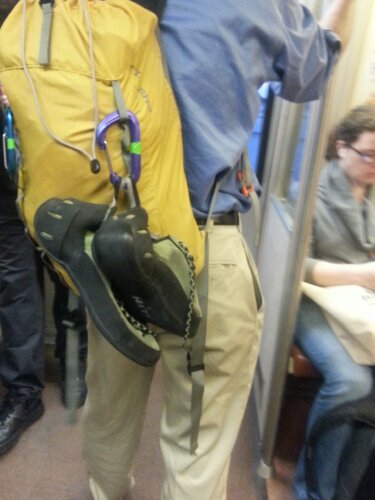
Every Wednesday evening, or another night during the week, I see this person carry his ultralite pack and his rock climbing shoes ride the Washington subway to meet his girlfriend at the climbing gym. He doesn’t climb outdoors much and he doesn’t know the route names of those he’s been on. But that’s not the point.

He and I haven’t spoken since the first time we met in a slightly belabored conversation, but I like seeing him on the train. Maybe climbing doesn’t end when you live far from real mountains; maybe it just takes on different forms.

Sometimes it’s just about following the news and living vicariously. The news from the last several weeks has been centered on one big alpine route: The south face of Annapurna. On October 9th, Ueli Steck summited Annapurna via an incomplete line first attempted by Jean-Christophe Lafaille and Pierre Beghin of France in 1992. He did so alone and at a lightening pace during a mere 28 hours.

Then, only days later on October 24th, French climbers Yannick Graziani and Stephane Benoist went up the same way (but that is unconfirmed), though no where near the same pace Steck traveled. They took eight days to climb.

I started thinking that the conditions (including the rock, snow, ice, weather, stability, etc.) on the south face must have been ideal to allow Steck to climb so swiftly and for a second team of two to ascend this wall. Ed Viesturs and David Roberts talk about the challenge and appeal of the wall in their book on Annapurna, The Will to Climb. If you have copy it’s worth going back and reading that chapter on the first ascent of the south face. (I’ve been carrying my copy in my bag on my commute these past few days.)

Now knowing that Graziani and Benoist struggled their way up, unlike Steck’s apparent saunter to the top. The pair experienced some cold nights with at least one spent without a shelter. Benoist suffered with significant frostbite and was evacuated once the they neared the base of the mountain.

What may seem like a stable route in ideal conditions can change quickly. It can also be subject to so many other factors, such as how a climber matches up to the challenge. Can they overcome the rock band? If their rope is too short, do you descend? If you run low on food, can you keep going?

It makes Steck’s ascent more impressive. But it also makes the climb by Graziani and Benoist stand for its own characteristics. They didn’t saunter, and their story will likely be a more compelling epic, especially in that they followed Steck’s lightning first ascent.

As a final note, the training guidebook that Steve House has been working on with Scott Johnston will be available to the general public in February 2014, and sooner if you can get to the Patagonia booth at the Outdoor Retailer Winter Market on January 24 in Salt Lake City. Its title is Training for the New Alpinism: A Manual for the Climber as Athlete. The forward is written by Mark Twight.

Well, Happy Halloween. I’m looking forward to leaving work a little early to take Wunderkind trick or treating for the first time. What costume do you think her father will wear?

I appreciate you stopping by for a read once again. If you enjoyed this post, please consider following the Suburban Mountaineer on Facebook and Twitter.

Michael Ybarra

I never knew Michael Ybarra. For that matter I never knew the great Fritz Wiessner either, but I still know what he did and I like to think we shared things in common. Michael, for those of you unfamiliar with him, was best known as a talented writer. Climbers knew him as a climber that made a living as a writer.

He passed away while climbing alone, in the Sierra Nevada mountains just over one year ago. The exact details of how he left us are unclear. It doesn’t really matter, either.

Unlike reading news of a death of an actor or actress, the news of Michael’s death actually stung. Michael died doing what I like to do and spend a lot of time day dreaming about. And Michael was more like me than say Bjørn-Eivind Artun, who we lost the same year, was like me. (No surprise there, really, but the point is made.)

Michael wrote for my local newspaper, The Washington Post once as an investigative reporter, and later he worked for the Wall Street Journal as their adventure correspondent. Then he also wrote articles in Alpinist, including a piece published posthumously in issue 43.

Michael also wrote a remarkable and very readable biography on the man behind the darkest days in Washington, DC, Patrick McCarren of Nevada. I am going to finish reading it shortly and will tell you more about it later.

And he loved the mountains. He lived out of his car for portions of his journey. He climbed regularly in Yosemite and had the respect of other climbers.

There will be a memorial service held at CalTech on Monday, October 14, 2013. I won’t be able to go, but maybe you can. If you go, you can celebrate what it Michael means to you.

For me, it is that life at work and with our family responsibilities may seem incompatible with climbing. In reality, love for the mountains and playing among them is actually an anchor for ensuring that I enjoy all aspects of life to the greatest extent possible. There is no doubt, from the people I know that actually knew Michael, that he was alert to life and he was at peace living his.

Thanks for dropping by again. If you enjoyed this post, please consider following The Suburban Mountaineer on Twitter and Facebook.

Climbing matters even though we work nine to five.

Child Carriers: Advice and a Story

Taking in the view of Stowe from Mt. Mansfield with Wunderkind (Stern 2012)

If you’re like me, you’ve probably become your non-outdoors oriented friends’ and colleagues first resource whenever they have questions about the best places nearby to hike and what kind of gear do they need. Climbing never seems to come up, but that’s okay.

Now that most of my friends are parents too, I have been getting slightly different questions. One friend, who prefers the mall to the park, has a daughter in Girl Scouts. Every Spring there is a new question related to camping, presumably because the badge for that stage in her development requires something more advanced. First it was about sleeping bags, mattress pads and flashlights. This spring it was all about tents. I’m always happy to weigh in (especially when she expresses gratitude with a couple extra boxes of Thin Mints.)

Since Natalie and I have two young kids and are known to take the kids outdoors more than most, the latest question is, “What child carrier do you use?”

First off, the term child carrier mostly refer to something that resembles an old fashioned exterior framepack, and you don’t need a child carrier if you’re doing a short day hike with minimum gear. I used a Bjorn when Wunkerkind was an infant to walk a mile or so around Great Falls, Virginia. That’s the same device we used for a walk along the block or just to bring her along as I also put out the recycling. So if you’re using some sling or carrier now, consider whether that holder might do the trick.

Second, keep in mind that the younger your child is, the further you might be able to walk with them. But once you reach toddlerhood, you don’t have to go far to share great outdoor experiences with them. So if you’re not deadset on going on overnight backpacking trips to the Presidentials with your little one, you might not need the premier pack.

On the descent of Mt Mansfield via the ski runs (Stern 2012)

Natalie and I took Wunderkind on her first “real” hikes in Vermont on Mount Mansfield (Vermont’s highest mountain, which is best known for having the biggest and best ski resort… on the east coast, that is) and around the town of Stowe last fall. She was thirteen months old so we limited the experience to one day hike on Mansfield and a couple of shorter nature walks on some secluded trails.

I carried Wunkerkind in a used Kelty Kids Back Country. It had a frame that hung far from my back and center of gravity, so it was a little bulky to manuever. Still, it was comfortable for Wunderkind. We used it on the “big” day hike (four miles up and down hill) and we’ve gone a lot of places on urban hikes here in Peaklessburg, like the National Zoo. Wunderkind often insists I carry her around in it even for walks to our neighborhood Starbucks.

Unfortunately, the Kelty carrier recently had a mishap. A few weeks ago after a trip with Wunderkind’s mother, new brother and godparents to see the big cats and elephants at the zoo, I noticed something alarming. One of the plastic joists holding the aluminum frame together snapped beyond reasonable repair. I considered glue, duct tape, and the stress such a fix could handle. Caution made me decide that this was the end of its road.

Since it was bought new in the 1990s and spent most of its life in the previous owner’s garage, it was exposed to more than a decade’s worth of Mid-Atlantic summer heat without any temperature controls. I suspect that weakened the plastic the joist was made. Combined with the increasing stress of carrying a growing Wunderkind, the weak plastic — or even the old cordura — was bound to break down eventually.

Enjoying a short walk around Stowe, Vermont (Stern 2012)

When I started writing this post I was going to suggest you start looking on Ebay for a similar model and vintage, but not anymore. The model is fine, but if the equipment is old, treat it like a used climbing rope: You don’t want your child dangling off it. So before Natalie and I go off on our next family adventure, we’ll be getting a new child carrier. What’s below is the advice I recently passed on to a friend over the TSM Facebook page, but now I will also be following my own advice:

Regardless of what child carrier you choose to buy, here are three key tips:

  1. Water — When trying out a child carrier in the store, especially if you have toddler, try to see where you will keep water and how you can get some to your rider. On the Kelty, I carried a Klean Kanteen off a carabiner hooked onto the webbing and can hold it over my back to just reach Wunderkind’s arm reach — she does the rest.
  2. Mirror — Also, if your child rides on your back, carry a mirror. I used the one on my compass. It allows me to check her mood, make sure she is okay, whether she fell asleep (it’s happened) or see what she’s looking at so I can keep her engaged, particularly when Wunderkind and I are walking alone.
  3. Storage — Lastly, make sure the carrier has at least a small pocket to store anything from a hat or snacks to a spare diaper.

We investigated new child carriers last week and I think we settled on which one worked best for Wunderkind and me. I’ll share more about that later.

I appreciate you stopping by for a read once again. If you enjoyed this post, please consider following the Suburban Mountaineer on Facebook and Twitter.

Climbing matters, even though we work nine to five.