Undaunted by the Wickersham Wall

Long before Yosemite was a climbing destination and Tommy Caldwell’s Dawn Wall Project was drawing the mainstream media to the Valley, climbing was a wilderness experience in the alpine. One of the greatest challenges of the 20th Century was the north face of Denali (20,237 ft./6,168 m.)

In a 2013 article of Harvard Magazine proudly proclaimed”Seven Harvardian’s Denali feat still unmatched 50 years later.” Rightfully so. The 1963 ascent of Denali that the article referred to filled many of my daydreams when I was in high school. It’s possible few climbs will surpass that ascent in greatness.

The students from Harvard, from its own Harvard Mountaineering Club, successfully scaled the Wickersham Wall. The name itself stung like a whip. It’s name given to the gargantuan north face of Denali. The wall rises from an ice fall, of cleaved glacial fissures, at a mere 5,000 feet, and then rises in a steep, and steady slope for 15,000 feet to the mountain’s modestly junior north summit.

The name of that wall was not merely to honor Alaska’s first federal circuit judge and one of its popular policymakers, but to honor the same man who was an Alaskan pioneer.

Ten years prior to Hudson Stuck’s first successful ascent of Denali and just shortly before Frederick Cooke tried to fool the world as the greatest explorer the globe had seen, James Wickersham organized a daunting quest to climb to the top of Denali. It was 1903 and the roads were far, the trails were not obvious, and the equipment was practical but may not have been efficiently functional.

The way up, it seemed to Wickersham, was a straight line up the north face from where the Peter’s Glacier ended. At first glance the path was simple and uncomplicated.

I have long speculated the feelings Wickersham and his four men, who threatened to flea several times, were thinking standing at the base of the north face. Despite witnessing rock fall and avalanches, they climbed to 8,100 feet on the Jeffrey Spur (named for one of Wickersham’s team members). Those same conditions pushed the determined, but inexperienced adventurers back to civilization.

When the Harvard Mountaineering Group traveled from Boston to the great north face, they climbed, as Harvard climber and respected climbing author David Roberts later explained, in a state of naivety. The avalanches and rock fall persisted, despite Bradford Washburn’s recommendation of a line that might be sheltered from them. But when the inexperienced college-aged climbers arrived, they didn’t know that the amount of rockfall and avalanches nearby were reasons to retreat. In reality, they scathed death.

I suspect that the route will one day be climbed again, but the conditions will have to be such to allow it and the climbers will have to accept more risk than the average climber would on a normal alpine route.

It still makes up my daydreams, but today, instead of thinking of climbing it myself, I consider what else is as challenging or as bold as the 1963 ascent of Denali. I’ll be looking…

Thanks again for stopping by. If you enjoyed this post, please consider following The Suburban Mountaineer on Twitter and Facebook.
What to Watch for in 2015

Sometimes we look on the events of the year behind us around the New Year’s holiday. This time we look at what we can expect in the next twelve months…

WINTER

Two 8,000-meter peaks remain unclimbed in the winter: K2 (28,250 ft./8,611 m.) and Nanga Parbat (26,660 ft./8,125 m.), the second and ninth highest mountains in the world, respectively. Denis Urubko’s desire to attempt K2 has become impossible this season because of a permit issue in China. However, three teams are converging on Nanga Parbat. You can follow their progress on Nanga Parbat on Raheel Adnan’s Altitude Pakistan.

If you admire persistence, Lonnie Dupre is making yet another attempt to summit Denali in calendar winter. I’m hoping his fourth attempt this month does the trick. This time he is carrying a compact tent rather than relying solely on snow caves for shelter, which can be exhausting to setup after a tiring day. Keep in mind, most of his climbing will be in the dark.

In addition, there always seems to be some story worth hearing comimg from Patagonia or somewhere else during the Austral summer. You can get updates from a number of sources, including Climbing, Alpinist, and PlanetMountain.

SPRING

The biggest question for this spring, and possibly year, is about Everest’s southern route. Since the season-ending ice fall collapse last year, the future of commercial guiding and relations with the Sherpa and other local and regional mountaineering supporters are in question. This isn’t a subject I follow closely, but it’s important to the public image of mountain climbing, so I’m sure that I’ll be bringing this up at least on social media. Here’s my commentary from 2014.

SUMMER

Kyle Dempster will return to the Charakusa Valley in Pakistan with Scott Adamson attempts on Latok I and Ogre II. The region is just developing its history now and, it could be argued, is where the most cutting edge exploratory alpine climbing is happening today. For more see the photo of the objectives and the announcement in the Mugs Stump release.

AUTUMN

Hopefully Tommy Caldwell will finish his quest on El Capitan’s Dawn Wall this winter so he won’t have to return in late 2015. We’ll know soon. It’s best to keep track of the journey, and Tommy, on his facebook fan page.

If you think I missed something significant, please don’t hesitate to leave me a comment or shoot me a note.

Thanks again for stopping by. If you enjoyed this post, please consider following The Suburban Mountaineer on Twitter and Facebook

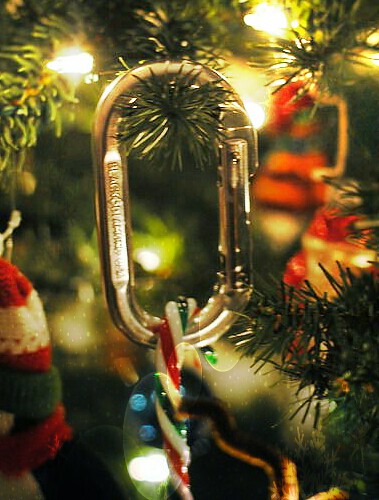
Candy Canes and Carabiners

In trying to explain why I love alpine climbing, the verseall was calm, all was bright, from a Christmas hymn has put into music the ephemeral feelings. For me, it glances at the still and fleeting qualities of the alpine, the same way Christmastime is something we want to hold on to.

At Christmas, the season is often described with language about wonder, like a child’s. Everything is new and surprising. Mysterious things are explained as miracles. The general notion of magical events are sacred.

It’s a magic where things are still. We pause in awe of the moment. We visit friends and, more importantly, loved ones. And it seems, here in the states at least, all busy-ness and work stops out of respect for the delicate moment.

It’s a magic where darkness is welcomed with a sense of anticipation. The twinkle of lights, whether in bulbs or flame, both charm and warm us on cold evenings.

It’s a magic almost like the alpine.

Time slows down. Little lights glow brighter. Good company feels closer. And the work what we have built in friendship in seeking a sacred moment all come to fruition.

I wish you all a Merry Christmas.

If you don’t celebrate, then I simply wish you a peaceful and joyous day. I am thinking of all of you and wish you well.

Good night.

Thanks again for stopping by. If you enjoyed this post, please consider following The Suburban Mountaineer on Twitter and Facebook

What Kind of Knife Do You Need for Climbing?

I carry a Swiss Army knife almost everywhere I go outside of work. It comes in handy almost daily. I open packages, fix my kids’ toys, and it even once helped me performed a small surgical procedure (don’t ask).

The other day a nonclimber asked me what kind of knife I bring with me when I climb. I paused.

What did he think goes on up there?

I don’t plan on cutting my rope and splicing it back together. A knife doesn’t help me reach for the next hold. I don’t fight off beasts. At most, I might use my pocket knife to prepare or eat my meal… when I am in camp.

Oh, and I have never contemplated having to cut the rope with my partner dangling from it. To the best of my knowledge that has only occurred once in history and that makes it the singular exception rather than the rule.

My knife is well stowed when my climbing gear is out. The only sharp objects I need out are the front points on my crampons or blades on my ice axe — and that’s only on true alpine routes. I don’t use those rock climbing. The knife won’t be needed. Put it away.

At least this is generally true… A knife can remove old, excess webbing or an old rope, or help you cut an end of a damaged rope off. And there are specialty blades that are serrated and made to efficiently for that. Still, my Swiss Army knife could do it, and, if I ever had to, that is what I would saw with.

Still, it’s not something a climber should keep handy next to his/her belay device and locking ‘biner. If he/she has it clipped there, you might not want to make that person your climbing partner.

Thanks again for stopping by. If you enjoyed this post, please consider following The Suburban Mountaineer on Twitter and Facebook.

How to Bring the Mountains Home with You

Alpinist magazine during the daily commute (Szalay 2014)

We often say that we should take only memories and pictures and leave only footprints in the wilderness. But it’s really not that simple. We’re human beings with passions and for some of us that means we want to immerse ourselves wholly in what we love, be that a national park or the ideal of a mountain man or woman.

While we don’t want to take anything physical or erect anything permanent or semi-permanent in the places we love, we want things that give a longer life to the euphoric sensations our adventures give us. For me, it even goes a bit deeper: My self-identity is wrapped in these places and adventures, so leaving my heart at the trailhead is impossible.

I try to bring the mountains home with me. I take pictures. I write down memories. Then I buy a twelve-pack of the locally brewed beer and buy gallons of maple syrup (at least for my journeys to Vermont) to enjoy for while longer. When I get home I look at gear in Patagonia catalogs with a bit of lust. I think about gearing-up for the next time my work schedule opens up for Natalie and I to go off with the kids someplace with wide open spaces. I consider buying that new backpack, I think, because I can load all my cool stuff and be as ready as Colin Haley for Mount Foraker.

Except, 85 percent of my daily routine involves driving city roads in our Subaru, riding subways and buses, walking on paved sidewalks, sitting in offices and cafes and climbing the three-story walk-up to our apartment. What do I need my Asolo TPS 520s and hard shell for when I usually need a pair of tasseled loafers and a sport coat?

I’m desperately trying to create an allusion of being in, or ready for, the mountains. I’m trying to satisfy a need for rock strewn trails, higher elevation, and the excitement of changing weather. This is despite the fact that I have responsibilities and commitments that conflict with that desire, and that I have I have willingly embraced those duties. (In fact, all of this is the true reason I started this blog.)

Desktop Mountain Art.

Shopping for new gear is a poor substitute for keeping the joy of the mountains; if I am just going to have it for that “one day” in distance, then it’s a waste. Gear wears out even from non-use. For example, my climbing harness just reached it’s expiration date after 10 years. Regardless of it’s visual appearance it’s done.

However, I recently realized that my library of mountaineering literature actually soothes my restless soul more than new duds from an outfitter. (Though, Sweetie, if you’re reading this, don’t let this discourage you from getting me another plaid shirt from Patagonia — I’ll wear those on the weekend anyway.) There is a wealth of climbing books, what Barry Blanchard called the “cannon of mountaineering” in his book The Calling is enormous — you should dive in. Plus publications, like the magazine Alpinist, are also wonderful outlets that connect with your mountain person ego.

Since Natalie and I moved back into our relatively small condo I have had to store the majority of my gear in a shed. What is left accessible is my library and some art. If you follow me on Instagram then you have seen my “Desktop Mountain Art,” which I put in different configurations and post periodically. Fascinatingly, these wooden models have struck gold inside me. I love them and they have raised ideas, thoughts and joy inside me. Of course, they also prompt conversations about art, mountains, and adventure. It makes me share memories and show pictures.

What we need is something that connects with us at a different level — maybe it’s our soul. The practicality of outdoor clothing and equipment are merely tools to shelter what houses that soul of ours. We need to reach deeper. In fact, we need to go directly to what those ads and descriptions in the Patagonia catalog are tugging at… the dormant feelings we usually only feel gallivanting in the outdoors. We need more art. It can be in written word or something for a shelf, or maybe something else I haven’t discovered yet.

So if all of this doesn’t get closer to telling you more about how to fix our problem (and describe how messed up I am), I don’t know what does. I’ll be back in touch with more later. For now, enjoy the rest of your week and have a good weekend.

Thanks again for stopping by. If you enjoyed this post, please consider following The Suburban Mountaineer on Twitter and Facebook

Why We Should be More Thankful

We’re expecting some moderate snow in the Mid-Atlantic region, and while I would normally be egging it on, it’s actually presenting a problem. It’s supposed to hit tomorrow, which is the biggest travel day of the year in the US. Natalie and I are hosting the Thanksgiving feast the next day; we have family driving down from Philadelphia and friends coming from London. We hope that they won’t be delayed.

Last year at this time I posted a piece on climber’s Thanksgiving traditions. This year I’m thinking about what, as a climber, I’m particularly grateful for. The answer brought be back… way back to sometime even before the 1900s.

But the story starts in high school when I began to think that I was born into the wrong era. I wanted to ascend unclimbed mountains in untouched wilderness. I wanted to hike in and port gear carried in by some exotic beast or a pied by shuttling loads. I though that roadside crags and airplanes dropping so-called adventurers or explorers into the backcountry was trivializing the experience.

Now, about 20 years later, I know that even explorers in the 1960s — when most of places like the Himalayas and Patagonia was untouched by Westerners — wish they were seeking out lands in the 1880s.

I also know that adventurers in the 1880s wish they were gallivanting before the advent of the telegraph or the railroad… when times were slower.

Sometime after starting to write here on TSM I got a little less ornery about the period we lived in. That is because I believe my kids, if they have a romantic and adventurous heart like their father, will wish they were actively exploring the world back when I was a kid.

So this is what I’m thankful for:

World Travel — We can go climbing on the other side of the globe and get there is 48 hours, not weeks or months.

Beta and the Internet — There is an unprecedented amount of information available for beta or just to take in the wonder of mountaineering history. Even the American Alpine Journal is now in expanded form online.

Climbing Style is Still First — Despite the armies of commercially guided “expeditions” that build tent cities at the base of major mountains and walk up fixed-rope paths, there are still climbers that climb in light and fast fashion and are not motivated solely by peak bagging. We just have to look for them, and searching for them is part of the pleasure of this age right now.

I’m sure that there is more. What else would you add? Leave me a comment, send me a tweet or shoot me an email.

Well, I’ve got to check the forecast… Have a happy Thanksgiving.

Thanks again for stopping by. If you enjoyed this post, please consider following The Suburban Mountaineer on Twitter and Facebook