Messner, Jurgalski, and Why Guinness’ Record Update Shouldn’t Matter to You

Prayer flags (All rights reserved)

Well, Guinness, I admired your work. I used to page through a paperback edition of your record books. I wasn’t looking for records that I could beat and see my name in you, rather I was reading it like the personal ads in City Paper, which was a full day of entertainment. But the records, whether it was the faster swimmer or the most covered human body with tattoos, were legitimate and credible. However, I think you messed up recently.

I’m not sure whether you’re proud of what you did or oblivious to it. You know, in unseating Reinhold Messner as the record holder for being the first to summit all fourteen 8,000-meter peaks? This all came out of a significant and legitimate research project by several people, most notably Eberhard Jurgalski, who is an old acquaintance, and a friend of a good friend of mine. No, he wasn’t working for you. He was trying to discredit the frauds that tried to emulate Messner and other credible mountaineers.

You see, some climbers in recent years have pushed the envelope of what was acceptably the top due to error or egregious attempts or “gimmes,” as we might say when putting in golf. Close enough isn’t close enough when some contemporary climbers are climbing on the backs of guides, porters, and not putting in all the work, prior to profiting form writing books and going on a lecture circuit based on the credential.

The Guinness World Records’ website entry about Messner is currently titled, “First person to climb all 8,000-m mountains without supplementary oxygen (legacy).” This headline seems correct, but I am bothered, like a lot of people about the word in parenthesis. Here is the text from entry:

Reinhold Messner (Italy), who became the first person to summit the world’s three highest mountains, is considered the greatest climber of all time. He achieved all of the 14 ascents without supplementary bottled oxygen, the last in 1986, making him the first person to climb all 8,000-m mountains without oxygen – a feat that, as of March 2017, only 14 other climbers have achieved.

Guinness World Records website, November 3, 2023

Climbing has a long tradition of using the honor system and accepting claims to mountains and routes having been climbed based on the reputation of the climber. If the climber has a record of climbing accomplishments, and describes his ascent reasonably, most often the account will be accepted and added to mountaineering journals. On the other hand, someone like Frederick Cook, trying to claim he climbed Denali, he didn’t have a record and his account didn’t add up.

Messner’s credibility has been unwavering. He is loved, admired, and at the same time derided the way tennis star Djokovic is for some of his pompous and petulant behaviors. (Admittedly, Messner is usually more often misunderstood and is never petulant or tone deaf.) Messner’s critics still respect him for his 14 oxygen-less ascents that culminated in 1986. Reinhold Messner was and continues to be a pioneering influence on the mountaineering community in spirit and legend. When you’re the first to surprise the world at what the would thought was impossible, and the standards and technology change because of how you blew their mind, that’s deserving of a place in the records.

And since when did we give a dump about what the Guinness World Records say? We’re climbers. We have Alpine Journals and magazines and Instagram. We don’t have scores or ratings for what Messner did or Ed Viesturs or Nims Purja. We care who was first, how they did it in style, and we mentally keep track of how we can one up them, do their deed better, or honor them.

If anything Jurgalski identified some contemporary glory-hounds seeking attention, book deals, and conference lectures. Thanks, Eberhard, for exposing them. We’ll keep watching from here, and some of us will do you justice on the proper summit and hopefully do it in style, honor, and challenge the next climber.

Well, thanks for dropping by. If you enjoyed this post, please sign up for my newsletter, which is the best way to get updates. And please tell a friend too; I am a humble hobbyist and don’t pay for advertising so organic search engine traffic and word-of-mouth referrals are all I’ve got. I just believe that climbing matters and you do too.
Kristin Harila, Nims Purja, Jerzy Kukuzcka, and the Summit Game

Good morning, K2. (All rights reserved)

This is a short post for you. I just need to get this notion of a summit game out there. It is quintessential and underlying most climbing stories. Dawn Hollis’ book, when it comes out next year, will indirectly uncover our modern perspective better, but for now, let me point it out this way.

Kristen Harila’s announcement that she climbed Cho Oyu and thereby completed reaching the true summits of all fourteen 8,000-meter peaks in record time got me thinking about reaching the true summits. She tagged the 14 tops in 12 months and five days.

But didn’t Nims Purja climb them in six months and six days? Of course he did. Well, actually he climbed them but missed two true summits. He returned to those peaks so the time clock kept ticking. Purja’s total elapsed time was actually two years five months and 15 days, despite a lot of popular media still citing the other figure. I think the nuance over true summits is a little ridiculous, as a recreational climber, except when I start comparing and contrasting his efforts and style to others competing on speed, it was as if he hit a triple but missed stepping on first base by an inch. If you play the summit game, and these days, most climbers that aren’t focused on routes alone do, the precise summit matters.

To the best of my knowledge, Harila reached the true tops. But her climb is unique in style; heavily supported, rather than lead, and was using supplemental oxygen. Good; it’s a lower bar for the next climber to try to beat.

Personally, I think Purja and Harila are both in separate categories within different approaches to the climb. The ultimate model of purity is still Jerzy Kukuzcka. He reached all fourteen with oxygen and by new routes.

Our chosen objective is climbing can be about quality time with friends on a mountain in wilderness, testing our fitness and skills, and seeking euphoria. Most of the stories we tell are spurred by a quest for firsts, new routes, and reaching the tops. The media, most of all, loves a higher grade and a true summit. The game we play and its variations are about the top. I do it. You do too. Less than that is called failure, which is just as made up as the game we play. It’s a beautiful game, but we take for granted that what we talk about and what we are all really are seeking from our climbs is more than the top.

Well, thanks for dropping by. If you enjoyed this post, please sign up for my newsletter, which is the best way to get updates. And please tell a friend too; I am a humble hobbyist and don’t pay for advertising so organic search engine traffic and word-of-mouth referrals are all I’ve got. I just believe that climbing matters and you do too.

A Royal Robbins Biography and More Mountain Lit News

Mount Riesenstein, British Columbia (All rights reserved)

Hi, everyone! Yep, here I am posting. And it is despite me being in my busy warm-weather season (i.e. kids’ sports and the Habitat building season). So, you know, I think this is worthwhile. In fact, we might be turning a corner.

In the last five years, Vertebrate’s Adventure Books, Rocky Mountain Books, and The Mountaineers Books have been releasing nearly 100 local guidebooks, covering hiking trails, foraging and nutrition, and cycling, but very few narratives. There has been a drought of narratives, particularly new biographies and memoirs of climbers on the market, seems to be coming to an end, or at least a break.

Perhaps the pandemic disruptions to publishers and writers were the reasons. There is certainly enough anecdote from the publishers to suggest that. I suppose the prolific writers were jostled, too, like the McDonalds and Smarts out there. The expected death of the late Great David Roberts hasn’t helped either. It stinks to be mortal. (Then again, the point of life is that it ends, isn’t it?)

Well, there are two in the narrative vein soon to be released. Also, one researcher, who you may recall from a contribution to Alpinist 57 in spring 2017 and this T.S.M. post, is putting a book out on how we really looked at mountains before climbing became a sport, and how what we think what we believed then is flat wrong. Let’s go…

ROYAL ROBBINS BIO

David Smart wrote another biography, and this one is about Royal Robbins. It will be titled Royal Robbins: An American Climber, which is both true and nuanced: Smart is Canadian and has most recently written biographies of Austrian and Italian great alpinists Paul Preuss and Emilio Comici. Smart and his publishers choose the titles carefully so I am interested in the perspective.

My background knowledge of Robbins of relatively wide; he’s instrumental in the history of American climbers and Yosemite in particular. He’s part of so many climbing stories I’ve read, and you probably heard in Climbing Magazine (and now on Climbing Online,) and other books and documentaries. I love the clash between his purist view, and later his own transcendence of that limited perspective, of how to climb big walls. I am looking forward to whether Smart will shed any new light on this, or, just as importantly, give the story a firm written record through this biography.

It will be available for purchase in September 2023. I think I will be getting an advance copy, so look out for my review beforehand.

A CLIMBER’S REFLECTION

Graham Zimmerman has written his first book, A Fine Line: Searching for Balance Among Mountains, and will be released on October 1, 2023. Zimmerman is an accomplished climber and savvy in today’s visual communications on Instagram and short, well-conposed videos. Zimmerman fascinates me: I watch his videos with a sincere appreciation but grimmace at his confident portrayal that has a smug quality, yet trying to be knowing instead. He is experienced and qualified, but maybe too young to speak as he does. Even the publisher’s book description says he’s only in his 30s. I think that disclosure is both necessary and notable; his adventures are “legit.”

I am not confident whether this book is an autobiography, a memoir, or a reflection. I’ll call it a reflection for now, since that suits the description from the Mountaineers Books. I am going to review this book too and look forward to it. I suspect his tone in his videos will translate better to reflection in writing and may come across as sincere, interesting, and mature. I am sincerely hoping for the best from Zimmerman.

RENEWING OUR PERSPECTIVE OF MOUNTAINS

If you dont remember or know the name Dawn Hollis, you should, and you will. She did her PhD. dissertation on how mountains were thought of before Modernity and the Alpine Club created the climbing game focused on reaching virgin summits or by new lines, preferably as challenging as reasonable and as manly (womenless) as possible. She contributed a piece to Alpinist 57 in spring 20017. I also wrote this reflection her on T.S.M.

Dawn Hollis is in the process of submitting her full-out book to her publisher . It will be published in 2024.

I had the chance to read a manuscript. This book will rock some perspectives and refresh our view of how we, even as climbers, can enjoy the mountains. Alpine Club members attached to the old summit game (my term, not Hollis’) will feel unsettled and attack her findings, and others, like me, will see that the grandness of mountains was indeed heavenly, and always has been. Watch out for it because it’s going to change things for us.

That’s all I had to tell you for now. I’m going back to building homes and getting my kids to the course, courts, and camps, and such. The winter is just more conducive to reading and writing more.

Well, thanks for dropping by. If you enjoyed this post, please sign up for my newsletter, which is the best way to get updates. And please tell a friend too; I am a humble hobbyist and don’t pay for advertising so organic search engine traffic and word-of-mouth referrals are all I’ve got. I just believe that climbing matters and you do too.

Re-Reading and Pre-Reading

Going through the read (past tense) pile.

Wine critic Robert Parker had a special sink built in his home. It was two or three times deeper than an ordinary sink so he could uncork a bottle that he personally purchased, slosh a sip to sense the flavors and hints of oak or whatever quality the barrel imparted before spitting it out and taking notes.

Parker is said to have taste buds that were well above their average capabilities. Parker himself said his strong memory of wines allowed him to compare glasses to one another so he could give each one on his scale, which was a score out of 100. Of course, the critique of what he scored as excellent wines was simply what Parker preferred.

For reading and reviewing climbing books, I don’t need any special apparatus. In fact, I read in multiple different settings. Buses, trains, at desks, libraries, living room couches, cafés, and hotel or guest beds. But there was a time when I read but never took notes or considered the book with the scrutiny Parker applied to rank wine. A good seat, and ideally with a cup of coffee (or, even better, an afternoon beer,) was really all that was needed. But reading for pleasure and with a critical point of view is a little different.

There are about 20-30 books that I need to re-read in order to properly consider elevating them to be candidates for climbing classics. So I am going back to reading, swilling, and comparing them more deliberately. I pulled the hard copies of the books on my Short-Long List and put them on my desk so I can start whittling through them.

I am quite excited about re-reading them this year. These are mostly books I enjoyed, but what will we think of them in terms of being a classic of climbing literature?

I will still review a new book or two as they are released, or at least I am open to that depending on the demands on me by work and family. I may post them elsewhere first and here later, so watch my social media.

An author with a new book deal arranged invited me to review their manuscript before submitting the whole first draft to the editor. I am behind my self-made schedule, but I think I can do a chapter a day and get my comments back to the author in a week or so.

The Banff Mountain Literature Competition is allowing me to participate as a pre-reader once again. I took a two year break over 2021 and 2022. It was rough times for “both” of us; the Banff Centre even shut down and laid off the majority of its staff during part of that. The pandemic disruptions with the Habitat for Humanity affiliate I run and the changes to Wunderkind’s and Schnickelfritz’s schooling shut down many things for me too, and pre-reading was one of mine. I was worried that by turning down the invitation that I would have difficulty getting back in, but it seems I did okay by them.

Well, thanks for dropping by. If you enjoyed this post, please consider joining my email list, which is the best way to get updates. (I am on Facebook too, but make sure your preferences will allow you to see my posts.) Thanks again and be well!

Ski Slopes and Vintage Climbing Instructionals

Smith’s 1957 Introduction to Mountaineering.

Stick season in Vermont is a period after the colorful leaves fall and before the snows take the leaves place in the branches. This winter in Pennsylvania has been one long stick season with only a brief snowfall near the Susquehanna River that landed on the pine branches and lawn during coffee but disappeared after breakfast. We returned to sticks.

Snow is important to Natalie, Wunderkind, Schnickelfritz, and me. I used to have this notion that snow reminded me of the Adirondacks or Green Mountains in winter that I romanticized a great deal while working long hours in Washington. Since the kids started playing in our new(ish) snow-filled yard when the conditions allowed, I saw that it’s about play and living in the moment. Snow is ephemeral, beautiful, and precious. So Natalie and I make sure the kids have good snow pants, coats, and boots for sledding and play before every Thanksgiving.

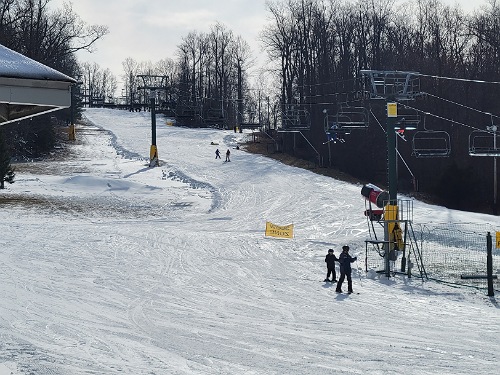
Ski lessons for Wunderkind and Schnickelfritz were overdue, but now that the conditions and restrictions of the pandemic have loosened, we were off to one of those little Ski-the-East hills. These little ones try tonpass themselves off as “resorts,” and boast a few rooms to remt plus a restaurant and bar. Interestingly, I never lived closer to any slope and ski lift than I do now in Lancaster, PA. I had a longer drive when I grew up in snowy Buffalo!

B photography from the PA slopes. Stick season officially, even here.

The kids took lessons and I stuck nearby. Natalie skied. We went to a bigger resort not far from DC before we had kids, but due to expecting our first, I skied, she didn’t. We’re square now.

VINTAGE CLIMBING INSTRUCTIONALS

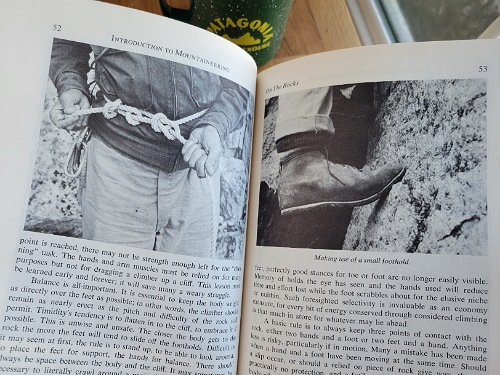
Grit has always been a key element in climbing, and an old instructional book substituted for lessons and mentorship. Take this one, for instance, by George Alan Smith, titled Introduction to Mountaineering, published by A.S. Barnes & Co. Inc. as a new and revised edition in 1967. The first edition was out in 1957. It taught climbing as it was done in the Himalayas and David Roberts’ books of the day: With ropes, sans harness, and your boots, pre-EBs.

This was once deemed safe and grippy.

My friend received it as a birthday present and was kind enough to loan it to me. There are other instructionals from this era, too, and I’m curious about why so many? I’ll keep digging. In the meantime, I am grateful for my Black Diamond harness and my Evolvs.

Well, that’s it for now. Next winter, if I get skis and a seasons pass, I might be able to forget about the gym and wait patiently for the golf course to come into form.

Well, thanks for dropping by. If you enjoyed this post, please consider joining my email list, which is the best way to get updates. (I am on Facebook too, but make sure your preferences will allow you to see my posts.) Thanks again and be well!

Dougald MacDonald Awarded for Literature Excellence by the AAC

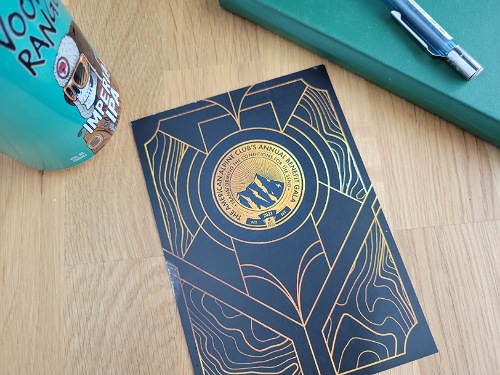
Your invitation to the 2023 AAC Annual Benefit Gala, March 10-11.

On Monday afternoon, as I was packing to travel to a conference, Natalie was going through the mail and handed me a modest postcard and said, “You’re invited to a dinner.”

How quaint. Usually, someone just calls or emails me for dinner. But this wasn’t from a friend or a donor from work. This was very different. New York City would be the site of this year’s Annual Benefit Dinner of the American Alpine Club.

I put it on my desk next to a list of questions for a future post about the future of the American Alpine Journal. I had three interviews to do, questions for Dougald MacDougald, the Executive Editor of the AAJ. Dougald and I have been exchanging messages about when to talk, but work (the day job,) has been dominating my time.

I should have reached out to Dougald sooner. He came up in my social media feed associated with that sharp gala logo as soon as I returned from my conference: Dougald was being honored as the H. Adams Carter Literary Award for Excellence in Climbing Literature.

If you’re wondering why Dougald, well, he hasn’t written a smashing best seller or wrote about a dashing first ascent in pure style for Alpinist, rather he has been conveying news and curating the record of the world’s most significant climbs in the annual American Alpine Journal, periodic updates online, and a podcast. Just a few weeks ago, I pointed out that Dougald’s list of climbing-book recommendations was the best, of literally thousands, on the Web.

His influence and character have ripples everywhere he goes. For example, he’s helped me with content and given me encouragement. And I am clearly not alone in that regard; Dougald’s Facebook friends responded warmly to his understated news of his recognition by pointing out his contributions to various publications and their own work as well as the enjoyment they share in the publications he leads.

Here is what the ACC included in its Meet the Awardees page about MacDonald:

“After learning to climb as a teenager in New England, Dougald MacDonald published his first climbing story (about ice routes on Maine’s Mt. Katahdin) in Summit magazine in 1983. Professionally, he spent the first quarter of his career as a business journalist, eventually serving as editor of the weekly Denver Business Journal for five years.

“In the early 1990s, he switched to climbing journalism, writing hundreds of articles and a book, Longs Peak: The Story of Colorado’s Favorite Fourteener. He has been editor-in-chief of two climbing magazines—Rock & Ice and Climbing—and co-founded Trail Runner Magazine. Since mid-2012, he has edited the American Alpine Journal currently hosts The Cutting Edge podcast and supervises other AAC publications.

“He considers his greatest career accomplishment to be mentoring dozens of writers and editors over the years. After decades of climbing, he still gets out at least once a week at home in Colorado and travels frequently—often with his wife, Chris Blackmon—for climbing, trekking, or skiing.”

Dougald wondered whether what he did was actually literature. Well, if journalism is indeed literature in a hurry, Dougald has nothing to be concerned about, but I do consider the AAJ an invaluable part of climbing literature.

So, to all of you heading to Manhattan for the gala, and even if you’re not, be sure to raise a glass to Dougald on March 11th.

Well, thanks for dropping by. If you enjoyed this post, please consider joining my email list, which is the best way to get updates. (I am on Facebook too, but make sure your preferences will allow you to see my posts.) Thanks again and be well!