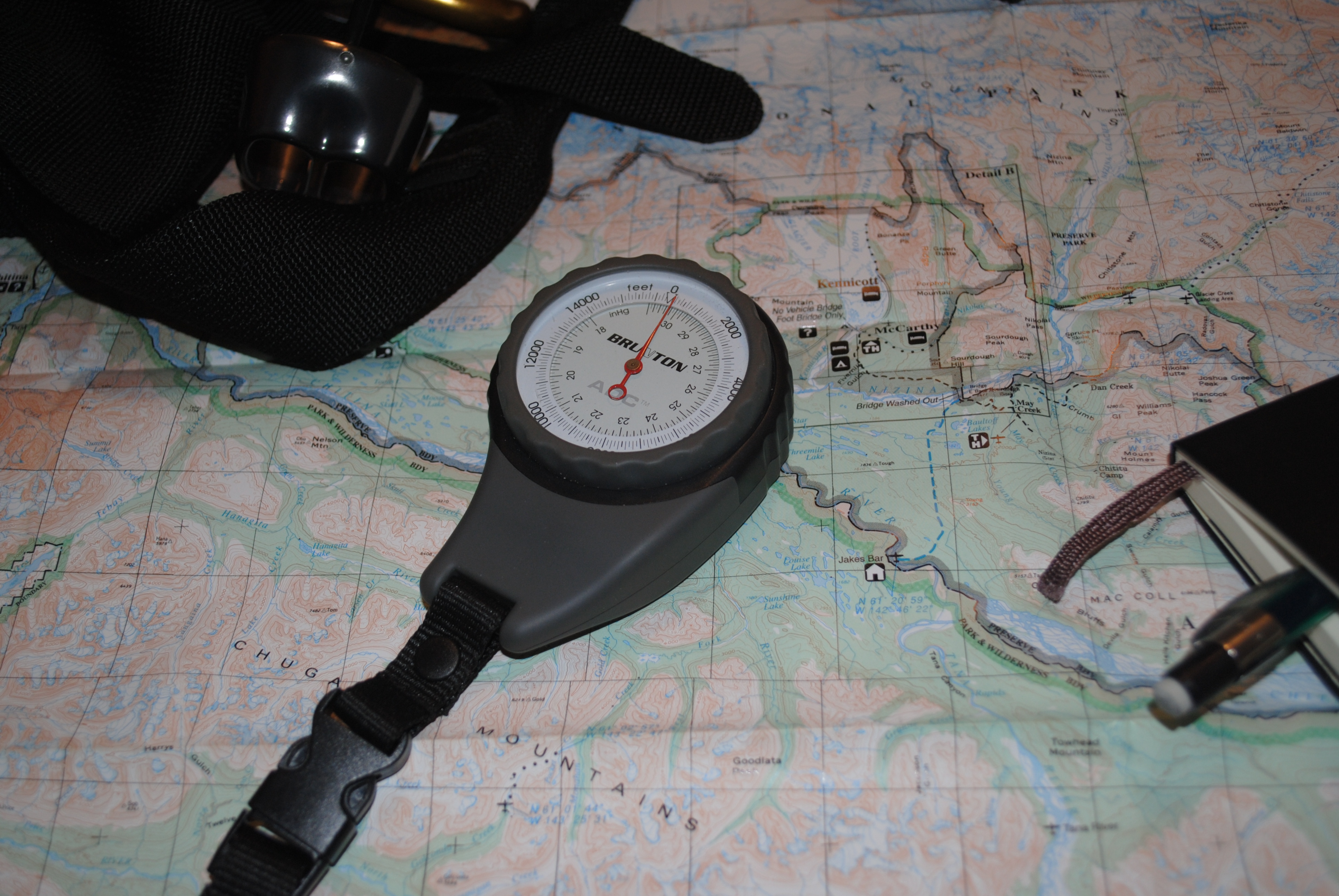
Analogue Altimeters Promote Better Mountain Skills

ADC Ridge analogue/aneroid altimeter (Szalay 2010).

There are a number of devices on the market that can determine your elevation, or to use a cooler mountaineering term: altitude.  While pilots may use any type of altimeter, such as radar altimeters, alpinists only use aneroid altimeters.  Aneroid altimeters measure the barometric pressure, or the air’s weight, to correspond to the altitude.

Digital altimeters, like the watches from Suunto or Casio or a GPS device with elevation output, and analogue altimeters, like my ADC Ridge shown in the picture above all have pros and cons.  Digital altimeters are also aneroid devices, which use a barometric scale that corresponds to altitude, but the output of data is presented digitally instead of on a pressure gauge.  The biggest advantage of a digital device is that it distinguishes barometric pressure changes from weather system from real elevation changes; analogue altimeters require the user to make the adjustments manually.  The downside is that digital devices are electronic and dependent on batteries though both are equally susceptible to moisture.

The analogue altimeter requires a bit of work to operate.  To properly determine your elevation with an analogue instrument you must adjust the dial to place the known elevation at the appropriate altitude.  However, the device requires the user to confirm higher elevations on its gauge at known points, to counter for non-climbing changes to the detected barometric pressure.   This requires the user to be using their navigation skills.  In this way, the altimeter compliments a hiker’s or climber’s information about his or her location, but it doesn’t replace map and compass skills.

In fact, if used properly, the analogue altimeter can help the hiker or climber be more aware of his or her terrain.  The compass determines bearings, the map can identify topography, and an altimeter can help confirm both.  By comparison, a digital altimeter provides the same output, but an analogue instrument encourages the user to actively think about the clues of the landscape.

Thanks again for stopping by. If you enjoyed this post, please consider following The Suburban Mountaineer on Twitter and Facebook.

Vermont’s Long Trail

The word Vermont was made from a loose version of French to mean green mountain.  The settlers adopted it in 1777 as a unique name for their land.  Arguably, the Green Mountain state would not have maintained its blend of rural life and passion for the environment without the establishment of the Long Trail.

The Long Trail was the brainchild of John P. Taylor, who back in 1908 came to Vermont to be an assistant principal at a local school.  He quickly noticed that while the area was rich in hills and woodland, there were no established trails for the community to enjoy and benefit from them.  In 1910, the Green Mountain Club was formed and his idea for a trail spanning the state through the Green Mountain range was adopted as the club’s own.

The trail is the oldest long distance trail in the United States and claims to have inspired the creation of the larger Appalachian Trail.  It was built between 1910 and 1930 and covers 272 mi./438 km. from East Mountain in Massachusetts to Quebec.  Approximately 100 mi./ 160 km. of which are shared with the AT until Sherburne Pass near Killington, VT, where a popular ski resort is located, as well as the Inn at Long Trail.

The Inn at Long Trail has been a traditional stop for through hikers of the AT and the Long Trail.  I’ve often wondered if the Irish pub at the Inn or the services they offer (beer and laundry services provided for a modest fee.)  Rooms are also available at a discount, when rooms are available, on a hike-in basis (literally) only.

The trail ascends several popular peaks with summits above timberline, including Camels Hump (4,083 ft./1,245 m.) near Waterbury, Mount Mansfield (4,393 ft./1,339m.), which is the highest point in the state and near Stowe, and Jay Peak (3,858 ft./1,176 m.), which is just south of the border with Quebec.  While every hike has potential dangers from trail conditions, weather and wildlife, I always appreciate the Long Trail for its simple elegance that follows a simple formula of putting one foot in front of another to take you to the next milestone or scenic outlook.

When I hike portions of the Long Trail or its adjacent trail network in the warmer months, I always carry the Ten Essentials plus my hiking staff and camera.  In the winter, I highly recommend the snowshoes of your choice (the bigger the better though, particularly in the middle of the snowy season).  Some summits during winter cannot be reached with snowshoes alone, particularly those above timberline.  Turn back if you are not trained and equipped with crampons and an ice axe.

Had the Long Trail not been established, ski resorts and mountain-side homes may have become even more common throughout the state.  The trail remains a landmark and a symbol of the conservation efforts to Vermonters and people like me far away in Peaklessburg.  I hope you get to try it or its adjoining trails out sometime.

Thanks again for visiting.  Remember, you can also follow these posts through Facebook or by subscribing to my RSS feed.  Happy hiking and climbing!

Rarely Climbed Peak is Ascended Again

British climbers Tom Chamberlain and Tony Barton sended a new line up the southwest wall of Huaguruncho (18,776 ft./5,723 m.) in August according UKClimbing.com and Alpinist.  The pics on these sites are well worth checking out.

It took these mountaineers four days to reach the summit on a new line that they are calling Llama Karma (1000m ED/ 90·/V, 24 pitches).  They attempted a similar route with a third teammate in 2008 but were unsuccessful.

What makes this ascent of Huaguruncho so interesting is that it has been successfully topped off by alpinists only three times in fifty years despite other attempts.  Its massif is located on the eastern portion of Peru and only 40 mi./64 km. from the rainforest, which helps attract the precipitation on the mountain, making for some difficulty getting up any part of this pyramid.  If you want to visit it to hike or climb, this link might provide a start: http://www.huaguruncho.com/

Remember, you can always follow these posts on Facebook.

Greenland “Vacation”

I just had to share this story posted on Black Diamond’s site about Jasmin Caton’s and Kate Rutherford’s trip to Greenland.  These girls cleary had a great send on one of the big walls. 

Arguably though, for those of us stuck working nine-to-five in Peaklessburg, it was hardly work.  They  just hung out at the “crag” by the fjord and finished off the wet weather and some nice, outdoor activities at the resort.  What a life!

Remember, you can follow the Suburban Mountaineer on Facebook; click here.

Great Andrew Skurka Completes Far North Mega Hike

In case you have not already heard (and you probably have), Andrew Skurka, a graduate of Duke University in North Carolina, completed his 4,700 mi./7,564 km. hike covering Alaska and the Yukon back on September 5th.

Here are some good links that recap his accomplishment:

His travels are epic, but I am sure that there are a few purists out there that snicker at his approach and use of media.  Well, I guess his ability to manage his communications and business operations keeps him doing these mega hikes.  Regardless, nicely done, Andrew!

If you enjoyed this post, please consider subscribing to my RSS feed or follow me on Facebook.

The Last of His Kind

To continue my armchair approach to hiking and mountaineering lately, I am happy to report completing read The Last of His Kind: The Life and Adventures of Bradford Washburn, America’s Boldest Mountaineer by David Roberts.

This biography is about David Roberts’ mentor.  As Roberts said of Washburn and his remarkable accomplishments in Alaska, “not only is he one of a kind, but as one of a kind they don’t make any more.”  The book is a wonderful tribute to Alaska’s greatest mountaineer.  Washburn was an explorer in Alaska, photographer and the Director of the Boston Museum of Science.  The book is a wonderful survey of earlier climbing and the great man’s life off the rock and ice.

While there are numerous other books on Washburn and while he is part of many other stories, the point this book makes that is most unique is about Washburn’s mountain photography.  His work is distinct from others like Ansel Adams and Roberts identifies why: Washburn took photos of mountains to document the mountain and possible routes.  They were archived records rather than artistic works, though they are certainly appreciated by mountain lovers like me.

Even in some of his controversies, Washburn is hard to dislike and even harder to unappreciate his strengths after reading this story, which is typical of a biography by a “fan” like Roberts.  Regardless, and unfortunately, because of the times and the evolution of mountaineering and exploration, there will never be another like him.

If you enjoyed this post, please consider subscribing to my RSS feed or follow me and The Suburban Mountaineer on Facebook.