What ‘Uplifted’ by Sonnie Trotter Is Not Makes it Beautiful

Uplifted by Sonnie Trotter (2025)

At first, I was puzzled. I was reading Sonnie Trotter’s book, Uplifted: The Evolution of a Climbing Life, from Patagonia Books, and wondering what he was doing here. Most climbing memoirs or autobiographies capture some grand incident that changed their life.

Think of Tommy Caldwell’s book, The Push; the ascent of the Dawn Wall was what people bought the book for, but it was the kidnapping in Kyrgyzstan that sent ripples through his life. A similar thing happened with Steve House’ book, Beyond the Mountain; we came for his climb on Nanga Parbat and we learned about his overseas exchange in Slovenia and indoctrination into their style of alpine climbing. What did I come to find in Uplifted?

I wanted Trotter’s story, but I couldn’t tell whether sure he knew, when I started out. Part of my irritation was that I was reading it via PDF; I could read the words, but with each page opening where the even pages were on the right and the odd numbers on the left, I was constantly sliding and zooming, and I couldn’t tell where I was in the scope and scale of the volume, by just checking how far the bookmark had advanced. Nearly three-fifths through, and it was abundantly clear that Trotter’s book was a different kind of book than Caldwell’s or House’s.

Trotter had, in essence, been writing the pieces that culminated into Uplifted for most of his climbing career. Some were his personal essays, some were published in magazines, and the book was in development prior to the pandemic. The result is Uplifted is Trotter’s collected works, shared chronologically (or at least that was his intention, according to interviews), largely with unpublished works, and we get to know Trotter even better than we did, and I started to understand what the book did well and did not.

Part of puzzling over this book was I was enjoying it, but it was different; I keep thinking of all that things that Uplifted is not. It isn’t about uncovering a new lens on Yosemite climbing. It isn’t a survival story. It wasn’t written in a cathartic fever. It isn’t a story about firsts, mostly. It isn’t about a turning point that shaped his career.

Well, on that last concept, maybe it all starts with discovering climbing on television on ESPN and then that a climbing gym opened near his home. It’s akin to an accomplished professional tennis player referencing how a city health program introduced them to the court and gave them their first racquet. The rest of incorporating their passion into life.
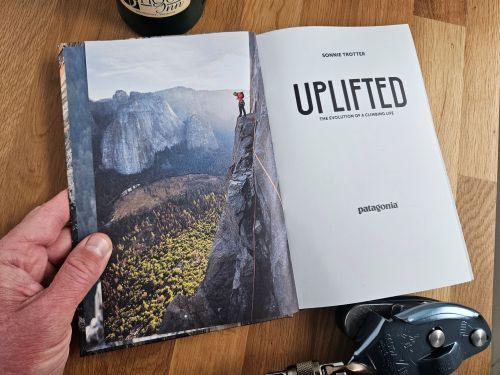
Cover page of Uplifted (2025)

What do we learn about how Trotter lives? He loves life in a big way, he loves the people in his life, and he has a passion for climbing that is energizing to the reader. He has had heavy moments, but he has made a life balancing the climbing life with “real life,” or whatever that means. Trotter’s book recounts his climbing career and how it’s part of him and how he and climbing has matured together. If there is a biographical plot to this assemblage of stories, that’s it.

My sole complaint is that Trotter and his editors didn’t go all the way and carve all of these stories into a one steady narrative. It has the parts, and I enjoy a long-read. Perhaps that was everyone’s hesitation. It is Trotter’s collective works, rather than his literary opus.

The beautiful hard copy just arrived here at my house a few days ago. It helped to have the text on paper in its fine binding so I can enjoy the reading process flipping pages forward, and sometimes back to reread a sentence. The book also has beautiful photos and the paper is appropriately think; Uplifted deserves to be displayed on a coffee table, if not just your shelf. Perhaps it’s the short-read, versus the long-read nature, with the photos that make me feel it’s suitable for the table. (It’s a vertical rectangle shape is conducive to reading, but perhaps it should have been a square or horizontal rectangle for laying on a flat surface? Personally, I like the way it was done, but it tries to do more and it makes me overthink it. Does it make you consider it’s approach too?)

Could Uplifted be a classic one day? I think it has the potential to be timeless. It’s not about a milestone in climbing events, but it is a memoir or some sort, about climbing in our time and about a milestone climber. I am giving it a five out of five because I enjoyed it thoroughly and plan to reread portions if not all of it again.

Bottom line is that it’s just a good read. I know you’ll enjoy it.
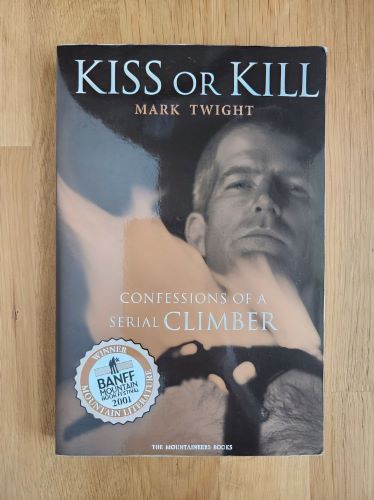
Reflecting on ‘Kiss or Kill’ by Mark Twight

‘Kiss or Kill’ by Twight (2001)

What I love about Mark Twight’s writing from the 1990s was that it was about alpinism. Boldly so. He had a purist view that had no room for rock climbing or bouldering; they were vehicles for skill building, but it was the big mountains in greater destinations that mattered, not our local crags.

I also liked that his writing challenged and even confronted my world view. His words got in my face like a Marine drill sergeant and demanded compliance and bravery. In his articles, everything was black or white, was trash or perfect. As a reader, you were either on the path to being elite, or you were missing the damn point.

I can’t seem to recall when I first read Mark Twight’s collected works in Kiss or Kill: Confessions of a Serial Climber. It was first published by The Mountaineers Books in 2001 when I was 22, but the copy I own was the eighth printing, from 2010. I might have had another copy, but I don’t remember. I must have read his articles earlier because they left a deep impression on my young mind and confused me for several years: How could someone so bold and innovative in his climbing, that was so insightful and inspiring, and be such a dark person at same time? Was there something wrong with him, or was there some wrong with my perspective?

In case you don’t know Mark Twight, he was an American climber that was adopting the European fast and light style of alpine ascents, and applying them to bigger routes around the world, from Denali to Nanga Parbat. He climbed in the late 1980s until around 2000 with Jeff Lowe, John Bouchard, and later Steve House, and Scott Backes. He also founded Gym Jones. (If you don’t know about Gym Jones, here is what Alastair Humphreys wrote about it.) He doesn’t own it any more, but it went from being created by a guy with a pair of ice axes to be owned by a woman with a machine gun (in her profile photo).

I love how climbing can elevate us from a dull life of mediocrity. I needed that when I was growing up in the homogeneous suburbs, where everyone grew up to be a contractor, teacher, or insurance agent, and everyone watched football on Sundays. Part of it was the ethics of climbers; the Internet didn’t connect the climbing community, but climbers sought challenge, nature, and wanted to be above the baseline of what everyone else accepted as normal. Well, at least I did. Twight’s written words painted a picture of climbing that made mediocrity unacceptable, and wrote in confrontational and antagonistic tones using words like, “honor,” “justification,” “process,” “elitist”, “crazy,” and “against the consensus” like breadcrumbs on his path to a higher quality life, through climbing and alpinism.

I could make a essay just quoting Kiss of Kill throughout this blog post, but I might as well lend you my book. But there were two lines that I believed, but felt my understanding validated through his words. Twight wrote, “[As] technology and psychological advances increase, the danger and difficulty of the routes must be raised as well to maintain an equivalent human experience.” Humans, if we let ourselves, aspire to more, in general, and those that want to be pioneers, need new challenges, even contrived ones, and everything we do is somewhat contrived.

“People die. Alpine climbers die. It is part of the game.” Since the first time I read that, I have been wrestling with whether that’s something to acknowledge, accept, or prepare for? I’m not interested in dying and don’t want to hear news of a deathly fall. Yet, the stakes are high, for this contrived, beautifully enlightening thing alpinists do.

Both of these quotes, have a theme, I’d argue, of competition. Is climbing competitive? Twight was, and I don’t enter competitions, but I am too. We just compete in different ways. I generally compete for leadership roles, but I don’t enter climbing or golf competitions; I’d get crushed, if I care. I do care. I play different games. I think all climbers are competitive, but it’s about style, respect, and maybe a desire for a little fairly given and merited awe. Hopefully we get a little self satisfaction too, but I usually forget about that.

However, Twight was either more or less complicated than he portrayed in his black or white lens of his writings at that time. In an interview on the Enormocast (podcast episode 171), he told Chris Kalous that he wouldn’t have written what he wrote if he was who he is today, or how he sees himself now. Clearly, Twight was thrashing with his own self image and need for achievement in those days. He also confessed that he wouldn’t have quoted so many punk rock lyrics and titles if he had his own words to employ. Ever since I heard this, it’s made me think about the book’s value. In his book, Twight shares in a comment about a climb with him, Jeff Lowe said to him after reading the article, “It’s like we weren’t even on the same route.”

He was writing at the height of what Barry Blanchard classifies as “invincible days” of a young man’s life, when testosterone was raging and he thought people would die, but it wouldn’t be him. For Twight, I feel like, without a war fight in and to prove himself, like previous generations, he chose the hardest path of alpinism, which is already a hard path.

Kiss or Kill won the Jon Whyte Award — the award for mountain literature — at the Banff Mountain Film & Book Festival in 2001. Rightfully so. Kiss or Kill influenced my life, or at least the way I thought of it, and I certainly wasn’t the only reader to be jolted awake by Twight’s writing. My perspective on the spectrum of possibilities widened, both from the examples of what he climbed to how he talked himself into performing stronger. I didn’t need to follow his routes to change. And if you haven’t read it yet, I hope you resist feeling compelled to, too.

Well, thanks for dropping by. If you enjoyed this post, please sign up for my email updates through the T.S.M. Newsletter, which is the best way to stay current. And be sure to subscribe to a climbing magazine to support the climbing community and climbing writing in print.

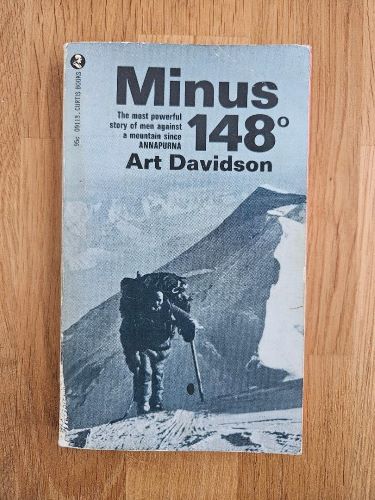
On ‘Minus 148 Degrees’ by Art Davidson

Minus 148 Degrees by Art Davidson (1969)

While leaving Denali National Park, I rode shotgun in Steve’s old black BMW. He had driven that car from Alabama, to Washington, DC, to Alberta for training on his new job, and down the Alcan Highway, and then on to Anchorage, where he lived and worked and we were heading. We were euphoric and mostly listening to CDs (it was 2004.) It was after a camping trip where we saw the big mountain on a very clear day. We drank beers late into the night and heard wolves howl.

On that drive, he told me that one of his inspirations for quitting his Capitol Hill job, where we met, and moving to the 49th State was Art Davidson’s 1969 book Minus 148°. He was in awe of the accomplishment, and the experience of those that climbed Denali. Earlier on the trip he taught me about the Sourdough Ascent, which was clearly one of his favorite stories. It became one of mine, too. I returned to work on Capitol Hill the following week and Steve went back to the Lower Forty-Eight a year or so afterward to work for a presidential campaign. A bit of Alaska went with us, and for me, a bit of curiosity about a book that seemed somewhat straightforward.

Minus 148° is on a lot of lists of good mountaineering books. It has an audacious objective: The first winter ascent of Denali when it is the darkest and coldest climbing conditions. Davidson lets you get familiar and feel for his teammates; you’ll start to call them by their nicknames, too. The story has enough details that you feel the cold in parts, but mostly feel warmth of the team’s comradery. Best of all, Davidson shares enough information to create a suspenseful story, even though we all know the outcome. Davidson would ration the tension of frostbite and conditions. In that way, it’s on par with Herzog’s Annapurna, though Davidson is much more modest.

There are parts that felt like an it’s a mere camping trip. (Or perhaps a more well-adjusted version of Moby Dick.) I think that is largely due to Davidson’s embrace of the expedition, his teammates, and the outdoors. Davidson retells his story largely in a state of gratefulness and wonder of the natural world. He is a happy camper. Who else would have been able to write this?

The darkness of the night is no match for the intense happiness and comradeship inside the tents. Our laughter spills out onto the snow with the light of the Coleman lanterns.

Even the death of one of them, who I won’t name in case you haven’t read it and don’t know the story, was gently told. In a way, you saw it coming. Davidson eluded to style and maybe a carelessness beforehand. There were warnings unheeded. As the team regrouped, and considered whether they ought to turn around and go home, I honestly wasn’t sure what they should do either; another well told chapter by Davidson.

Until I read Minus 148 Degrees, I hadn’t realized how much Davidson’s vision and will was what made this objective come together. Knowing the story and it’s outcome didn’t tell the origin. There wasn’t a group of people in the Mountaineering Club of Alaska asking who will go, or discussing how to go about it. Davidson was the catalyst. Cold and dark winter ascents need a vision keeper to stoke enthusiasm. Someone that stands up and says, “This is where we’re going, who wants to be part of it?” That was Davidson. And I am equally impressed he knew his role and that they needed an experienced climbing expedition leader, which he patiently recruited. And he was a heck of a writer.

This one is certainly a candidate on my list for a Climbing Classic and I added it to list of candidates.

Thanks for dropping by. If you enjoyed this post, please sign up for my newsletter, which is the best way to get updates. And please tell a friend too; I am a humble hobbyist and don’t pay for advertising so organic search engine traffic and word-of-mouth referrals are all I’ve got. I just believe that climbing matters and you do too.

Current Trends in Mountain Lit

Rope Team (All rights reserved)

What makes today’s mountain climbing books — the narratives — unique, among those that have come before? Some are a little contrived, but is that for good reason?

Although I am principally focused on reading through mountain literature to understand the genre and identify the climbing classics so I can make a definitive list (and some other lists, too), I read several newly released books every year. I can’t help but compare the new one’s to things that have been widely read or in print for decades.

The newest sub-genre of climbing books are about underrepresented populations and sharing new perspectives. For two examples, Headstrap by Nandini Purandare and Deepa Balsavar and Alpine Rising by Bernadette McDonald. Both are award winning books, and they both focus on Sherpa and other indigenous climbers and their families and local communities in the Himalaya and Karakoram, which have been underrepresented in mountain literature. Reviewing history and subjects with a new lens are also popular products right now, for example, Other Everests: One Mountain, Many Worlds, which is a collection of original articles by researchers and experts edited by Paul Gilchrest, Peter Hansen, and Jonathan Westaway. Other Everests addresses everything from the names of Chomolungma to hyper masculinity in the heyday of Himalayan mountaineering.

Combining self-help with outdoor pursuits, or using climbing or climbing as a platform to include a topic that could stand on its own. For example, Francis Sanzaro introduces us to Zen Buddhism through the Zen of Climbing, which seems to work beautifully together. Well, sometimes it works. I have seen some hiking and self-help combination books, and they are two separate books duct-taped into one, but I haven’t seen a actual-climbing related bad duct-tape job, yet.

There are many books that are biographies and memoirs of lives of climbers. They span lifetimes or a period of time, such as the 1980s. Think of the David Smart biographies of Royal Robbins, Paul Preuss, or Emilio Comici , or the memoirs of Katie Brown, Mimi Zieman, or Rick Accomazzo. For the most part, this is not new, as biographies and memoirs have been in the genre, and I hope that they continue. They’re usually, but not always, my favorites.

In fact, no one writes a book recounting a single climb, anymore, with the exception of Mark Synnott’s book about Honnold’s remarkable solo of El Cap. And even that work covered more than the lonely ascent of Free Rider. Stories of singular ascents were the large-scale trip report from the Himalayas. What started as a travelogue by Edward Whymper in the 1800s, became obligatory titles including logistics, journal entries, and maps, of the first successful ascent of major peaks, like Annapurna or the first ascent of Chomolungma’s West Ridge. No, today we are telling stories of what those old single-climb stories overlooked and plainly ignored, biographies of swaths of time, and even whole lives.

I have noticed that many books are smaller, or have smaller print and are more compact than they used to be. Interestingly, very few have made old-fashioned pocket-sized books popular again; seems publishers know we like them a little larger. And there aren’t many coffee table books being made, with the rare exception of more compact hardcover books that include more photography, like the upcoming Mountaineering Women. I’ve wondered whether the colorful guidebooks from Falcon Guides, and those that have followed their lead and made well-photographed guides, into the backpack-sized coffee table book of today? The cost of paper, and word-to-size value tend to drive many of these decisions.

I recall, not too long ago, the good folks from Adventure Books, from Vertebrate Publishing, often share on their personal social media feeds about the growing cost of paper, and what that has done to the books they publish. How many copies will they print initially, that can give a profit, and what size does the print fit in, and they consider margins. Perhaps this has always been the way it has been, but the cost of paper has risen noticeably over the last five years.

I don’t like all of these trends. Although I love the increase in biographies and memoirs, I wish there was at least a great coffee table book with photos and maps every couple of years. The guides are nice, but I also think all the “promotional” and well-chosen photos diminish the notion of exploring; I prefer my guidebooks with more words and needing a separate topo map, perhaps from USGS. And new books today make me appreciate the older books in an unexpected way: The old books’ flaws of narrow perspectives, singular climbs, and often colonial and nationalist leanings opened us up for today’s perspectives. We shouldn’t write in the old themes today, but the new content allows us to enlighten, and sometimes correct, the perspectives we had in the past.

Thanks for dropping by. If you enjoyed this post, please sign up for my newsletter, which is the best way to get updates. And please tell a friend too; I am a humble hobbyist and don’t pay for advertising so organic search engine traffic and word-of-mouth referrals are all I’ve got. I just believe that climbing matters and you do too.

On ‘A Youth Wasted Climbing’ by David Smart

A Youth Wasted Climbing by Smart (2015)

I wish I read A Youth Wasted Climbing sooner.

It’s a memoir by David Smart, who you probably remember primarily for the award winning books Paul Preuss: Lord of the Abyss and Emilio Comici: Angel of the Dolomites, and for creating and shepherding the underrated magazine Gripped. His memoir was short-listed at the Banff Mountain Book Competition in 2015.

I am fortunate to have been acquainted with David Smart since 2015. I think we met through Katie Ives or the Climbing Writers Group on Facebook, which Katie established. But David and I didn’t really correspond until Paul Preuss was published in 2019 and I was writing a review, for Rocky Mountain Books, the publisher. I saw that he had written another book, but my focus was all on Preuss at the time.

Smart is a climber and author who has published and had by-lines under the name David Chaundy-Smart, prior to his divorce. He’s now just, as he was before, David Smart, and the story of his younger years and discovering a singular passion for climbing in A Youth Wasted Climbing is beautiful and relatable, well for some readers especially.

A Youth Wasted Climbing is about Smart’s years in grade school. Actually, it’s about Smart’s years during grade school where he skipped class to train or actually climb. He was labeled a truant, often misclassified as a troublemaker who got into fights, because of his scratched hands from crack climbing, and his long hair like both drug and alcohol abusers and, in a whole other category, the climbers he saw in the magazine Mountain. He went from climbing underpasses around Toronto to Yosemite, and tells his stories of many people that would take him on the branches of the river of his climbing life.

This memoir is now my footnote to clear something up: The age-old criticism that climbing is a selfish activity is wrong, but there are plenty of instances where people in Smart’s life asked him to do something other than climb. His parents asked him to actually attend school, not be a truant, and get good grades. A vice principal made a similar request. A girlfriend asked him to take up hockey instead. In all of these cases, Smart was prioritizing climbing — racing to learn climbing from scraps of knowledge and climb better and more often to improve — but his vice principal, parents, and girlfriends (there were multiple like this one) that wanted Smart to use his time and develop skill the way they wanted.

(Smart says when he was put into detention by the vice principal that Smart would imagine that he was more than a troublemaker with “an obscure skill,” and he would daydream that “climbing threatened the VP’s thousand-year Reich of televised golf, swimming pools, tranquillizer-numbed housewives and TV-dinners.”)

Smart demonstrated grit through holding hard and dirty jobs all to support his pursuit of climbing. If he had pursued hockey, at the elite level he reached in rock climbing, where he might have underperformed in school anyway, and maybe girls would have stuck with him longer, would elite hockey have been less selfish because he would be playing for a crowd?

Throughout reading Smart’s memoir, I wondered how he went from being an uninterested student to being the magazine editor and award winning author he is now known as. I found it in these pages. Although he didn’t apply himself in school, he inherited the writing gene from his father. His father wrote technical pieces for his work, and David Smart had a desire to write as well. Smart received writing guides from the late climber Gerry Banning.

I share this somewhat gratuitously, but it was one of my favorite lines about his older brother Reg:

He said I should have spent the time getting ready for Yosemite, as if skipping a workout to see a girl defied some tenant of our religion.

Smart writes his memoir as a stream of consciousness, which is how I like to write. It’s authentic and honest. I have received feedback about my own pieces like this that it can seem disjointed, or that it lacks context and orientation for the reader, especially if I am writing about climbing or golf and the reader doesn’t know about either one. Smart writes down what happened, not how he feels. It’s Hemmingway-esque, with words of action and reporting, not explanation or extraneous exclamation points. A Youth Wasted Climbing is a show-us, not an explain-to-us story. Those are always better. I imagine if you haven’t fallen in love with climbing, or relate to his struggles of being misunderstood, then this book wouldn’t be for you. If it is, buy it and re-read it.

Smart’s memoir is about passion, human potential, being scrappy, and how life is rarely a straight line. My wife looked at the book on the dining room table one evening, where I was typing some notes and said: “Can a youth be wasted on any activity you’re serious about?”

Well, thanks for dropping by. If you enjoyed this post, please sign up for my newsletter, which is the best way to get updates. And please tell a friend too; I am a humble hobbyist and don’t pay for advertising so organic search engine traffic and word-of-mouth referrals are all I’ve got. I just believe that climbing matters and you do too.

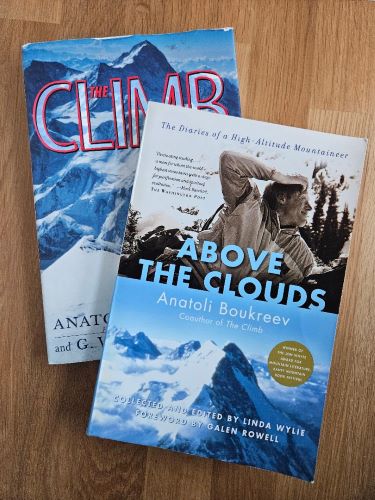
On ‘The Climb’ and ‘Above the Clouds’ by Anatoli Boukreev

‘The Climb’ and ‘Above the Clouds’ by Anatoli Boukreev.

I avoided reading Anatoli Boukreev’s two books for as long as I could for two reasons: First, I read Into Thin Air and wanted to be done with the 1996 tragedy and Chomolungma in general, and secondly, you can glean much about Boukreev from admirers and critics in their various articles and posts from time to time. (Goodness the conversation is still going!) Since I got rid of my prohibition on Everest books, I decided to finally read Boukreev’s own words, albeit translated.

The chatter about Boukreev (which is pronounced as “boo-kre-ev,” saying both Es as separate syllables) was that he was either a villain or a hero, and the articles and posts would seem divided. I realized that the more you knew or read about Boukreev outside of Jon Krakauer’s Into Thin Air, the more sympathetic to Boukreev you would be. That’s why Boukreev worked with G. Weston DeWalt to write The Climb (1997), which told the story from Boukreev’s perspective. In a video interview, Reinhold Messner said that he thought Krakauer and Boukreev/DeWalt were both right and their stories were reconcilable.

(Ronald Turnbull wrote an interesting piece on the website UK Climbing about a 1996 Chomolungma disaster trilogy: Into Thin Air, The Climb, and Left for Dead by Beck Weathers (2000). Turnbull argues that the three books give the more accurate picture of the tragedy. In theory I suppose Weather’s book should be next, but I have no interest. Maybe that will change one day.)

Boukreev was a respected mountaineer long before the 1996 Everest guiding season. He was born in Russia and made Kazakhstan his home base to climb in the Greater Ranges. He was a climber first and foremost and sought ways to stay in the Himalaya. He was poor and often sold his climbing gear to pay for his way home or extended lodging until his next climbing opportunity. His gear was nearly always pre-owned and simply designed. The new commercial guiding ventures on Chomolungma provided him income, and a way to stay among the mountains longer.

I recently read Everest, Inc. (2024) by Will Cockrell and he shared new insight into the climbers that become guides on Chomolungma. The guides made more joy from getting their clients up to the summit and back than they were about their own summit successes. They generally enjoyed providing assistance and a degree of hand-holding, while watching the clients grow in their self-sufficiency. Cockrell also explained that guiding at altitude, above the so-called Death Zone, makes guiding on Chomolungma different than guiding lower peaks in the Himalayas or the Alps.

In The Climb, Boukreev and DeWalt confirm Krakauer’s observation that Boukreev would go far ahead of his clients and give minimal instructions, and appeared aloof. Krakauer wasn’t wrong, but Boukreev was a mountaineer trying to make mountaineers and he believed that the hand-holding approach did not prepare them for the challenges ahead.

The Climb was a book born in rebuttal to aspects of Into Thin Air and it needs to be read second. Arguably, Into Thin Air is a classic to many readers (I’m still mulling whether it is a classic) and I don’t think it’s a book worth reading without an interest in Krakauer’s book or the 1996 tragedy. I do think it deserves to be read after Into Thin Air.

Another book partly by Boukreev came out in 2001: Above the Clouds: The Diaries of a High-Altitude Mountaineer. Boukreev died attempting to climb Annapurna in winter during December 1997. His life partner, Linda Wylie arranged this book. The preface was quite long, and necessary to introduce the mountaineer and person. His reputation as a solid and competant mountaineer and mountain man is established more there than in the previous works in print. But the rest of the book, it’s just translations of Boukreev’s own writing. They’re authentic and relatable about connecting with the outdoors and mountains. It won the Jon Whyte Award for Mountain Literature at the Banff Mountain Book Festival, which is a gold standard.

I didn’t copy down any notes or quotes or page numbers in reading The Climb, but there were lots of copying and page numbers from Above the Clouds. It’s the latter where his most popular quote comes form:

Mountains are not stadiums where I satisfy my ambitions to achieve. They are cathedrals, grand and pure, the houses of my religion.

That was from pages 36-7. Although there were more, this one struck me as extremely relatable, especially as I grow more mature:

Standing there [atop Dhaulagiri in 1995,] I realized that I needed these trials and struggles, that they are important to me. It is with myself that I struggle in this life, not with the mountains.

That was from page 128, though not that it matters. And I might be featuring that quote because I have realized that most of life’s struggles, once we handle basic needs like food and shelter, is terribly internal with ourselves.

I also enjoyed his observations as a Russian visiting America in the 1990s, in Above the Clouds. They seem to resonate as relevant even today. Perhaps especially today. That’s not a statement about politics, but one about how great this county is, that anyone can be successful, but that the stakes of not being successful, because of it’s structure, made him appreciate the meager things of Russia. For me, in reflection, I get the structure and work hard to play well within the rules, but most of my reward isn’t from the tangible rewards, but from the time I spend outdoors and with friends. Those were things he kept returning to reflect on as well. It’s a beautiful book, and I see why it won at Banff.

I wish I had read Above the Clouds sooner. It stands alone. You do not need to read the conversations of Into Thin Air and The Climb. I think Krakauer’s observations about Boukreev were correct, but his characterization was limited to what he saw. So skip that, or forget about it altogether and go read Above the Clouds. You won’t regret it.

Well, thanks for dropping by. If you enjoyed this post, please sign up for my newsletter, which is the best way to get updates. And please tell a friend too; I am a humble hobbyist and don’t pay for advertising so organic search engine traffic and word-of-mouth referrals are all I’ve got. I just believe that climbing matters and you do too.