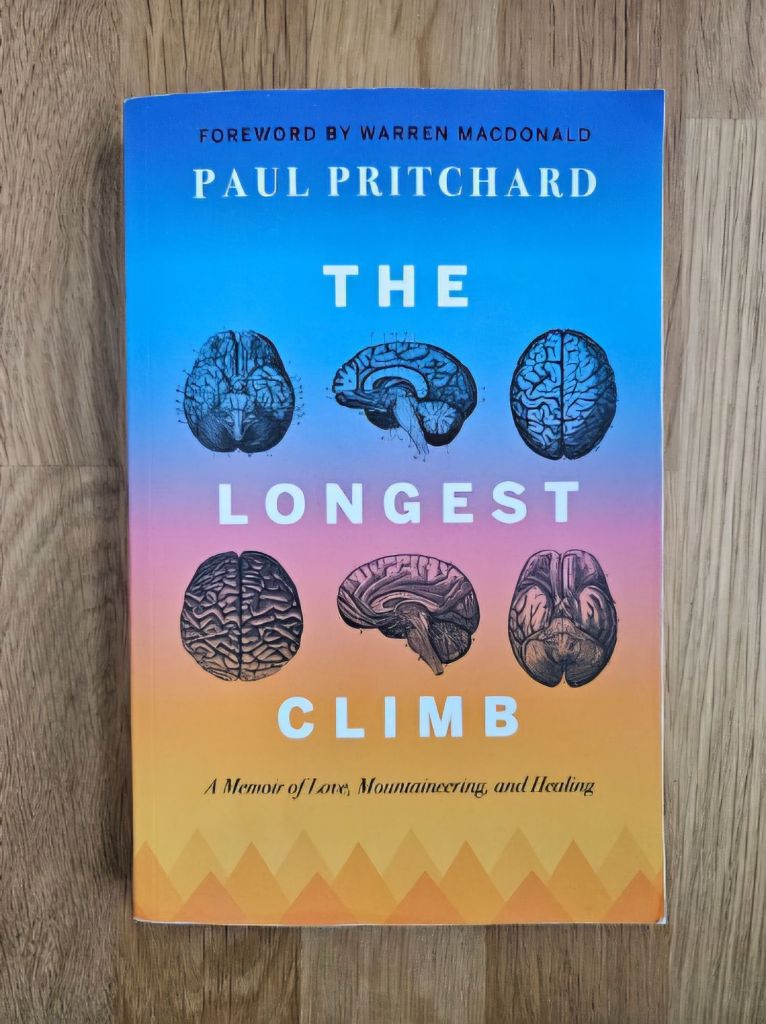
Paul Pritchard is a climber, a diversity and inclusion educator, and an accomplished author. His first book, Deep Play, won the Boardman Tasker Prize for Mountain Literature in 1997 and his second, The Totem Pole, won the Boardman Tasker and the grand prize at the Banff Mountain Book Competition, held in conjunction with the famous film festival, in 1999. When his 2005 book, The Longest Climb, was republished here in North America this year, I immediately said I wanted to review it when asked.
The 2005 edition was published by Robinson with the subtitle Back from the Abyss. The 2024 edition from Rocky Mountain Books is A Memoir of Love, Mountaineering, and Healing. After reading it, and having gotten to know Pritchard through social media and direct messages, the newer subtitle is a more appropriate one for readers. The former subtitle is overly dramatic and less soft than the book actually comes across, though when he wrote it and when Robinson published it, the title had a shelf life of relevancy. Rocky Mountain Books’ change was smart and I am pleased with the Oxford comma (which, if my colleagues at work read this, will roll their eyes at me pointing that out. So there’s that.)
The Longest Climb: A Memoir of Love, Mountaineering, and Healing was Pritchard’s first book after his life-altering climbing accident on the Totem Pole in Tasmania in 1998. He incurred a traumatic head injury that left him paralyzed on his right side. He retells the story of coming home from rehab, discovering cycling, trying golf, diving, and pushing his limits on hiking up Jebel Toubkal and Kilimanjaro. During this journey, I am told that I am a TAB, which is a Temporarily Able Body, or said another way, a non-disabled human. I am given a new perspective on what prejudice toward disabilities means, and the urge inside many of us that keeps us going even when someone says it’s pointless because it is supposed to be impossible.
Before his injury, Pritchard was a well known climber embedded in the niche community. Despite earning his way in, like many climbers that aren’t pursuing the next route or summit, he didn’t feel like he was part of the community. Even when he want to the American Alpine Club dinner he was recognized more for his injury than his exploits. Later, as Pritchard grew in new skills and started plodding up Wales hills, he experienced resentment to the others around him going up too, also taking easier paths, including babies and the elderly. Hadn’t he earned more privilege. But a new sense was revealed to him that everyone belonged, and his heart grew for humanity.
Pritchard, as I learned in Deep Play, came from a tough upbringing and was quite rough himself. However, as he grew through climbing his heart increasingly opened up. After rehab, he learned that asking for help, often after he got himself into trouble from attempting to be independent, became a way to let go of his control freely and embrace the world through others. For Pritchard, not asking for help had kept him from community and left him unknowingly aloof. When he started asking for help, he didn’t feel alone and could express greater and greater amounts of gratitude and appreciation.
Making good decisions has always been a challenge for Pritchard. In Deep Play he took an unroped leap off his school stairs. In this book, he injured his elbow and it was at risk of infection, right before completing a life goal and swimming in the Great Barrier Reef. The doctor said do not swim, and he did anyway. The consequences took days to recover from, partly because he refused to pause life and address it. He gets extremely graphic, and my wife and kids would have ran out of the house as if their hair was on fire, had they read it too. I took pity on him through the ordeal and sympathized in some but not others. I love Paul, but he’s stubbornly foolish at times.
The Longest Climb culminates in two mountain climbs (significant journeys trekking and hiking) in Africa, and Pritchard does an excellent job of showing how he felt and his decisions along the way. On Jebel Toubkal, Pritchard falls ill and his partners continue up. Here was a longueur about the climb and his life since being injured and meeting his wife and caretaker, Jane, who was back home. He knows, like everything else in his life, his strength and patience are going to have to come from within.
Overall, I feel I grew from reading Pritchard’s story of recovery. I knew it previously, but not the immersive detail from this book. Through it all, I feel stronger. He quoted Helen Keller: “Life is either daring adventure or nothing.” He was emphatic through his actions and this book that the worst thing he could do was waste the rest of his life. His sense of insecurity generated a response that constantly pushed him to be more, and it taught him new lessons and perspectives, such as community from asking for help.
The Longest Climb was easier to read and follow than Deep Play. If you read my review of the latter, I said that the language was disjointed but surprisingly descriptive. This new book may have been edited more or differently to overcome that as a criticism.
The book made me feel uncomfortable many times, and even grossed out over his elbow injury before his dive. It was incredibly heartwarming and the new subtitle is true. I give the book a high score for the author and his story, but it’s not a climbing story. It’s a story of a climber’s recovery and life with a growing heart and overcoming uncertainty and insecurity. Reading it will change you, so be prepared.
For me, I now look at disabled acquaintances as people and am more cautious in how I can help them with dignity and respect. I also look at my time for myself, my wife, and my kids with a new sense of respect and willingness to say yes, let’s do that. I don’t know how complicated it will be should I not be physically able ever again.
Rating: 4/5
Is it a climbing classic? No. Primarily because it is not about climbing and climbing is not the central activity. Climbing made this book, like many great climbing stories, but it is foremost about recovery and resiliency of human spirit. These are important themes, but the story is not what I would seek for a climbing classic.
Well, thanks for dropping by. If you enjoyed this post, please sign up for my newsletter, which is the best way to get updates. And please tell a friend too; I am a humble hobbyist and don’t pay for advertising so organic search engine traffic and word-of-mouth referrals are all I’ve got. I just believe that climbing matters and you do too.



 The Suburban Mountaineer